11.1 Thermal and EM Signatures
Updated: v2026.02.02

Every ship, missile, and orbital installation in Aurora radiates energy that can be detected by enemy sensors. Understanding how these signatures work is fundamental to both detecting opponents and avoiding detection yourself. There are two primary emission types: thermal signatures produced by engines and other heat-generating systems, and electromagnetic (EM) signatures produced by active sensors, shields, and other electronic equipment.
Contents
Updated: v2026.02.02
11.1.1 Thermal Signature
Updated: v2026.01.30
A ship’s thermal signature represents the heat it radiates into space, primarily from its engines. The thermal signature is the single most important factor in determining whether a ship can be detected passively at long range.
Base Thermal Signature Calculation
The thermal signature of a ship is determined by its engine power output. The base formula is:
Thermal Signature = Total Engine Power / Engine Thermal Reduction
\hyperlink{ref-11.1-1}{[1]}
Each engine component has a thermal efficiency rating determined by the Thermal Reduction technology used in its design (see Section 8.3 Engines for engine design options). The available thermal reduction levels are:
| Technology | Thermal Signature | Research Cost |
|---|---|---|
| Signature 100% Normal | 1.00x | Starting |
| Signature 75% Normal | 0.75x | 1,500 RP |
| Signature 50% Normal | 0.50x | 3,000 RP |
| Signature 35% Normal | 0.35x | 6,000 RP |
| Signature 24% Normal | 0.24x | 12,000 RP |
| Signature 16% Normal | 0.16x | 25,000 RP |
| Signature 12% Normal | 0.12x | 50,000 RP |
| Signature 8% Normal | 0.08x | 100,000 RP |
| Signature 6% Normal | 0.06x | 200,000 RP |
| Signature 4% Normal | 0.04x | 400,000 RP |
| Signature 3% Normal | 0.03x | 750,000 RP |
| Signature 2% Normal | 0.02x | 1,500,000 RP |
| Signature 1% Normal | 0.01x | 2,500,000 RP |
\hyperlink{ref-11.1-2}{[2]}
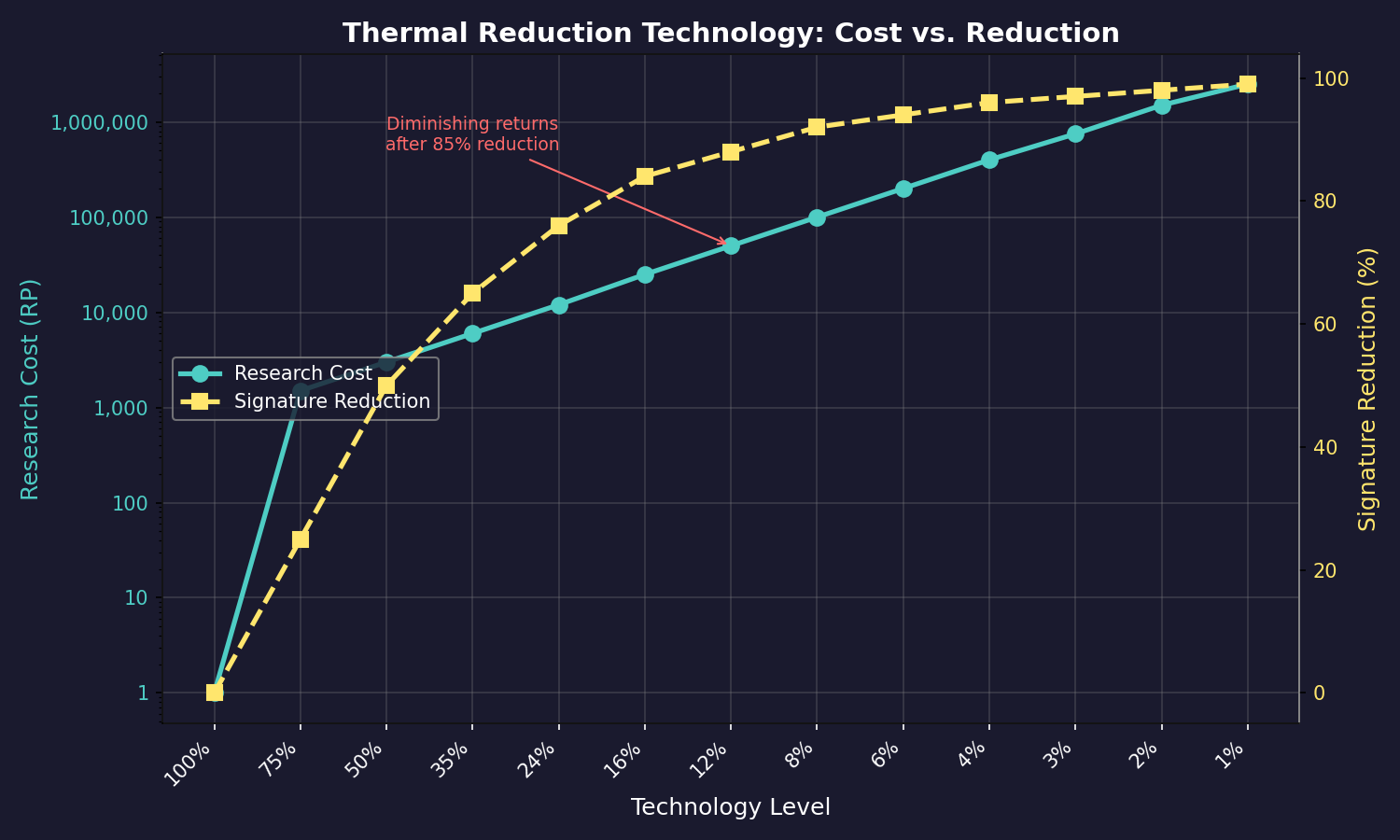
Thermal reduction is selected during engine design and affects the engine’s fuel efficiency. Lower thermal signatures require more advanced engine designs that consume fuel at higher rates. The exact fuel consumption penalty depends on the Fuel Consumption technology level selected during engine design (see Section 8.3 Engines).
Thermal Signature When Under Power
A ship’s thermal signature when it has movement orders is calculated as:
Thermal Signature = (Current Speed / Max Speed) * Max Thermal Signature
\hyperlink{ref-11.1-3}{[3]}
This formula applies whenever a fleet has movement orders, regardless of whether the order involves actual positional change. A freighter loading cargo at a colony still produces a thermal signature based on its movement orders, identical to one actively in transit.
The minimum thermal signature for any ship with movement orders equals its idle thermal output (see below), establishing a floor regardless of speed reduction. \hyperlink{ref-11.1-4}{[4]}
Idle Thermal Signature
Ships without movement orders still produce a baseline thermal signature equal to:
Idle Thermal Signature = 5% of ship size in [HS](/aurora-manual/appendices/B-glossary.html#hs) (or equivalently, 0.1% of size in tons)
\hyperlink{ref-11.1-5}{[5]}
For example, a 10,000-ton vessel (200 HS) emits an idle thermal signature of 10. This baseline applies uniformly to all ship types – commercial vessels generate idle heat equivalent to warships of the same size, as commercial functions like mining and terraforming produce thermal output comparable to basic ship systems.
Component Contributions
- Power plants do not contribute to thermal signature in C# Aurora \hyperlink{ref-11.1-6}{[6]}
- Shields do not contribute to thermal signature in C# Aurora \hyperlink{ref-11.1-11}{[11]}. Shields generate only EM signature (3x Shield Strength) when active – see EM Signatures below \hyperlink{ref-11.1-8}{[8]}
Detecting Engine Type
Thermal sensors can identify whether vessels moving faster than 1 km/s are equipped with military or commercial engines. Once identified, this intelligence is permanently recorded for the associated alien class. The thermal contact strength for a ship is preceded by “M” or “C” in sensor readouts once the engine type for the parent class is known. (unverified — #716 – engine type detection threshold and readout format are documented in community sources but not directly confirmed in the database)
This distinction has strategic implications for NPR (Non-Player Race) behavior: ships lacking identifiable military engines that have shown no weapons capability are evaluated at only 10% of their actual tonnage when NPRs calculate threat levels. (unverified — #716 – NPR threat evaluation percentage is documented in community sources but not confirmed in the database) This creates an incentive for civilian vessels to maintain lower profiles around hostile alien races, while military ships are properly recognized as threats regardless of other factors.
Practical Implications
- Large, fast warships with powerful engines are visible at enormous distances
- Slow freighters with modest engines are harder to spot thermally
- Ships without movement orders still have a small but non-zero idle thermal signature (5% of HS), meaning passive sensors can detect large stationary alien warships at relatively short ranges
- A fleet that arrives in-system and cancels movement orders reduces to idle thermal output, but does not disappear entirely from thermal detection
- Light Naval vessels (informally called “fighters” or “FACs”) have small engines in absolute terms but often have high power-to-weight ratios, making their thermal signatures moderate relative to their size
- Reducing speed proportionally reduces thermal signature (50% thrust = 50% of max thermal signature), but never below the idle floor
Example: A destroyer with 4,000 EP (engine power) and standard engines has a max thermal signature of 4,000. At 50% speed, it produces a thermal signature of 2,000. With engines off (no movement orders), it produces an idle signature of its HS * 0.05 (e.g., a 6,000-ton / 120 HS destroyer produces an idle signature of 6). The same ship redesigned with Signature 50% Normal engines has a max thermal signature of 2,000 but consumes fuel at a higher rate determined by the engine’s fuel consumption technology.
11.1.2 EM Signature
Updated: v2026.01.30
The electromagnetic signature represents electronic emissions from a ship’s active systems. While thermal signature is generated by engines, EM signature comes from a variety of sources.
Sources of EM Signature
| Source | EM Contribution |
|---|---|
| Active Sensors (while active) | Equal to the sensor’s GPS (Gravitational Pulse Signature) \hyperlink{ref-11.1-7}{[7]} |
| Shields (while active) | 3x Shield strength value \hyperlink{ref-11.1-8}{[8]} |
| ECM (while active) | Contributes to EM signature (exact value unverified – sensor jammers and missile jammers are electronic systems but their EM output formula is not stored in the database) \hyperlink{ref-11.1-10}{[10]} |
| Active Search Sensors on missiles | Missile sensor rating |
Active Sensor Emissions
The largest source of EM signature for most warships is their active sensors. Each active sensor component has a rated EM output that is added to the ship’s total EM signature whenever that sensor is turned on. Larger, more powerful sensors emit more, creating a fundamental tension: the better you can see, the more visible you become.
The EM emission of an active sensor (called GPS – Gravitational Pulse Signature) is calculated as \hyperlink{ref-11.1-9}{[9]}:
Sensor EM Output (GPS) = Active Sensor Strength * Sensor Size (HS) * Resolution
Note: An earlier version of this section omitted the Resolution factor from this formula. The correct formula includes all three components: strength, size, and resolution. See Section 11.3 Active Sensors for the full active sensor mechanics.
A ship can reduce its EM signature by turning off its active sensors, relying instead on passive detection or on the active sensors of other ships in the task group. This is a common fleet tactic: designate one or two sensor pickets to radiate actively while the rest of the fleet listens passively.
Shield Emissions
Active shields (see Section 12.6 Damage and Armor) generate EM signature equal to three times their total shield strength \hyperlink{ref-11.1-8}{[8]}. This means a heavily shielded ship that raises its shields is broadcasting its position to any EM sensor in range at considerable distance. Many commanders keep shields down during approach and only raise them when combat is imminent.
Practical Example
Consider a cruiser with:
- A size-10 active sensor using strength-20 technology at resolution 100: GPS = 20 x 10 x 100 = 20,000 \hyperlink{ref-11.1-9}{[9]}
- Shields rated at 150 total strength: EM output = 450 (150 x 3) \hyperlink{ref-11.1-8}{[8]}
- Total EM signature when fully active: 20,450
If the commander turns off the active sensor and lowers shields, the cruiser’s EM signature drops to zero (assuming no other emitting systems). This represents a major tactical choice between situational awareness/protection and stealth. Note the dramatic difference in scale: a high-resolution active sensor’s GPS can dwarf even substantial shield emissions.
11.1.3 Signature Reduction
Updated: v2026.01.30
Beyond the engine-level thermal reduction technology discussed above, there are several additional methods to reduce your ships’ detectability.
Thermal Signature Reduction Technology
The primary method for reducing thermal signatures is selecting a higher thermal reduction level when designing engines. This is set at design time and cannot be changed afterward. The trade-off with fuel efficiency makes this a strategic rather than tactical decision.
Emission Control (EMCON)
Ships and task groups can be placed in Emission Control mode, which prevents them from using active sensors and other emitting systems. Under EMCON:
- Active sensors are turned off (EM signature from sensors = 0)
- The ship relies entirely on passive sensors
- Shields can optionally be lowered
- The ship retains its thermal signature if engines are running
EMCON is the most common tactical method for reducing EM signature. See Section 11.4 Stealth for detailed discussion.
Reducing Speed
Since thermal signature is calculated as (Current Speed / Max Speed) * Max Thermal Signature, a ship that reduces its speed proportionally reduces its thermal signature. A ship at 50% thrust produces 50% of its maximum thermal signature. However, the thermal signature can never drop below the idle floor (5% of HS) as long as the ship has active movement orders.
Cancelling Movement Orders
A ship that cancels its movement orders (removes all orders from its queue) reduces to its idle thermal signature (5% of HS). This is the minimum non-zero thermal state and is dramatically lower than full engine output. Note that in C# Aurora, ships always have a non-zero thermal signature – there is no way to reach absolute zero thermal output. However, the idle signature of most ships is low enough to make passive thermal detection difficult except at short ranges.
Cloaking Devices
Researching and installing cloaking devices provides a percentage reduction to both thermal and EM signatures. See Section 11.4 Stealth for full details on cloaking technology.
Small Ship Advantage
Smaller ships inherently have smaller absolute signatures because they mount smaller engines. A 500-ton FAC might have engines producing a thermal signature of 200, while a 15,000-ton battlecruiser might produce 6,000. Both are detectable, but the FAC’s detection range is dramatically smaller.
Design Tips for Signature Reduction
- Consider split engine designs: one set of efficient engines for cruising, another set (with thermal reduction) for combat maneuvering
- Do not over-engine your ships if stealth matters; the minimum speed needed for your mission should drive engine sizing
- Remember that thermal reduction increases fuel consumption multiplicatively – plan your fuel storage accordingly
- EM signature is entirely within your tactical control: keep active sensors off until you need them
- Shield emissions can be avoided by keeping shields down during approach phases
11.1.4 Weapon Fire and Missile Launch Detection
Updated: v2026.01.30
When ships fire weapons or launch missiles, this creates detectable events for races with appropriate sensor contacts. These mechanics allow players (and NPRs) to build intelligence profiles of enemy weapons through combat observation.
Beam Weapon Detection
When a ship fires beam weapons, each race which has a current active sensor contact on the firing ship detects (unverified — #716 – beam weapon detection mechanics are documented in community sources and forum posts but not directly represented in the database):
- The type of weapon fired (Railgun, Laser, Particle Beam, etc.)
- The power of the weapon
- The number of weapons fired simultaneously
- The weapon range
If a ship fires multiple times, the interval between firing for each weapon type is tracked, providing tactical estimates about reload rates and weapon characteristics. All collected weapon intelligence appears in the Alien Class information window.
Missile Launch Detection
In C# Aurora, an additional detection phase takes place immediately after missile launch. This phase is specifically restricted to the detection of newly launched missiles at the point of launch. The missile is still in the same location as the launching ship when this detection phase occurs, ensuring missiles are always detectable at launch regardless of firing distance. (unverified — #716 – post-launch detection phase is documented in developer forum posts but not directly represented in the database)
When missiles are launched, each race which can detect the new salvo at the point of launch detects:
- The number of launchers on the firing ship (only those launchers that actually fired)
- The size of the launchers
This represents a significant improvement over VB6 Aurora, where missiles fired from very close range could potentially impact before being detected. The C# model ensures at least one detection opportunity always exists at the moment of launch.
Intelligence Accumulation
Weapon detection data accumulates over time through combat observation. Repeated engagements provide increasingly detailed profiles of enemy capabilities, including:
- Weapon types and power levels
- Number of weapons per class
- Firing intervals and reload rates
- Launcher counts and sizes for missile-equipped ships
This intelligence appears in the Alien Class window and is permanently recorded once observed.
UI References and Screenshots
Updated: v2026.02.02
- Forum screenshots:
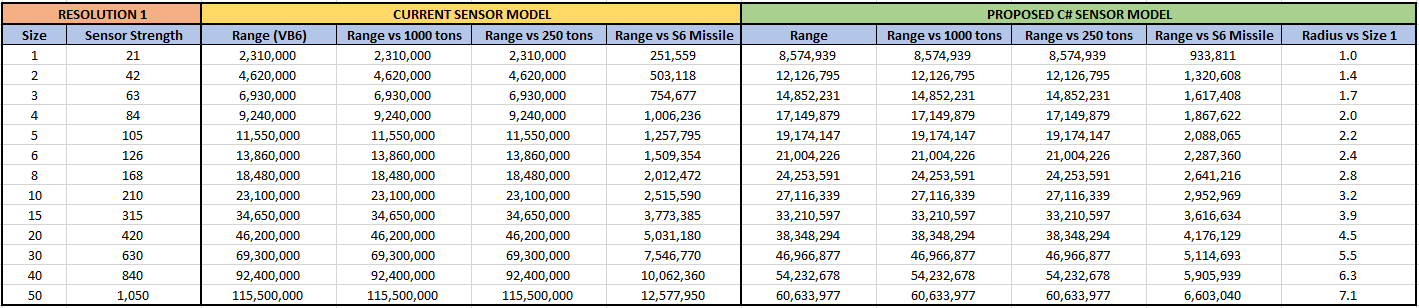
- New Sensor Model — sensor detection mechanics
Related Sections
- Section 8.3 Engines – Engine design and thermal reduction options
- Section 8.4 Sensors – Sensor component EM output design
- Section 11.2 Passive Sensors – How thermal and EM signatures are detected
- Section 11.4 Stealth – Cloaking and EMCON techniques
- Section 12.3 Missiles – Missile sensor and launch signatures
- Appendix A: Formulas – Signature calculation formulas
References
\hypertarget{ref-11.1-1}{[1]}. Aurora C# game mechanics – Thermal Signature = Total Engine Power / Thermal Reduction Modifier. Cross-referenced with Appendix A detection formulas.
\hypertarget{ref-11.1-2}{[2]}. Aurora C# game database (AuroraDB.db v2.7.1) – FCT_TechSystem TechTypeID=127 (Thermal Reduction): 13 levels from 100% Normal (starting, 1 RP) through 1% Normal (2,500,000 RP). Values and costs verified against database: 100% (1), 75% (1,500), 50% (3,000), 35% (6,000), 24% (12,000), 16% (25,000), 12% (50,000), 8% (100,000), 6% (200,000), 4% (400,000), 3% (750,000), 2% (1,500,000), 1% (2,500,000).
\hypertarget{ref-11.1-3}{[3]}. Aurora C# game mechanics – Thermal signature scales linearly with speed ratio. Confirmed via community testing and Appendix A.
\hypertarget{ref-11.1-4}{[4]}. Aurora C# game mechanics – Idle thermal signature (5% of HS) serves as floor for ships with movement orders. Documented in Aurora Wiki and community guides.
\hypertarget{ref-11.1-5}{[5]}. Aurora C# game mechanics – Idle Thermal Signature = Ship_Size_HS x 0.05. For 200 HS ship: 200 x 0.05 = 10. Equivalent to 0.1% of tonnage (since 1 HS = 50 tons).
\hypertarget{ref-11.1-6}{[6]}. Aurora C# game mechanics – Power plants do not contribute to thermal signature. This is a documented design decision in C# Aurora, distinct from some VB6 behaviors.
\hypertarget{ref-11.1-7}{[7]}. Aurora C# game database (AuroraDB.db v2.7.1) – Active sensor EM output (GPS) verified from FCT_ShipDesignComponents. ComponentValue = Active_Strength x Size, and GPS = ComponentValue x Resolution.
\hypertarget{ref-11.1-8}{[8]}. Aurora C# game database (AuroraDB.db v2.7.1) – Shield_EM_Signature = Shield_Strength x 3. Confirmed via Appendix A ref-A-5 and FCT_TechSystem TechTypeID=16.
\hypertarget{ref-11.1-9}{[9]}. Aurora C# game database (AuroraDB.db v2.7.1) – GPS = Active_Sensor_Strength x Size_HS x Resolution. Verified against multiple FCT_ShipDesignComponents entries (e.g., a 10 HS sensor at strength 16 and resolution 102 has GPS = 16 x 10 x 102 = 16,320). Correction: The original formula in this section omitted the Resolution factor.
\hypertarget{ref-11.1-10}{[10]}. Aurora C# game database (AuroraDB.db v2.7.1) – FCT_ShipDesignComponents ComponentTypeID=20 includes both Sensor Jammers (ship ECM, levels 1-10) and Missile Jammers (missile ECM, levels 1-10). All are 3 HS, ElectronicSystem=1. As electronic systems they contribute to EM signature when active, but no explicit EM output formula for ECM components is stored in the database.
\hypertarget{ref-11.1-11}{[11]}. Aurora C# game database (AuroraDB.db v2.7.1) – FCT_ShipClass table: for every ship with ShieldStrength > 0, ClassThermal equals EnginePower exactly. No ship in the database shows thermal contribution from shields. Query: SELECT COUNT(*) FROM FCT_ShipClass WHERE ShieldStrength > 0 AND ClassThermal != EnginePower returns 0 rows.