13.3 Ground Combat
Updated: v2026.02.15

Ground combat in Aurora C# resolves battles between opposing formations on the same planetary body. Combat occurs after each naval phase, with one ground combat round per eight hours of game time. \hyperlink{ref-13.3-11}{[11]} Ground combat activates automatically whenever hostile forces from two or more powers occupy the same system body with populations.
Important: Ground forces will not engage enemy forces unless the owning race is set as hostile in the diplomacy settings. Without this setting, forces from different powers can coexist on the same body without fighting. Before landing troops on an enemy colony, verify the target race is marked hostile in the Diplomacy window (see Section 15.4 Diplomacy), or your forces will simply sit alongside the enemy without combat.
Contents
Updated: v2026.02.15
- 13.3 Ground Combat
- Contents
- 13.3.1 Planetary Terrain
- 13.3.2 Field Positions
- 13.3.3 Combat Resolution
- 13.3.4 Fortification
- 13.3.5 Ground Forces Detection
- 13.3.6 Ground Support Fighters (Removed in v2.8.0)
- 13.3.7 Ground-Based Anti-Aircraft Fire
- 13.3.8 Orbital Bombardment Support
- 13.3.9 Ground Combat Events
- 13.3.10 Naval Bombardment of Ground Forces
- 13.3.11 Surface-to-Orbit Weapons
- 13.3.12 General Orbital Bombardment
- 13.3.13 PDC Ground Assault Mechanics
- 13.3.14 Boarding Combat
- 13.3.14.1 Requirements
- 13.3.14.2 Boarding Attempt (Transfer Phase)
- 13.3.14.3 Breaching Phase
- 13.3.14.4 Internal Combat
- 13.3.14.5 Marine Detachments
- 13.3.14.6 Crew Defense
- 13.3.14.7 Deployment Window
- 13.3.14.8 Capture Consequences
- 13.3.14.9 Collateral Damage
- 13.3.14.10 Boarding Infantry Design
- 13.3.14.11 Practical Tips
- 13.3.15 Surrender
- 13.3.16 AI Ground Offensives (v2.0.0+)
- 13.3.17 Combat Summary
- UI References and Screenshots
- Related Sections
- References
13.3.1 Planetary Terrain
Updated: v2026.01.30
Each planet receives a dominant terrain type determined by environmental conditions. Terrain significantly affects combat through fortification modifiers, to-hit penalties, and interactions with unit combat capabilities.
13.3.1.1 Terrain Type Determination
Barren/Mountain Default Rules: Worlds meeting any of these conditions default to “Barren” terrain:
- Temperature below -100C or above 200C
- No atmosphere
- Atmospheric pressure exceeding 10 atm
Exception: Worlds with platelet or extreme tectonics receive “Mountain” terrain instead of Barren.
Other Worlds: Check environmental compatibility tables to determine eligible terrain types, randomly selected from the available terrain pool.
13.3.1.2 Available Terrain Types (v2.0.0+)
As of v2.7.1, there are 41 distinct terrain types. \hyperlink{ref-13.3-1}{[1]} The original set was expanded with additional types to better represent planets with significant orbital temperature variation:
High-Variation Terrains (require minimum 30-degree orbital temperature swing):
| Terrain | Temperature Range | Notes |
|---|---|---|
| Arid | -50C to 200C | Max 30% hydrosphere; broader than standard desert |
| Arid Mountain | -50C to 200C | Mountain variant of arid |
| Arid Rift Valley | -50C to 200C | Rift variant of arid |
| Grassland | -40C to 80C | Covers steppe, prairie, savanna equivalents |
| Alpine Grassland | -40C to 80C | Mountain variant of grassland |
| Boreal Forest | -50C to 40C | Cold-climate forest |
| Boreal Mountain Forest | -50C to 40C | Mountain variant of boreal forest |
\hyperlink{ref-13.3-3}{[3]}
Standard Additional Terrains:
- Cold Steppe, Coniferous Forest, Rainforest, Mountain Rainforest, Subarctic, Subarctic Mountain, Alpine Forest
These additions enable planets with significant orbital eccentricity to maintain realistic biomes rather than defaulting to extreme terrain classifications.
13.3.1.3 Terrain Effects on Combat
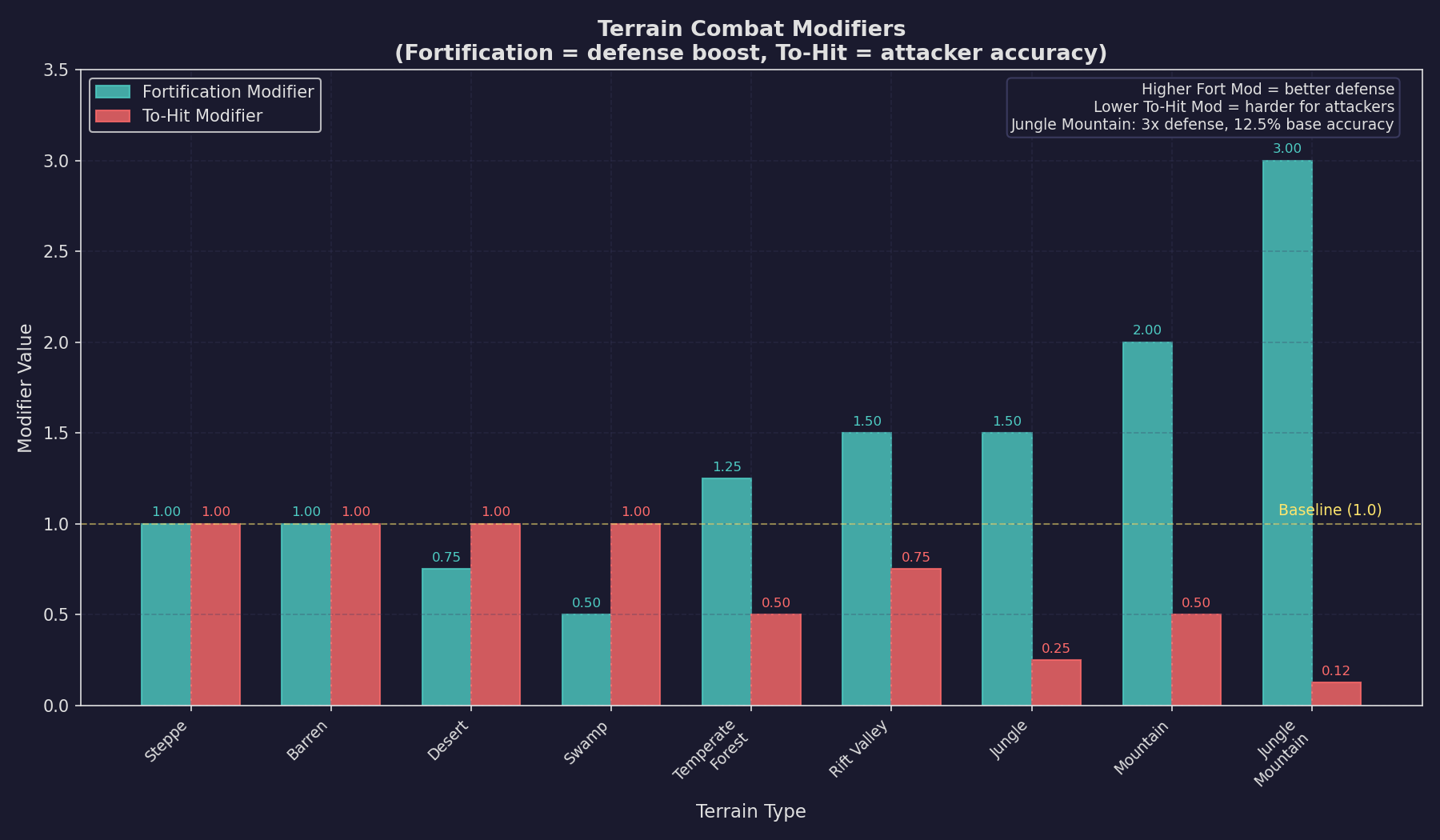
| Terrain Type | Fortification Modifier | To-Hit Modifier | Notes |
|---|---|---|---|
| Steppe | 1.0 | 1.0 (no penalty) | Open terrain; no penalty to orbital fire |
| Desert | 0.75 | 1.0 | Arid environments; minimal concealment |
| Swamp | 0.5 | 1.0 | Wet terrain; poor for fortification |
| Temperate Forest | 1.25 | 0.5 | Moderate concealment |
| Mountain | 2.0 | 0.5 | Elevation advantage |
| Jungle | 1.5 | 0.25 | Dense vegetation favors defense |
| Jungle Mountain | 3.0 | 0.125 | Combined terrain; extreme defense |
| Rift Valley | 1.5 | 0.75 | Broken terrain |
| Barren | 1.0 | 1.0 | No concealment advantage |
\hyperlink{ref-13.3-2}{[2]}
The fortification modifier from terrain multiplies the element’s fortification level. If a formation element’s fortification level is greater than 1, it is multiplied by the fortification bonus of the dominant terrain.
13.3.1.4 Dominant Terrain Change (v2.0.0+)
Terrain assignment and change is governed by orbital mechanics:
Fast-Orbiting Bodies (orbital period < 6 months):
- Bodies with orbits shorter than six months (and their moons) can only be assigned dominant terrains that fall within the minimum and maximum temperatures of their orbit
- This prevents unrealistic constant terrain shifts during brief orbital periods
Slower-Orbiting Bodies:
- Terrain changes based on current temperature, which may shift as the body moves around its orbit
- Eccentric orbits can produce terrain variation as temperature fluctuates with orbital position
13.3.1.5 Terraforming Effects on Terrain (see Section 5.5 Terraforming)
Terrain can shift through three mechanisms:
- Type Progression: Worlds with base types (Barren, Mountain, Rift Valley) transition between similar terrain categories as environmental conditions improve through terraforming
- Environmental Incompatibility: Unsuitable terrain regenerates when conditions no longer support current type
- Orbital Temperature Variation: Bodies with eccentric orbits may experience terrain shifts as their temperature changes with orbital position (v2.0.0+)
13.3.1.6 Combat Capabilities vs. Terrain
The game consolidates terrain into three primary combat specialization categories:
- Mountain Warfare: Applies to any mountain or rift valley terrain type, including combined terrain (e.g., Jungle Mountain)
- Desert Warfare: Covers desert, cold desert, and arid classifications, including combined variants (e.g., Arid Mountain)
- Jungle Warfare: Applies to jungle and rainforest terrain, plus combined forms
Modifier Application:
- Single Specialization: Divides the environmental penalty by 2 (50% reduction)
- Dual Specialization: Stacks multiplicatively. A unit with both Jungle and Mountain Warfare divides the environment modifier by 4 (75% reduction) in combined terrain like Jungle Mountain
13.3.2 Field Positions
Updated: v2026.02.15
Forces in ground combat can occupy one of four field positions, each with distinct tactical roles:
13.3.2.1 Front Line Attack
- Can target any enemy position (front line, support, rear echelon)
- Rear areas are less likely targets due to weighted-size calculations
- Forfeits all fortification bonuses while in attack mode (unverified — #747)
- Generates doubled morale gains from kills (unverified — #747)
- Only fully-supplied formations may assume this position (unverified — #747)
Tactical Note: When forces first land on a hostile planet, set them to front-line attack immediately. Newly-landed forces have no fortification, so the defensive bonus of front-line defence is wasted. Front-line attack lets your troops engage the enemy right away rather than sitting in reserve while the enemy fires on them. Once the initial engagement stabilizes, you can transition select formations to defence to begin fortifying.
13.3.2.2 Front Line Defence
- Can only engage other front-line hostile formations
- Retains fortification bonuses
- Standard morale gains from kills
13.3.2.3 Support
- Indirect fire only; cannot directly attack
- Provides bombardment support
- Fires simultaneously with orbital bombardment (v2.8.0+: ground support fighters removed)
- Same target selection options as heavy bombardment
Artillery Targeting by Weight Class:
- Medium Artillery: Targets individual elements within a formation. Damage is applied to specific units, making it effective for attrition of exposed elements.
- Heavy Artillery: Targets entire formations. Damage is distributed across the formation, making it effective for suppressing large concentrations rather than destroying individual units.
This distinction affects damage distribution: medium artillery concentrates fire for focused kills, while heavy artillery spreads damage across the formation, degrading overall combat power rather than eliminating specific elements.
13.3.2.4 Rear Echelon
- Limited fire capability
- Primarily logistical support role
- Less likely to be targeted by enemy front-line attack formations
13.3.3 Combat Resolution
Updated: v2026.02.15
13.3.3.1 Target Selection
Each front-line formation randomly targets a hostile formation based on weighted formation sizes. Larger formations are more likely to be targeted. Front-line defence can only engage front-line hostiles, while attack formations can target any position.
No Targeting Priority Control: (unverified — #866)
Ground unit weapons cannot be directed at specific enemy types. Targeting is random – weapons fire independently and players cannot specify that anti-vehicle weapons should prioritize enemy armor over infantry or vice versa.
Workarounds for targeting control:
- Multi-wave deployment: Deploy infantry-killer units first, then armor units after enemy infantry is eliminated
- Weapon load diversification: Equip heavy vehicles with mixed weapon types (HCAP, CAP) rather than all SHAV, since most enemies are infantry/light armor
- Formation mixing: Create separate unit models with different weapons and combine them in formations
Targeting Range Modifiers by Position:
The effective size of a formation for targeting purposes is modified by its field position:
| Field Position | Size Modifier for Targeting |
|---|---|
| Front Line (Attack or Defence) | 100% of formation size (no modification) |
| Support | 25% of formation size |
| Rear Echelon | 5% of formation size |
(unverified — #747)
This means support and rear echelon formations are significantly less likely to be targeted by front-line attack formations. Rear echelon units in particular are nearly invisible to targeting selection, making them safe positions for headquarters and logistics elements.
13.3.3.2 To-Hit Calculation
The fundamental accuracy formula:
Final To-Hit = (Base 20%) x (Terrain Modifier) x (Morale Ratio) / (Fortification x Environment x Unit Defensive Value)
(unverified — #747) \hyperlink{ref-13.3-10}{[10]}
Modifiers:
- Fortification Level: Divides incoming accuracy (higher = harder to hit)
- Environmental Penalties: x2 multiplier per unsuitable condition (gravity, pressure, temperature)
- Terrain-Trained Units: 0.5x modifier per matching capability (stacks multiplicatively)
- Morale: Ratio between attacker and defender morale affects accuracy
- Commander GCO Bonus: Improves accuracy of direct-fire weapons \hyperlink{ref-13.3-9}{[9]}
- Commander GCA Bonus: Improves accuracy of indirect-fire weapons \hyperlink{ref-13.3-9}{[9]}
Ground Commander Skill Distinctions: (unverified — #866)
| Skill | Affects | Combat Type |
|---|---|---|
| Ground Command Offense (GCO) | Hit chance for direct fire weapons | Ground Combat only |
| Tactical (on ground commanders) | Hit chance of STO weapons under command | Space-to-Ground Ordnance only |
Important: Tactical skill on ground commanders has no effect on ground combat – it only affects Space-to-Ground Ordnance (STO) weapons. This is a common source of confusion because Tactical skill is typically associated with naval commanders.
Commander Hierarchy Bonus Stacking:
Ground combat bonuses apply through the command hierarchy with diminishing returns by echelon:
- Direct Commander: Provides 100% of their ground combat bonus (GCO, GCD, GCA, etc.) to the formation they directly command (unverified — #747)
- Superior Commander (one level up): Provides 25% of their bonus to formations commanded by their subordinate commanders (unverified — #747)
These bonuses stack additively. For example, a battalion with a commander providing 10% GCO, subordinate to a brigade commander providing 20% GCO, receives: 10% (direct, 100%) + 5% (superior, 25% of 20%) = 15% total GCO bonus. This rewards proper hierarchical organization with competent senior officers.
13.3.3.3 Damage Resolution
Upon a successful hit, damage is resolved in two stages:
1. Armor Penetration:
- Penetration chance = (Weapon AP / Target Armor)^2 \hyperlink{ref-13.3-5}{[5]}
- If AP >= Armor, penetration is automatic \hyperlink{ref-13.3-5}{[5]}
- If AP < Armor, penetration becomes increasingly unlikely
2. Destruction:
- Destruction probability = (Weapon Damage / Target Hit Points)^2 \hyperlink{ref-13.3-5}{[5]}
- If Damage >= HP, destruction is automatic \hyperlink{ref-13.3-5}{[5]}
- If Damage < HP, destruction becomes increasingly unlikely
13.3.3.4 Morale Effects
- Successful kills generate morale gains for the attacker (doubled in attack mode)
- Targets suffering kills receive morale losses
- Morale affects to-hit calculations and breakthrough potential
- Maximum morale = 100 + (5 x commander training bonus percentage)
- Morale recovers between combat rounds based on commander training bonus
13.3.3.5 Breakthrough Mechanics
When a defending formation takes sufficient damage, breakthrough may occur:
- Breakthrough potential = Formation Cohesion Rating x Formation Breakthrough Rating
- Commander GCM bonus increases breakthrough probability \hyperlink{ref-13.3-9}{[9]}
- When breakthrough potential >= 30%, attacking formations gain additional attacks (unverified — #747)
- Breakthrough attacks do NOT include support capabilities (no artillery, no air support)
- Breakthrough attacks can target all hostile formations regardless of field position
- Represents exploitation of a gap in enemy lines
Breakthrough Value Calculation:
The breakthrough value for individual elements is calculated as:
Vehicles: Element Class Size x Number of Units x (Morale / 100)
Infantry: Element Class Size x Number of Units x (Morale / 100) x 0.5
(unverified — #747)
Infantry elements contribute half the breakthrough value of equivalently-sized vehicle elements, reflecting the role of armored forces in exploitation operations.
13.3.3.6 Counter-Battery Fire
Artillery units in the Support field position can engage enemy artillery that has fired during the current combat round. This counter-battery fire mechanic enables suppression of enemy fire support:
- Trigger: When enemy artillery fires from the Support position, its location becomes known to opposing forces for counter-battery targeting
- Eligible Units: Any friendly artillery in the Support position can direct counter-battery fire against identified enemy artillery
- Effect: Counter-battery fire allows suppression or destruction of enemy indirect fire assets, reducing their bombardment effectiveness over time
- Tactical Implication: Players should consider rotating artillery units or distributing them across multiple formations to reduce vulnerability to counter-battery fire. Concentrating all artillery in a single formation makes it an attractive counter-battery target.
Tip: Counter-battery fire is one of the few ways to directly engage enemy support-position units. If enemy artillery is inflicting heavy casualties, assigning your own artillery to counter-battery duty can neutralize the threat, though at the cost of losing your own bombardment against front-line targets.
13.3.4 Fortification
Updated: v2026.02.15
Fortification represents ground forces digging in and constructing defensive positions. Fortified formations are dramatically harder to dislodge.
13.3.4.1 Fortification Levels by Unit Type
| Unit Type | Self-Fortification | Max Fortification | Time to Self-Fortify |
|---|---|---|---|
| Infantry | 3 | 6 | 30 days |
| Static Weapons | 3 | 6 | 30 days |
| Light/Medium/Heavy Vehicles | 2 | 3 | 30 days |
| Super-Heavy Vehicles | 1.5 | 2 | 30 days |
| Ultra-Heavy Vehicles | 1.25 | 1.5 | 30 days |
\hyperlink{ref-13.3-4}{[4]}
13.3.4.2 Automatic Self-Fortification
All elements move from non-fortified to their maximum self-fortification level in 30 days without outside assistance: (unverified — #747)
- Progression occurs automatically and linearly
- Only occurs when formations are NOT set to front-line attack mode
- Commander GCD bonus increases effective fortification level when fortified
13.3.4.3 Construction-Assisted Fortification
Construction elements can fortify other units beyond their self-fortification maximums:
- Only works on elements already at their self-fortification maximum
- Given sufficient capacity, a construction element can fortify any other element from its self-fortification level to maximum fortification in 90 days (unverified — #747)
- Construction capacity = construction rating x unit count x racial construction rating x commander bonus x 100 tons (unverified — #747)
- Multiple construction elements work in parallel
13.3.4.4 Fortification in Combat
- Fortification level divides incoming to-hit probability
- Fortification level is further multiplied by the dominant terrain’s fortification bonus
- Front-line attack formations forfeit all fortification bonuses
- Moving/loading a formation resets fortification to 0 (unverified — #747)
- Taking casualties does NOT reduce fortification level (unverified — #747)
13.3.4.5 Breaking Fortifications
Approaches to overcoming fortified positions:
- Overwhelming Force: Raw combat power to overcome the defensive multiplier
- Orbital Bombardment: Reduce fortification levels from orbit before landing
- Siege: Sustained combat attrits defenders even through fortifications (costly)
- Combined Arms: Heavy armor + artillery most effective against fortified positions
v2.8.0+: Ground support fighters have been removed and are no longer an option for breaking fortifications.
13.3.5 Ground Forces Detection
Updated: v2026.02.15
Ground forces use a specialized detection system that rewards defensive positioning.
13.3.5.1 Detection Mechanics
- Ground forces are treated as size-1 for detection purposes (unverified — #747)
- Resolution-1 sensors are best for detecting them
- Makes ground forces inherently harder to spot than larger space targets
13.3.5.2 Signature Calculation
Formation Signature = (Total Formation Signature) / 100

Element Signature = (Unit Size x Unit Number) / (Fortification Level x Dominant Terrain Fortification Modifier)
(unverified — #747)
13.3.5.3 Practical Signature Interpretation
When viewing ground force sensor returns, the thermal and EM signatures provide a rough guide to enemy strength. As a rule of thumb, a signature reading gives you the product of unit size and unit count divided by fortification and terrain modifiers. A large signature could mean many unfortified troops in open terrain, while a small signature could mean either a small force or a large force that is heavily fortified in defensive terrain. If you detect a moderate signature on a jungle-mountain world, assume the actual force is significantly larger than the raw number suggests, since the terrain fortification modifier (up to 3.0) dramatically suppresses signatures.
13.3.5.4 Strategic Implications
- Well-fortified units have smaller signatures than unfortified ones of equivalent strength
- Observers cannot distinguish between “a small force, or a well-fortified larger force” without additional intelligence
- Defensive positioning and fortification reduce detectability
- Reconnaissance is more difficult against prepared positions
13.3.5.5 Hostile Force Intelligence During Combat
Intelligence about enemy ground unit composition becomes progressively more accurate as combat continues. The system uses a formula based on the number of combat rounds:
Intel Error Range = 200 / Number of Combat Rounds
Intel Error = 1 + (Random(Intel Error Range) / 100)
(unverified — #747)
After each combat round, estimates are recalculated. The actual number of hostile units is either multiplied or divided by the Intel Error value (50/50 chance).
Practical Examples:
| Combat Rounds | Possible Estimate Range (for 1,000 actual units) |
|---|---|
| 2 rounds | 500 - 2,000 units |
| 10 rounds | 833 - 1,200 units |
| 20 rounds | 909 - 1,100 units |
Early estimates are highly unreliable, but extended combat provides increasingly accurate force composition data. Players gradually learn the true strength of enemy forces through sustained engagement.
13.3.5.6 Alien Ground Unit Intelligence
Players accumulate knowledge about alien ground unit classes through combat engagement. Intelligence is tracked in the Diplomacy and Intelligence window alongside ship and sensor data.
Identification Thresholds (combat milestones):
| Milestone | Requirement | Information Revealed |
|---|---|---|
| Weapon Detection | Alien unit fires on friendly forces | Weapons systems |
| Unit Type ID | 20 hits scored against the unit class | Base type (infantry, vehicle, etc.) |
| Armor Discovery | 20 armor penetrations against the class | Armor value |
| Hit Point Learning | 20 units of the class destroyed | Total hit points |
(unverified — #747)
Requirements:
- Players must have their own ground forces present on the same body where alien units operate
- Intelligence thresholds are per-class (each alien unit class must be independently identified)
Renaming Alien Units (v2.0.0+):
- The Intelligence window allows players to rename each alien ground unit class (same interface as renaming alien ship classes)
- Custom designations are used in all ground combat reports throughout the interface
- Enables clearer battlefield communication based on tactical experience with the enemy
13.3.6 Ground Support Fighters (Removed in v2.8.0)
Updated: v2026.01.30
Warning: Ground support fighters were removed from Aurora C# in v2.8.0. Fighter-based ground support orders, fighter pods, and all related mechanics are no longer available in current versions. Orbital bombardment by ships remains the primary method for providing fire support to ground forces (see Section 13.3.8 Orbital Bombardment Support and Section 13.3.10 Naval Bombardment of Ground Forces).
This section is retained as a historical reference for players using versions prior to v2.8.0. All mechanics described below are non-functional in v2.8.0 and later.
Historical content (pre-v2.8.0 only)
Ground support fighters provided aerial assistance during ground combat, using fighter pods rather than standard missiles. **Deployment Requirements:** - Fighters required a "Provide Ground Support" order targeting a friendly population - Order persisted until manually removed - Only fleets carrying appropriate fighter pods qualified - Eligible fleets appeared in a dedicated section on the Ground Combat Window - Fleets on ground support duty at their designated population could not be engaged in standard naval combat **Combat Integration:** - Attacked simultaneously with bombardment elements - Same target selection options as heavy bombardment - Accuracy influenced by crew quality and unit morale - Aircraft avoided environmental penalties affecting ground-based units **Fire Direction Limits:** - Each Forward Fire Direction component permitted support from up to 6 fighters - Excess fighters beyond FFD capacity fired with reduced accuracy: `Accuracy Modifier = (Number of FFD x 6) / Number of Fighters` **Fighter Pod Systems:** - Specialized fighter pods (bombardment, autocannon, or air-to-air configurations) - Configuration changes occurred while stationed in hangars13.3.7 Ground-Based Anti-Aircraft Fire
Updated: v2026.02.15
AA units defend against ground support fighters using specialized targeting mechanics.
13.3.7.1 Engagement Rules
- AA units participate in normal ground combat using standard combat values
- Can draw supply twice if engaged in both ground-to-ground AND ground-to-air combat simultaneously
- All AA damage applies after all attacks resolve in the combat sequence
13.3.7.2 AA Targeting Priority
- All AA units in a formation directly attacked by aircraft select a random aircraft from those attacking that formation
- Medium/Heavy AA in parent formations of attacked units target aircraft engaging subordinates
- Heavy AA units engage random hostile aircraft, including those on combat air patrol
13.3.7.3 Accuracy Formula
AA To-Hit = (10% x (Tracking Speed / Aircraft Speed) x (Morale / 100)) / Environment Modifier
(unverified — #747)
- Units untrained in specific environments face a 2x penalty per environmental condition
- Higher tracking speed relative to aircraft speed improves hit chance
- Commander GCAA bonus improves AA accuracy \hyperlink{ref-13.3-9}{[9]}
13.3.7.4 Damage Against Aircraft
Aircraft Damage = ((Ground Damage Value / 20)^2) rounded down
(unverified — #747)
Example: An AA unit with 40 ground damage inflicts 4 points of damage to fighters (40/20 = 2, 2^2 = 4).
13.3.8 Orbital Bombardment Support
Updated: v2026.02.15
Ships equipped with energy weapons can provide precision ground combat assistance when assigned to support friendly formations. This is distinct from general orbital bombardment.
13.3.8.1 Deployment
- Ships must receive a “Provide Orbital Bombardment Support” order targeting a friendly population
- Ships in orbit appear in the “Orbital Bombardment Support” section of the Ground Combat Window
- Players drag and drop vessels onto ground formations for assignment
- Unlike ground support fighters, these ships remain vulnerable to naval combat and surface-to-orbit weapons
13.3.8.2 Combat Mechanics
- Ships attack simultaneously with bombardment elements
- Each vessel fires once per ground combat phase (unverified — #747)
- Cannot fire if the ship fired during the preceding naval combat phase in the same increment (unverified — #747)
- Uses same accuracy system as ground unit bombardment
13.3.8.3 Accuracy Modifiers
- Modified by crew grade and morale
- Tactical officer contributes 100% of their ground support bonus (unverified — #747)
- Ship commander provides 50% of their bonus (unverified — #747)
- Standard ground support accuracy calculations apply
13.3.8.4 Damage Conversion (Ship-to-Ground)
Energy weapon damage converts to ground combat values using:
Ground Damage = 20 x sqrt(Point Blank Ship-to-Ship Damage)
Armor Penetration = Ground Damage / 2
(unverified — #747)
Examples:
| Weapon | Ship PB Damage | Ground AP | Ground Damage |
|---|---|---|---|
| 10cm Railgun | ~0.25 | 5 | 10 |
| 10cm Laser | ~3 | 17.3 | 34.6 |
| Heavy Laser | Higher | Higher | Higher |
(unverified — #747)
13.3.8.5 Fire Direction Requirements
- Each formation FFD component enables 1 orbital bombardment ship \hyperlink{ref-13.3-6}{[6]} (v2.8.0+: ground support fighters removed; prior versions also allowed 6 fighters per FFD)
- If a formation loses FFD capability, ships automatically seek alternative formations at the same location
- Formations without FFD cannot receive orbital bombardment support
13.3.8.6 Strategic Considerations
- More accurate than general bombardment (precision directed by ground controllers)
- Ships fire far less frequently than in general bombardment role
- Ships are vulnerable to STO weapons while in support orbit
- Powerful but costly advantage requiring dedicated warships
13.3.9 Ground Combat Events
Updated: v2026.01.30
C# Aurora generates granular combat reports with multiple detail levels, allowing players to filter information according to preference.
13.3.9.1 Combat Summary Organization (v2.6.0)
Added: v2.6.0
Ground combat summaries are organized by planet or ship rather than empire-wide. This location-based grouping makes it significantly easier to track combat progress and conduct after-action analysis for specific engagements:
- Planetary Combat: Summaries are grouped by the planet where combat is occurring
- Boarding Combat: Summaries are grouped by the ship being boarded
- Improved Tracking: Players can quickly assess the status of individual engagements without sifting through combined empire-wide reports
13.3.9.2 Tactical-Level Reports
| Event Type | Description |
|---|---|
| Element vs GUC | One element vs one GUC (shots, hits, penetrations, kills) |
| Ship vs GUC | One ship vs one hostile ground unit class |
13.3.9.3 Aggregate Reports
| Event Type | Description |
|---|---|
| GUC vs GUC Summary | Friendly vs hostile ground unit class performance comparison |
| Attack vs GUC Summary | All friendly ground force attacks against specific hostile types |
| Orbital vs GUC Summary | All ship attacks against particular hostile ground unit classes |
13.3.9.4 Formation-Level Reports
| Event Type | Description |
|---|---|
| Formation Attack Summary | Hostile unit types and quantities destroyed by a specific friendly formation |
| Ground Attack Summary | Comprehensive list of hostile units destroyed by all surface and orbital forces |
| Element Loss Summary | Enemy attack results against friendly formation elements |
| Formation Loss Summary | Types and quantities of friendly units lost per formation |
| Ground Defence Summary | Total friendly unit casualties across all formations |
| Breakthrough Achieved | Notification when a formation achieves a breakthrough |
Players can filter events to avoid excessive detail or enable granular information for role-playing and after-action reports.
13.3.10 Naval Bombardment of Ground Forces
Updated: v2026.02.15
Naval Bombardment of Ground Forces (NBG) allows ships to mass-bombard ground-based sensor contacts using missiles or energy weapons. This operates as part of normal naval combat without requiring friendly ground forces or fire direction support, distinct from the precision Orbital Bombardment Support in Section 13.3.8 Orbital Bombardment Support.
13.3.10.1 Targeting Mechanics
Each weapon type on each ship targets separately. A ship with 10cm and 15cm railguns makes two independent targeting rolls. Target formations are selected based on a weighted random roll, with the weighting based on formation size. Within selected formations, shots target random elements using additional weighted rolls.
13.3.10.2 Energy Weapon NBG
Ships using energy weapons for NBG have one-third of the chance to hit compared to using Orbital Bombardment Support (Section 13.3.8 Orbital Bombardment Support) and cannot benefit from ground support bonuses.
To-Hit Formula:
NBG Energy To-Hit = (Base 20% / 3) x (Terrain To-Hit Modifier) / (Target Fortification x Terrain Fortification Modifier)
(unverified — #747)
This means blind-firing energy weapons at enemy concentrations is not very effective, especially in difficult terrain.
13.3.10.3 Missile NBG
Missiles for NBG have a 100% base chance to strike their targets due to nuclear warheads requiring less precision than energy weapons.
Damage Distribution:
Missile warhead damage is distributed across multiple attacks to simulate blast effects:
- 1 attack at full warhead damage
- 2 attacks at half damage
- 4 attacks at quarter damage
- Continues doubling attacks at half damage until damage per attack drops below 1
Each attack can hit multiple targets within a formation. The number of sub-attacks per attack equals 50 / target size. (unverified — #747)
Example: An 8-point missile warhead against infantry (size 5):
- 1 attack at 8 damage, hitting 10 targets (50/5)
- 2 attacks at 4 damage, hitting 10 targets each
- 4 attacks at 2 damage, hitting 10 targets each
- 8 attacks at 1 damage, hitting 10 targets each
- Total: 15 attacks hitting 10 targets each = 150 infantry elements attacked
13.3.10.4 Damage Conversion
Ground combat damage for orbital weapons:
Ground Damage = 20 x sqrt(Point Blank Ship-to-Ship Damage)
Armor Penetration = Ground Damage / 2
Examples:
| Weapon | Ship PB Damage | Ground AP | Ground Damage |
|---|---|---|---|
| 10cm Railgun | 0.25 | 5 | 10 |
| 10cm Laser | 3 | 17.3 | 34.6 |
| 25cm Laser | 16 | 40 | 80 |
| 9-point Warhead | 9 | 30 | 60 |
(unverified — #747)
13.3.10.5 Environmental Impact
| Effect | Missile Warheads | Energy Weapons |
|---|---|---|
| Radiation increase | Equal to warhead size | None |
| Dust level increase | Equal to warhead size | 5% of damage amount |
13.3.10.6 Collateral Damage
- Each NBG shot has a one-third chance to also strike the population itself, inflicting installation damage and population losses (unverified — #747)
- Conversely, planetary bombardment attacks (targeting population/installations) have a one-third chance to hit any ground forces present, regardless of detection status (unverified — #747)
- All ground combat to-hit modifiers apply to these collateral hits
13.3.10.7 Constraint
Ships cannot perform orbital bombardment in the ground combat phase if they fired in the preceding naval combat phase of the same increment.
13.3.11 Surface-to-Orbit Weapons
Updated: v2026.02.15
Surface-to-Orbit (STO) weapons are ground unit class-mounted beam weapon systems that can engage ships in orbit. They represent a significant ground-based anti-ship capability.
13.3.11.1 Component Generation
STO weapons automatically generate integrated components when designed as a ground unit class:
Beam Fire Control: Created with either:
- 4x Racial Fire Control Range + 1x Tracking Speed (for normal anti-ship weapons), or
- 1x Range + 4x Tracking Speed (for point defense variants)
The fire control features a 25% range bonus versus ship-mounted equivalents. Cost and size are 50% of the ship version due to dedication to a single weapon (uses the single weapon fire control system). (unverified — #747)
Active Sensor: Resolution-1 with minimum 5-ton size, range matching the weapon’s maximum range. (unverified — #747)
Reactor: Generates sufficient power for the weapon capacitor at normal cost/size. (unverified — #747)
ECCM: Optional 50-ton component at half normal cost. (unverified — #747)
13.3.11.2 STO Targeting Options
Ground elements with STO capability can select from these targeting modes:
- Target random/largest/smallest/fastest/slowest/easiest ship — when set to “random,” the targeting roll granularity (whether the entire formation fires at one randomly selected ship, or each element independently selects a random target) is unknown (unverified — #1359)
- Target shipyards or populations (same body restriction applies)
- Target ground forces or STO ground forces
- Final Defensive Fire (full or surface-only)
- Area Point Defence against missiles
13.3.11.3 STO AI Targeting (v2.0.0+)
The AI uses a custom priority list based on distance, size, and known capabilities rather than simple player-selectable options. This ensures the AI prioritizes high-value or vulnerable targets rather than taking low-chance shots against warships while ignoring closer commercial or unarmed targets.
13.3.11.4 Detection and Contact Classification
Before Firing: STO elements that have not fired are detected with other ground forces as a standard ground forces contact. Their active sensors are detectable through EM sensors like any other active sensor, but EM detection alone does not flag the element as an STO weapon.
After Firing: Once an STO element fires, detecting races flag it as a separate “STO Ground Forces” contact distinct from standard ground forces. All known STO elements on a planet are grouped as a single STO Ground Forces contact.
Multiple Knowledge States: An STO element may be known to some races (flagged as STO) while still being part of the normal ground forces contact for other races that have not witnessed it fire.
Targeting Implications: Players can choose to engage either the identified STO elements specifically or target the general ground forces, which might contain undetected STO units.
13.3.11.5 Strategic Considerations
- STO weapons make sustained orbital bombardment costly for the attacker
- Ships in bombardment support orbits are vulnerable to STO fire
- Suppressing STO assets before committing to prolonged bombardment is advisable
- Multiple formations with STO weapons stack their defensive contribution
- STO point defense variants can engage incoming missiles, providing ground-based anti-missile capability
13.3.12 General Orbital Bombardment
Updated: v2026.02.15
General orbital bombardment allows ships in orbit to fire on enemy surface positions to soften defenses, reduce fortification levels, or support friendly forces. This differs from the precision support in Section 13.3.8 Orbital Bombardment Support and the mass NBG bombardment in Section 13.3.10 Naval Bombardment of Ground Forces.
13.3.12.1 Bombardment Mechanics
- Eligible Weapons: Energy weapons (lasers, particle beams, railguns, etc.) and missiles
- Targeting: Ships in orbit of a body with enemy ground forces bombard surface formations
- Damage: Applied to enemy ground formations, destroying elements and reducing fortification
- Terrain Modifier: Terrain to-hit modifier applies to bombardment accuracy (e.g., Jungle Mountain’s 0.125 modifier makes bombardment far less effective)
13.3.12.2 Bombardment Types
- Targeted Bombardment: Focuses fire on military formations, minimizing collateral damage. Less total damage but more precise
- General Bombardment: Fires indiscriminately at the surface. Maximum military damage but significant collateral damage to colony infrastructure and population
13.3.12.3 Collateral Damage
- Population Casualties: General bombardment kills civilians at approximately 100,000 civilians per point of warhead strength. (unverified — #747) Even a modest missile salvo can devastate a colony’s population, making orbital bombardment an extremely blunt instrument against inhabited worlds.
- Infrastructure Destruction: Installations (factories, mines, labs) can be destroyed
- Political Impact: Excessive civilian casualties may have diplomatic consequences
- Capture vs. Destroy: Excessive bombardment defeats the purpose of capturing a colony
13.3.12.4 NPR Bombardment Behavior (v2.0.0+)
As of v2.0.0, some Spoiler and NPR (Non-Player Race) factions will avoid bombing populations except when specifically targeting Surface-To-Orbit (STO) weapons. This behavior is influenced by the race’s xenophobia setting. Low-xenophobia races are more likely to restrict their bombardment to military targets only, while highly xenophobic races may still employ indiscriminate bombardment.
13.3.12.5 Reducing Fortification
- Sustained bombardment gradually reduces defending formation fortification levels
- High-damage weapons (particle beams, heavy lasers) are most effective
- Terrain modifier significantly affects bombardment effectiveness against fortified positions
- Monitor progress through the ground forces display
13.3.12.6 Anti-Aircraft and STO Defense
- AA elements reduce bombardment effectiveness
- STO weapons can engage bombarding ships, making sustained bombardment costly (see STO AI Targeting above)
- Multiple formations with AA/STO stack their defensive contribution
- Consider suppressing AA/STO assets before committing to prolonged bombardment
13.3.13 PDC Ground Assault Mechanics
Updated: v2026.01.30
Planetary Defence Centres (PDCs) interact with ground combat in specific ways that differ from open-field engagements. Understanding these mechanics is essential when planning assaults on fortified worlds.
13.3.13.1 PDC Defense Rules
- Isolated Defense: Only the defending troops garrisoned within the specific PDC under attack participate in its defense. Troops in other PDCs or in open-field positions do not reinforce the defenders of a PDC being assaulted.
- No Reinforcement: Defenders cannot reinforce a PDC that is already under ground attack. Once an assault begins, the garrison fights with whatever forces were present when the attack started.
- No Magazine Reload: A PDC under ground attack cannot reload its weapon magazines from the planetary stockpile. The PDC fights with whatever ammunition it had loaded when the assault commenced.
- Offensive Sorties: Troops garrisoned in OTHER PDCs (those not currently under attack) can emerge to fight offensively against attacking ground forces in the open. They are not trapped inside their PDC.
13.3.13.2 Why Ground Forces Are Needed
PDC weapons systems (missiles, energy weapons, point defense) are designed to engage spacecraft in orbit, not ground troops on the surface. A PDC’s formidable anti-ship armament cannot be turned against infantry or vehicles assaulting its perimeter. This is why ground forces are required to neutralize PDCs – orbital bombardment may suppress them, but only ground assault can capture or destroy them from the surface.
13.3.13.3 Tactical Implications
- Divide and Conquer: Since PDC garrisons fight in isolation, an attacker can concentrate overwhelming force against one PDC at a time while the others cannot intervene
- Starve Ammunition: Sustained ground assault prevents magazine reloads, eventually silencing the PDC’s anti-ship weapons even if the garrison holds
- Exploit Sorties: When defenders emerge from other PDCs to fight offensively, they lose their PDC’s protective fortification, making them vulnerable to destruction in the open
13.3.14 Boarding Combat
Updated: v2026.02.15
Boarding combat allows ships to attempt capture of enemy vessels through marine assault. This is a specialized form of ground combat that occurs in the confined spaces of a starship.
Diplomatic Consequence (v1.13.0+): As of v1.13.0, boarding an alien ship is classified as a hostile act. This triggers the same diplomatic penalties as an unprovoked attack, immediately dropping relations to hostile (-100) if not already hostile. Plan boarding operations with full awareness of their diplomatic ramifications.
13.3.14.1 Requirements
- Attacking ship must have a boarding-equipped troop transport bay \hyperlink{ref-13.3-7}{[7]}
- Only all-infantry formations can participate in boarding
- Target ship must not be faster than attacking ship
- Fleet must end movement in target’s location to trigger the attempt
- Infantry with “Boarding Combat” capability are far more effective \hyperlink{ref-13.3-8}{[8]}
- Boarding Combat specialization requires Powered Armour technology as a prerequisite – the option will not appear in the unit designer until this tech is researched \hyperlink{ref-13.3-12}{[12]}
13.3.14.2 Boarding Attempt (Transfer Phase)
Individual soldier success chance for reaching the target:
Transfer Success = 10% x (Boarding Ship Speed / Target Ship Speed)
(unverified — #747)
- Ships 10x faster achieve automatic success (100%)
- Units with “Boarding Combat” capability receive double the normal hit chance during boarding operations (only need 5x speed differential for certainty) \hyperlink{ref-13.3-12}{[12]}
- Failed boarders are killed – they represent soldiers lost in the transfer attempt
- If an HQ unit dies and only one exists, the formation commander automatically perishes
13.3.14.3 Breaching Phase
After successful transfer, boarders must breach the hull:
- If armor is already breached (from prior combat damage), survivors enter immediately
- Otherwise, boarders apply a “breaching charge to destroy one armour at the weakest point every thirty seconds” until access is gained
- Thicker armor means longer breaching time and more vulnerability
13.3.14.4 Internal Combat
Once inside the target vessel:
- Combat rounds occur every 300 seconds (5 minutes) (unverified — #747)
- Defender fortification bonus: Defenders receive a fortification value of level 2, representing dug-in positions in corridors, choke points, and makeshift barricades. Attackers have a base fortification of level 1 (before any commander GCD bonuses). (unverified — #747) This gives defenders a significant accuracy reduction against incoming fire without needing time to fortify.
- No retreat: Boarding is a one-way commitment. Once marines have transferred to the target vessel, they cannot withdraw or return to their ship. Combat continues until one side is completely eliminated.
- Each unit randomly selects opposing targets
- Standard to-hit, armor penetration, and damage calculations apply
13.3.14.5 Marine Detachments
Ships can carry marine detachments – ground force formations assigned directly to the ship – that serve as dedicated defenders against boarding actions. Marines are significantly more effective than regular crew at repelling boarders, as they use their full combat statistics (weapons, armor, hit points) rather than the crew’s improvised defense values. Assigning a marine detachment to high-value ships (carriers, flagships, transports) provides a substantial defensive upgrade against boarding attempts.
13.3.14.6 Crew Defense
The target ship’s crew forms a temporary defensive formation:
- Crew defense has armor equal to half the lowest racial armor for infantry (unverified — #747)
- Represents improvised defense by non-combat personnel
- Smaller crews are overwhelmed more quickly
- Larger crews provide more targets but also more defenders
13.3.14.7 Deployment Window
If a boarding shuttle can reach the target ship within 5 seconds of deployment, the troops will deploy before the shuttle can be intercepted and destroyed. (unverified — #747) This makes boarding viable even against ships with point defense, provided the boarding vessel is close enough at the moment of launch. Plan your approach to close within this 5-second transfer window before committing marines.
13.3.14.8 Capture Consequences
Upon defeating all defenders:
- Ship transfers ownership to the boarding faction
- Captured ship receives a “01 status” – an overhaul factor of 0.01 (essentially requires complete overhaul) (unverified — #747), indicating the ship needs full crew replacement and extensive repair (see Section 14.2 Maintenance)
- Simulates sabotage, locked controls, and unfamiliar systems
- Ship must be returned to a shipyard for overhaul before being fully operational
- Reverse Engineering: Captured ships can be reverse-engineered at a research facility to unlock alien technology components, or scrapped at a shipyard to recover materials. Even a heavily damaged capture may yield valuable technological insights that justify the boarding casualties.
13.3.14.9 Collateral Damage
Internal combat causes ship damage:
- Fractional damage results apply as percentage chances of full-point damage conversion
- Critical systems may be damaged during the fighting
- The captured ship may require significant repairs beyond the overhaul
13.3.14.10 Boarding Infantry Design
Boarding combat is extremely brief – resolved in 300-second (5-minute) increments – which makes logistics capacity completely irrelevant for boarding teams. Marines will never consume supplies during the engagement. Instead, invest in maximum survivability and lethality: heavy powered infantry armor for the best protection, genetic enhancements for increased hit points, and crew-anti-personnel weapons optimized for close-quarters shipboard fighting. A boarding team designed this way will vastly outperform general-purpose infantry in the confined, short-duration engagements of shipboard combat.
13.3.14.11 Practical Tips
- Boarding is most effective against slower or disabled ships
- Fast boarding ships with large infantry capacity maximize transfer success
- The “Boarding Combat” capability is essential for infantry intended for boarding operations
- Consider the cost-benefit: a heavily damaged captured ship may not be worth the marine casualties
- Elite boarding infantry with genetic enhancements make the best marines due to their increased hit points
13.3.15 Surrender
Updated: v2026.01.30
Ground forces can be compelled to surrender when overwhelmed by superior opposing forces on the same body.
13.3.15.1 Population Surrender Mechanics
Populations (colonies) surrender when the occupying ground force strength exceeds the defender’s remaining capability:
- The ground forces strength required to force a population to surrender is based on the population’s remaining military power
- Surrender evaluates the total combat power of attacking forces versus defending forces
- Populations without adequate military defense may surrender to invading ground forces
- As of v1.13.0, the surrender threshold for populations with STO (Surface-To-Orbit) weapons is correctly calculated – prior versions required 100x the intended ground force strength to compel surrender when STOs were present
13.3.15.2 Conquest Rewards
When you successfully conquer a colony through ground combat or forced surrender, you gain several benefits:
- Reparations: The conquered colony yields wealth and mineral resources as spoils of war. The reparation amount is determined by the colony’s existing wealth stockpile, mineral reserves, and the economic output of its installations. Larger, more developed colonies yield proportionally greater reparations. This provides an immediate economic benefit to the conquering empire.
- Captured Technology: Research facilities and installations on the conquered world may yield alien technology components that can be reverse-engineered, potentially unlocking tech advances your empire has not yet discovered. The probability of recovering usable technology increases with the number of intact research facilities captured. Prioritize minimizing orbital bombardment damage to research infrastructure if technology capture is a goal.
- Intact Installations: Colony installations (factories, mines, research labs, shipyards, etc.) may survive the conquest intact, particularly if the attacker relied on ground assault rather than heavy orbital bombardment. Surviving installations immediately begin producing for the conquering empire once the colony stabilizes. This makes ground-only conquest significantly more valuable than bombardment-followed-by-occupation.
- Population Absorption: The conquered population becomes part of your empire as a subject people. They contribute to your labor force and economy, but suffer from elevated unrest due to the conquest (modified by the Political Status Modifier for conquered peoples). Managing conquered populations requires attention to stability and garrison forces sufficient to meet the Required Garrison Strength formula (see Section 13.1.8 Colony Garrison and Security).
13.3.15.3 Naval Surrender (for reference)
AI naval fleets may also surrender under specific conditions:
- Conditions: Fleet must be unarmed, badly damaged, or incapable of completing its mission while under attack from energy weapons
- Decision Factors: Fleets may attempt evasion, surrender, or ramming based on crew attributes
- Crew Traits: Determination and Xenophobia ratings influence which action occurs
- Exception: Certain spoiler races will never surrender under any circumstances
- Consequence: Surrendered ships receive an overhaul factor of 0.01 (matching ships captured through boarding)
13.3.16 AI Ground Offensives (v2.0.0+)
Updated: v2026.01.30
The AI uses improved decision-making for ground combat operations, particularly regarding when to transition from defensive to offensive postures.
13.3.16.1 AI Offensive Decision Process
- Previous Behavior: The AI would only launch ground offensives with specific formation types (such as armor units), creating exploitable situations
- Current Behavior (v2.0+): The AI assesses whether to mount offensive operations using formations that would normally remain in defensive positions
13.3.16.2 AI Intelligence Assessment
The AI evaluates available intelligence before deciding on offensive action:
- Known Information: Assesses player armor, hit points, and offensive capabilities based on the Alien Ground Unit Class intelligence system
- Default Assumptions: When lacking information, the AI assumes basic infantry until discovering otherwise
- Adaptive Behavior: The AI may launch aggressive offensives against unknown forces, then revert to defensive postures once it gains better intelligence about enemy composition
13.3.16.3 AI Tactical Considerations
- Fortification Trade-offs: The AI accounts for the benefits of maintaining fortification bonuses versus initiating offensive operations
- Exploitation: The AI will now attack reluctant landing forces rather than allowing indefinite defensive standoffs
- Strategic Flexibility: AI decisions create more dynamic ground combat scenarios where players cannot exploit purely passive AI behavior
13.3.17 Combat Summary
Updated: v2026.02.15
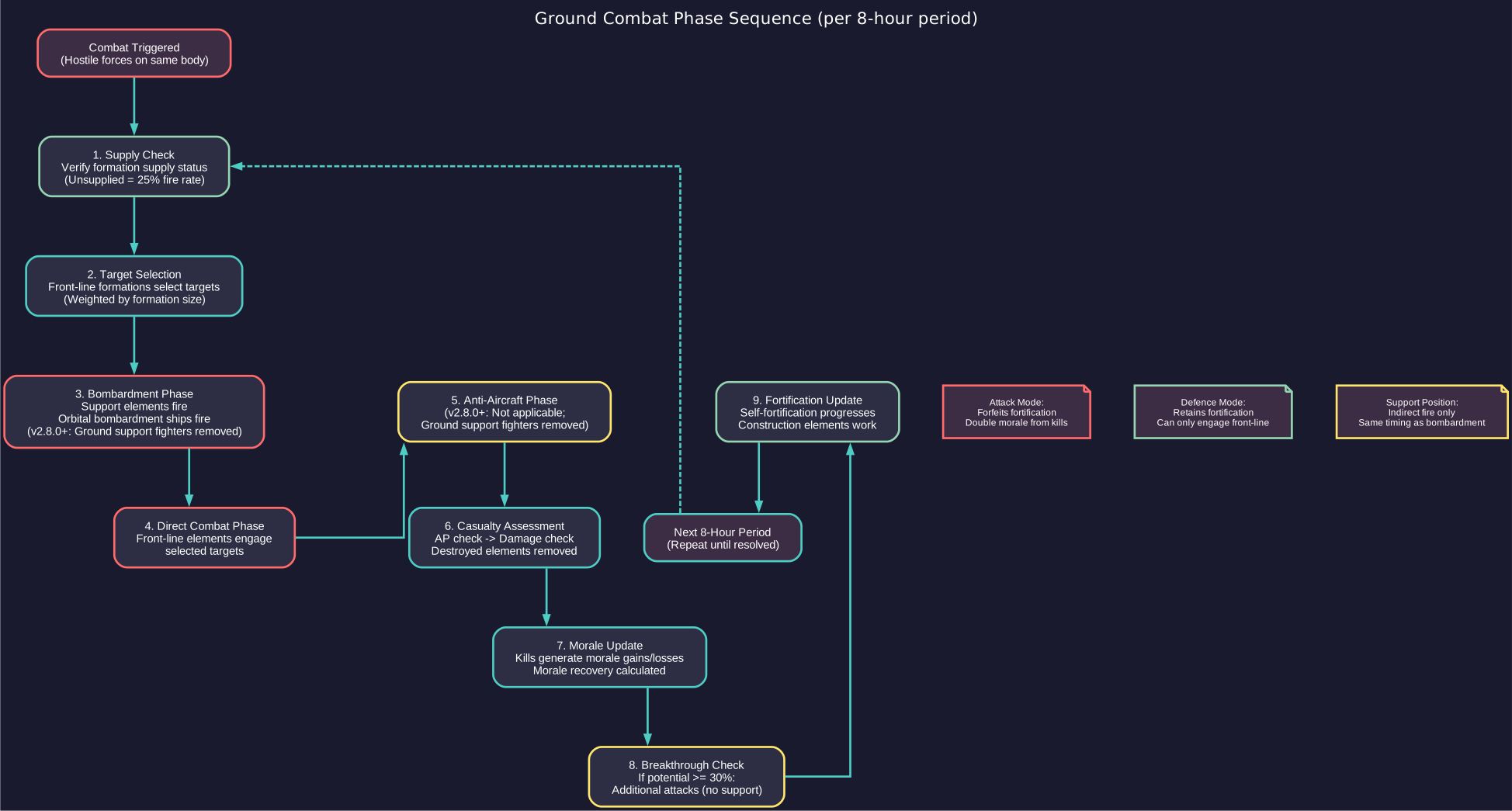
13.3.17.1 Ground Combat Flow (per 8-hour phase)
- Supply Check: Verify formation supply status; unsupplied units restricted to 25% fire rate
- Target Selection: Front-line formations randomly select targets weighted by formation size
- Bombardment Phase: Support elements and orbital bombardment ships fire (v2.8.0+: ground support fighters removed)
- Direct Combat Phase: Front-line elements engage selected targets
- AA Phase: Anti-aircraft elements engage attacking aircraft (v2.8.0+: no longer applicable with ground support fighters removed)
- Casualty Assessment: Hits resolved through AP check then damage check; destroyed elements removed
- Morale Update: Kills generate morale gains/losses; morale recovery calculated
- Breakthrough Check: If breakthrough potential >= 30%, additional attacks without support
- Fortification Update: Self-fortification progresses (if not in attack mode); construction elements work
13.3.17.2 Key Formulas Reference
| Calculation | Formula |
|---|---|
| Armor Penetration | (AP / Armor)^2 |
| Destruction | (Damage / HP)^2 |
| Base To-Hit | 20% x terrain / (fortification x environment) |
| AA To-Hit | 10% x (tracking/speed) x (morale/100) / environment |
| AA Damage vs Aircraft | ((Ground Damage / 20)^2) |
| Ground Damage (Orbital) | 20 x sqrt(ship PB damage) |
| Orbital Bombardment Accuracy | Modified by Tactical Officer (100%) + Ship Commander (50%) |
| Boarding Transfer | 10% x (boarding speed / target speed) |
| GSP per 10 rounds | penetration x damage x shots |
| Formation Signature | (size x count) / (fortification x terrain modifier) / 100 |
| Intel Error Range | 200 / Number of Combat Rounds |
| Intel Error | 1 + (Random(Intel Error Range) / 100) |
UI References and Screenshots
Updated: v2026.02.15
- Ground Forces Window Layout — combat status and unit deployment
- Forum screenshots (archived – pentarch.org URLs no longer accessible as of 2026-01):
- Ground Rules (was: pentarch.org/steve/Screenshots/GroundRules005.PNG) – combat resolution
- Ground Support (was: pentarch.org/steve/Screenshots/GroundSupport002.PNG) – orbital bombardment support
Related Sections
- Section 5.5 Terraforming – Terrain changes from terraforming
- Section 12.6 Damage and Armor – Orbital bombardment and radiation effects
- Section 12.7 Planetary Defence Centres – Orbital bombardment defense and fortification interactions with PDCs
- Section 13.1 Unit Types – Ground unit class design and capabilities
- Section 13.2 Training and Transport – Deploying forces to combat zones
- Section 14.2 Maintenance – Overhaul requirements for captured ships
- Section 16.2 Skills and Bonuses – Ground combat commander bonuses
- Worked Example: Ground Invasion – Planetary assault planning and execution walkthrough
References
\hypertarget{ref-13.3-1}{[1]}. Aurora C# game database (AuroraDB.db v2.7.1) – DIM_PlanetaryTerrain. Contains 41 distinct terrain types (TerrainID 1-41). Previously stated as 38; corrected to 41. Additional terrains added since v2.0.0 include Hot Desert (39), Cold Desert Mountain (40), and Hot Desert Mountain (41).
\hypertarget{ref-13.3-2}{[2]}. Aurora C# game database (AuroraDB.db v2.7.1) – DIM_PlanetaryTerrain. Fortification/To-Hit modifiers confirmed from database: Steppe (1.0/1.0), Desert (0.75/1.0), Swamp (0.5/1.0), Temperate Forest (1.25/0.5), Mountain (2.0/0.5), Jungle (1.5/0.25), Jungle Mountain (3.0/0.125). Corrections: “Forest” renamed to “Temperate Forest” with fortification corrected from 1.0 to 1.25; “Rift Valley” corrected from 2.0/0.5 to 1.5/0.75; “Barren” corrected from 0.5/1.0 to 1.0/1.0.
\hypertarget{ref-13.3-3}{[3]}. Aurora C# game database (AuroraDB.db v2.7.1) – DIM_PlanetaryTerrain. High-variation terrain types confirmed with MinTempRange=30: Arid (ID 31), Arid Mountain (32), Arid Rift Valleys (33), Grassland (34), Alpine Grasslands (25), Boreal Forest (35), Boreal Mountain Forest (36). Temperature ranges verified from MinimumTemperature/MaximumTemperature columns.
\hypertarget{ref-13.3-4}{[4]}. Aurora C# game database (AuroraDB.db v2.7.1) – DIM_GroundUnitBaseType. Fortification values confirmed: Infantry (3/6), Static (3/6), Light Vehicle (2/3), Medium Vehicle (2/3), Heavy Vehicle (2/3), Super-Heavy Vehicle (1.5/2), Ultra-Heavy Vehicle (1.25/1.5). Note: “Standard Vehicle” corrected to “Medium Vehicle” per database naming.
\hypertarget{ref-13.3-5}{[5]}. Aurora C# game database (AuroraDB.db v2.7.1) – DIM_GroundComponentType. Weapon penetration and damage values confirmed for all component types. The (AP/Armor)^2 penetration formula and (Damage/HP)^2 destruction formula are from Steve Walmsley’s ground combat mechanics documentation on the Aurora Forums.
\hypertarget{ref-13.3-6}{[6]}. Aurora C# game database (AuroraDB.db v2.7.1) – DIM_GroundComponentType. Forward Fire Direction (ID 20): FireDirection=1. The “6 fighters per FFD” and “1 orbital bombardment ship per FFD” values from Steve Walmsley’s ground combat rules.
\hypertarget{ref-13.3-7}{[7]}. Aurora C# game database (AuroraDB.db v2.7.1) – FCT_TechSystem. Troop Transport Boarding Bay techs confirmed: Standard (ID 65454, 2,500 RP), Small (ID 65848, 100 RP), Very Small (ID 67060, 100 RP). All are CategoryID=32 (Planetary Combat).
\hypertarget{ref-13.3-8}{[8]}. Aurora C# game database (AuroraDB.db v2.7.1) – DIM_GroundUnitCapability. Boarding Combat (ID 1): InfantryOnly=1, CostMultiplier=2.5. FCT_TechSystem: Boarding Combat Capability (ID 65822) = 2,500 RP.
\hypertarget{ref-13.3-9}{[9]}. Aurora C# game database (AuroraDB.db v2.7.1) – DIM_CommanderBonusType. Ground combat bonus types confirmed: Ground Combat Offence (BonusID 30, GCO), Ground Combat Defence (BonusID 10, GCD), Ground Combat Artillery (BonusID 31, GCA), Ground Combat Manoeuvre (BonusID 32, GCM), Ground Combat Logistics (BonusID 33, GCL), Ground Combat Anti-Aircraft (BonusID 35, GCAA), Ground Combat Occupation (BonusID 29, OCC), Ground Combat Training (BonusID 12, GCT). All have Ground=1, confirming ground-force-only restriction.
\hypertarget{ref-13.3-10}{[10]}. Aurora Forums – Steve Walmsley’s ground combat mechanics posts. Combat resolution formulas (base 20% to-hit, armor penetration, destruction probabilities), field position mechanics, fortification timing, breakthrough mechanics, boarding combat details, and orbital bombardment conversion formulas. (forum-sourced; specific post URLs unavailable)
\hypertarget{ref-13.3-11}{[11]}. Aurora C# game database (AuroraDB.db v2.7.1) – FCT_Game.MinGroundCombatPeriod = 28800 seconds (8 hours). This defines the interval between ground combat rounds.
\hypertarget{ref-13.3-12}{[12]}. Aurora Forums – Steve Walmsley response in “Is boarding specialization still a thing?” (https://aurora2.pentarch.org/index.php?topic=13828.0). Confirmed: Boarding Combat specialization requires Powered Armour technology as a prerequisite and provides double (2x) hit chance during boarding operations.