15.3 Treaties
Updated: v2026.02.15

[Screenshot Pending — #1094] Treaty Proposal Interface
Contents
Updated: v2026.02.15
- 15.3 Treaties
15.3.1 Treaty Types
Updated: v2026.02.15
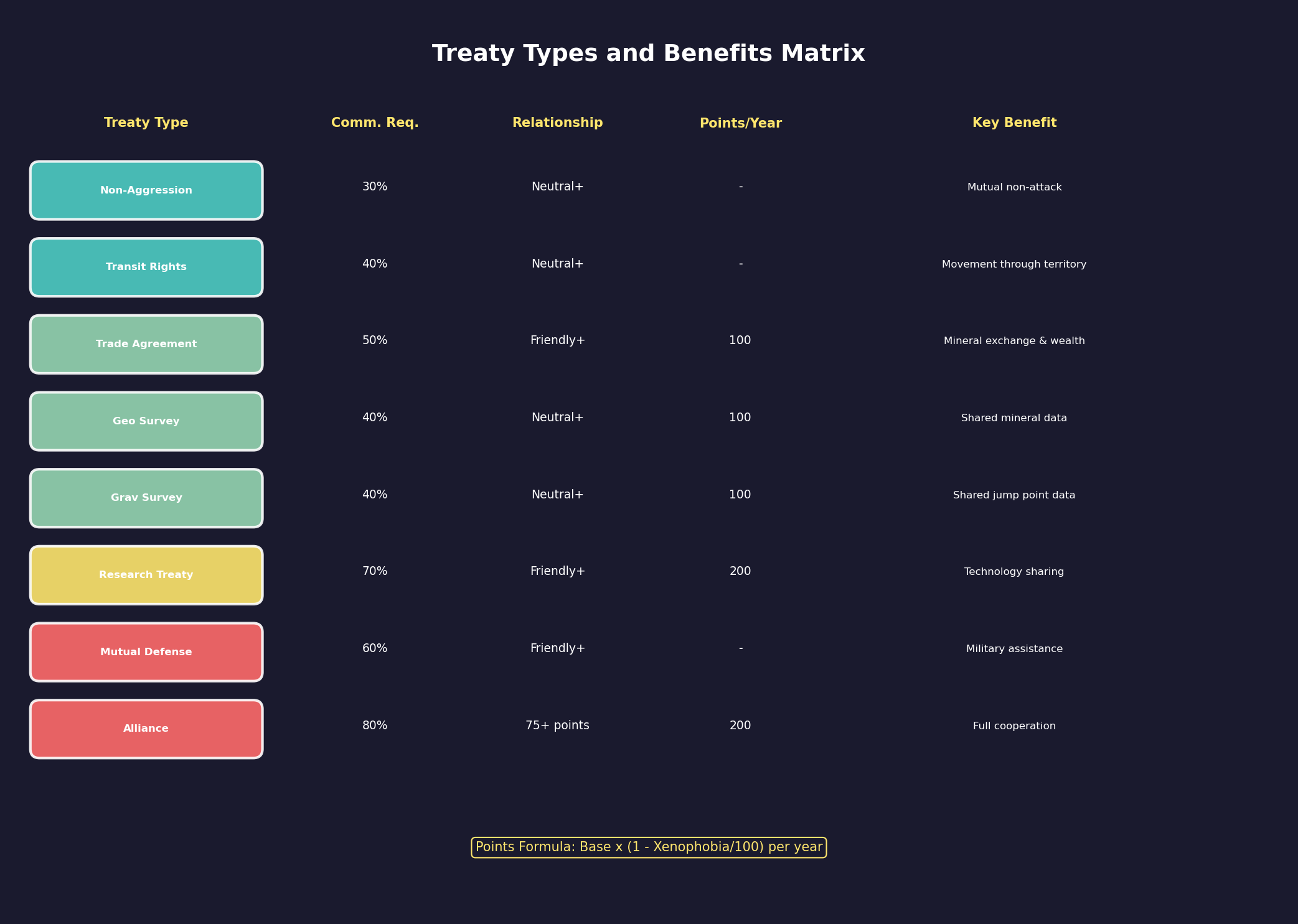
Treaties in Aurora C# formalize diplomatic agreements between your empire and alien races. \hyperlink{ref-15.3-1}{[1]} Each treaty type provides specific mechanical benefits and obligations. Treaties require a minimum communication level to propose (typically 40% or higher) and the other party must agree to the terms. \hyperlink{ref-15.3-2}{[2]} NPRs evaluate treaty proposals based on their diplomatic attributes. The specific communication level thresholds listed below for each treaty type are forum-sourced and have not been verified against the game database (unverified – #1257).
15.3.1.1 Non-Aggression Pact
The simplest form of treaty, a non-aggression pact is a mutual agreement not to engage in hostilities.
- Requirements: Communication level of at least 30% (unverified — #1259). Relationship must be neutral or better.
- Effect: Both parties agree not to attack each other’s ships or installations. Violating this pact results in severe diplomatic penalties.
- Duration: Indefinite until broken by either party.
- Use Case: A good first step when you encounter a race you do not want to fight but are not ready to fully trust. Provides basic security while you assess the situation.
15.3.1.2 Trade Agreement
A trade agreement establishes economic cooperation between the two empires, enabling the exchange of resources.
- Requirements: Communication level of at least 50% (unverified — #1259). Relationship must be friendly or better.
- Effect: Enables trade of minerals (see Section 6.1 Minerals) between your colonies and the alien race’s colonies. Trade generates wealth for both parties and can help address mineral shortages. Both sides must have appropriate trade infrastructure (trading stations or assigned freighters).
- Diplomatic Points: Generates 100 base points per year, modified by
(1 - Xenophobia / 100). - Duration: Indefinite, though either party can withdraw.
- Use Case: Excellent for supplementing scarce minerals. If an NPR has abundant Duranium but lacks Gallicite, and your situation is reversed, trade benefits both empires.
15.3.1.3 Geological Survey Treaty
A specialized agreement allowing shared geological survey data.
- Requirements: Communication level sufficient for diplomatic proposals. Relationship must be neutral or better.
- Effect: Both parties share geological survey data (see Section 17.1 Geological Survey) for systems they have surveyed. This can dramatically reduce the time needed to identify mineral-rich bodies in explored space.
- Diplomatic Points: Generates 100 base points per year, modified by
(1 - Xenophobia / 100). - Duration: Indefinite until dissolved by either party.
- Use Case: Particularly valuable early in the game when survey fleets are stretched thin. Gaining access to an NPR’s survey data can reveal mineral deposits in systems you have already explored but not yet surveyed.
15.3.1.4 Gravitational Survey Treaty
Similar to the geological treaty, focused on jump point survey data.
- Requirements: Communication level sufficient for diplomatic proposals. Relationship must be neutral or better.
- Effect: Both parties share gravitational survey data (see Section 17.2 Gravitational Survey), revealing jump point locations in surveyed systems. This can open up new expansion routes without needing to send your own survey ships.
- Diplomatic Points: Generates 100 base points per year, modified by
(1 - Xenophobia / 100). - Duration: Indefinite until dissolved by either party.
- Use Case: Extremely valuable for understanding the galactic map. An NPR’s gravitational survey data may reveal jump points you missed or confirm the absence of connections in certain systems.
15.3.1.5 Research Treaty
A technology-sharing agreement focused on scientific cooperation.
- Requirements: Communication level of at least 70% (unverified — #1259). Relationship must be friendly or better.
- Effect: Both parties share selected research discoveries. This does not give you complete technologies instantly, but provides research point bonuses toward technologies the other race has already discovered.
- Diplomatic Points: Generates 200 base points per year, modified by
(1 - Xenophobia / 100). - Duration: Typically linked to another treaty and remains active as long as the parent agreement.
- Use Case: Can dramatically accelerate your research in areas where the NPR is ahead. However, it also accelerates their research in your areas of expertise, which may not always be desirable.
15.3.1.6 Mutual Defense Treaty
A mutual defense treaty obligates both parties to come to each other’s aid if attacked by a third party.
- Requirements: Communication level of at least 60% (unverified — #1259). Relationship must be friendly or better.
- Effect: If either party is attacked, the other is expected to provide military assistance. The NPR will actually dispatch fleets to help defend your territory if you are invaded, and may request the same of you.
- Duration: Indefinite until dissolved by either party.
- Use Case: Valuable when facing a powerful threat. An allied fleet arriving to reinforce your defense can turn the tide of a war. However, it also means you may be drawn into conflicts you would prefer to avoid.
15.3.1.7 Alliance
The highest form of diplomatic agreement, an alliance represents a deep partnership between empires.
- Requirements: Communication level of at least 80% (unverified — #1259). Relationship must be strongly friendly (75+).
- Effect: Combines the benefits of all lower treaty types. Allied races share sensor data, coordinate military operations, and may share technology. Alliance partners will coordinate expansion to avoid conflicting territorial claims.
- Diplomatic Points: Allied Status generates 200 base points per year, modified by
(1 - Xenophobia / 100). - Duration: Indefinite, but difficult to dissolve without severe penalties.
- Use Case: Reserve for races you fully trust and intend to cooperate with long-term. An alliance with a powerful NPR can provide security, but also limits your freedom of action.
15.3.1.8 Transit Rights
Grants permission for ships of one party to pass through the other’s territory.
- Requirements: Communication level of at least 40% (unverified — #1259). Relationship must be neutral or better.
- Effect: Your ships can move through the alien race’s systems without triggering hostile responses. Without transit rights, the presence of your ships in their space will generate intrusion penalties scaled by tonnage, system value, and xenophobia (see Section 15.1 Alien Races).
- Duration: Indefinite until revoked.
- Use Case: Essential for reaching distant parts of your empire if an NPR controls intervening systems. Also useful for establishing commercial shipping routes.
15.3.2 Treaty Effects
Updated: v2026.01.30
Treaties are not merely diplomatic formalities – they produce real mechanical effects that alter gameplay.
15.3.2.1 Diplomatic Point Generation
Active treaties continuously generate diplomatic points, improving your relationship with the other party. The formula for treaty-based point generation is:
Points per Year = Base Points x (1 - Xenophobia / 100)
| Treaty/Status | Base Points per Year |
|---|---|
| Trade Agreement | 100 |
| Geological Survey Treaty | 100 |
| Gravitational Survey Treaty | 100 |
| Research Treaty | 200 |
| Friendly Status (passive) | 100 |
| Allied Status (passive) | 200 |
\hyperlink{ref-15.3-2}{[2]}
Note that Friendly and Allied status themselves generate points passively, creating a positive feedback loop where good relationships tend to improve further over time (unless counteracted by territorial disputes or other negative events).
15.3.2.2 Economic Effects
Trade agreements produce tangible economic benefits:
- Mineral Exchange: Both parties can trade surplus minerals for those in short supply. The exchange rate is determined by relative abundance.
- Wealth Generation: Active trade routes generate wealth for both empires, funding construction and research.
- Supply Chains: Trade can sustain remote colonies that lack local mineral deposits, reducing the need for dedicated mining operations in every system.
15.3.2.3 Military Cooperation
Defense treaties and alliances enable military coordination:
- Shared Intelligence: Allied races share sensor contacts (see Section 11.1 Thermal and EM Signatures), giving you visibility into areas you otherwise could not observe.
- Coordinated Defense: Allied NPRs will move fleets to defend your territory when threatened.
- Joint Operations: Under an alliance, you may see NPR fleets operating in conjunction with your own against mutual enemies.
15.3.2.4 Territorial Effects
Treaties affect how both parties handle territorial claims:
- Transit Rights: Ships can pass through each other’s territory freely without generating intrusion penalties.
- Reduced Tension: The presence of your ships in allied space does not generate diplomatic friction.
- Expansion Coordination: Allied NPRs will generally avoid colonizing worlds you have already claimed, reducing territorial disputes.
15.3.2.5 Truce Countdown Effects
When a truce is established (typically after a war ends), both parties enter a Fixed Relationship period with a Truce Countdown:
- During this period, neither side will make territorial claims against the other.
- The race under a truce countdown will also ignore claims from the other side, with no diplomatic penalty applied.
- This provides a cooling-off period after conflict where both sides can stabilize without fear of immediate re-escalation.
Tip: Do not underestimate the value of shared sensor data from an alliance. Knowing what is happening several systems away can give you crucial early warning of incoming threats. An ally two jump points closer to a hostile race effectively serves as your early warning system.
15.3.3 Breaking Treaties
Updated: v2026.01.30
Treaties can be broken, but doing so carries significant consequences. Both you and NPRs can violate treaty terms, either deliberately or through circumstances.
15.3.3.1 How Treaties Are Broken
Treaties can be violated in several ways:
- Deliberate Cancellation: You can choose to formally withdraw from any treaty through the Diplomacy window. This is the “cleanest” way to end an agreement but still carries diplomatic costs.
- Military Action: Attacking ships or installations of a treaty partner automatically breaks all treaties with that race. Attacking a diplomatic ship carries triple the normal diplomatic penalty (-300 relationship points for an unprovoked attack).
- Territorial Violation: Colonizing a world claimed by your partner (without transit rights or alliance status) strains treaties.
- Failure to Honor Defense Obligations: If a mutual defense partner is attacked and you do not provide assistance, the treaty may be considered violated.
- Demand Refusal: Persistent refusal of treaty partner demands can erode the relationship to the point where treaties collapse.
15.3.3.2 Consequences of Breaking Treaties
Breaking treaties produces several negative effects:
15.3.3.2.1 Immediate Effects
- Relationship Penalty: A large immediate drop in relationship values. The severity depends on the treaty type broken (breaking an alliance is far worse than withdrawing from a non-aggression pact).
- Trust Modifier: Your race receives a “treaty-breaker” modifier that makes all NPRs less likely to enter treaties with you in the future. This modifier decays slowly over time.
- NPR Response: The offended NPR may immediately declare war, especially if the treaty violation involved military action.
15.3.3.2.2 Long-Term Effects
- Reputation Damage: Other NPRs who are aware of your treaty violation (through their own intelligence) will factor this into their dealings with you.
- Higher Requirements: Future treaty negotiations with any race may require higher communication levels and relationship values to overcome the trust deficit.
- NPR Paranoia: Races that have been betrayed by you become permanently more suspicious and may maintain larger military forces on their border with your territory.
15.3.3.3 NPR Treaty Violations
NPRs can also break treaties:
- An NPR that becomes significantly more powerful than you may decide your alliance is no longer necessary and withdraw.
- NPRs with high Militancy may violate non-aggression pacts if they sense an opportunity to take valuable territory.
- Under extreme economic or military pressure (such as losing a war to a third party), NPRs may break trade agreements to redirect resources.
- Treaty violations by NPRs generate the same event notifications as other diplomatic events. When an NPR breaks a treaty with you, the relationship penalty is applied to them rather than to you.
15.3.3.4 Strategic Considerations
When considering breaking a treaty, weigh the following:
- Military Readiness: Are you prepared for the likely war that follows?
- Alternative Partners: Will breaking one treaty damage your other diplomatic relationships?
- Timing: Is the strategic advantage worth the long-term diplomatic cost?
- Precedent: Once you break one treaty, all NPRs become harder to negotiate with.
Tip: Sometimes the most effective strategy is to provoke an NPR into breaking a treaty with you rather than breaking it yourself. Their ships in your space, their demands, their hostility – if you can document NPR aggression before the break, the diplomatic fallout is entirely on them while you retain your reputation as a reliable partner.
15.3.4 Independence
Updated: v2026.01.30
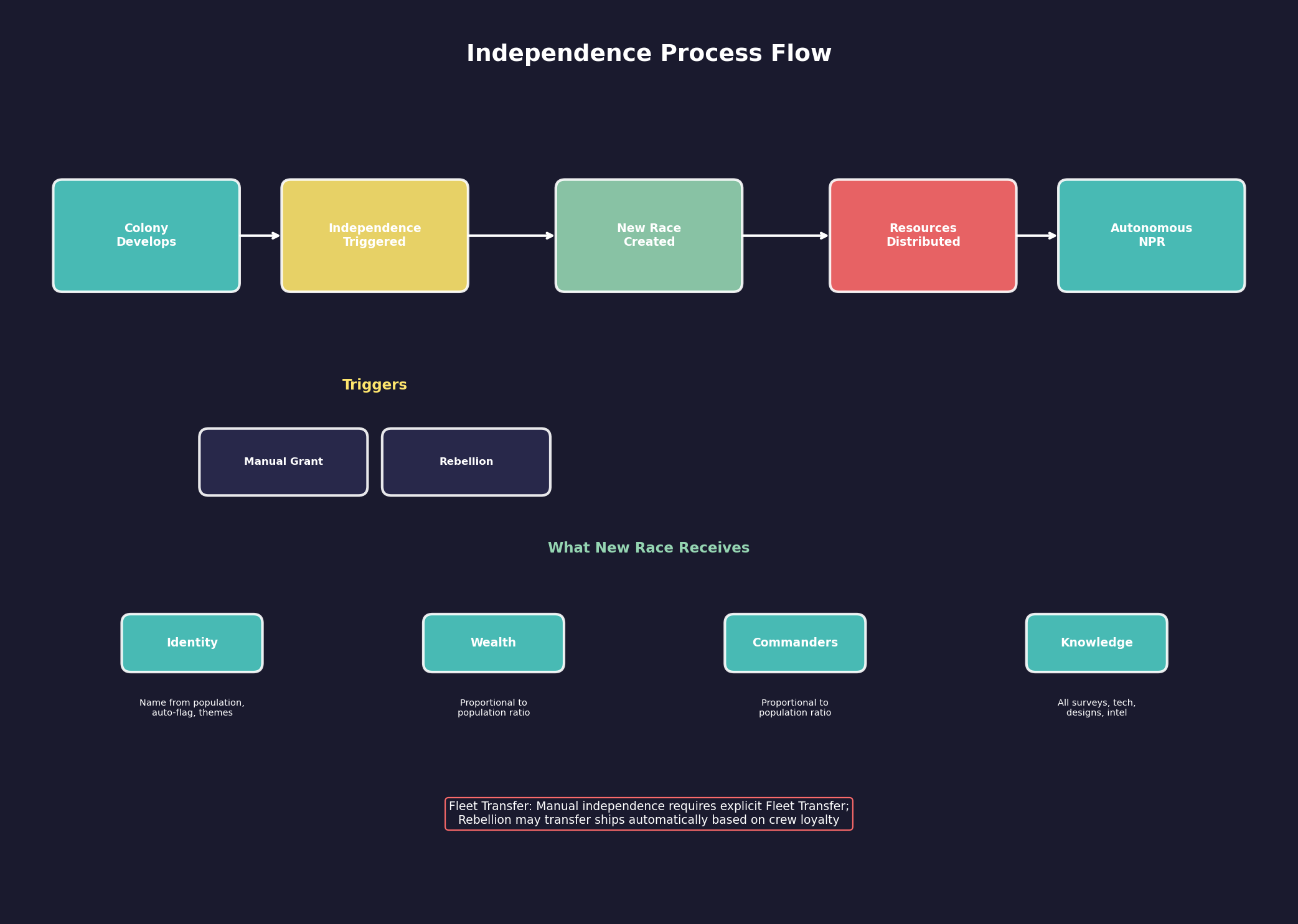
Colonies can become independent from their parent race, either through the player granting independence manually or through rebellion. This creates a new fully-functional race with comprehensive capabilities inherited from the parent.
15.3.4.1 Independence Declaration Process
When a colony becomes independent, a complete new race is created with the following characteristics:
New Race Identity:
- The new race title derives from the population’s name
- An auto-selected flag and random naming themes are assigned for classes and systems
- Commander name themes remain identical to the original (parent) race
- Rank structure is copied from the parent race
15.3.4.2 Resource Distribution
The newly independent race receives resources proportional to its population:
Wealth:
New Race Wealth = Total Original Race Wealth x (Independent Pop Size / Total Original Race Pop Size before Independence)
Commanders:
Commander Count = Total Commanders x (Independent Pop Size / Total Original Race Pop Size before Independence)
A top-level admin command is automatically established at the new population.
15.3.4.3 Knowledge Transfer
The newly independent faction receives comprehensive information from the parent race:
- Complete galactic map with all existing labels (see Section 4.1 Star Systems)
- All geological and gravitational survey data (see Section 17.1 Geological Survey)
- Full technology systems and component designs
- All ship and ground unit class designs
- Complete intelligence database on alien races, systems, and forces
- Control race flags and protection status settings
- Locations of ruins, anomalies, and wrecks
- Event color configurations
15.3.4.4 Fleet Transfer
The handling of naval forces depends on the method of independence:
- Manual Independence: Naval forces require explicit transfer using the Fleet Transfer option in the diplomacy interface. The player chooses which ships to assign to the new race.
- Rebellion: In rebellion scenarios, some ships may transfer automatically to the new faction based on crew loyalty and location.
15.3.4.5 Strategic Implications
Independence creates a new fully-functional NPR (or player-controlled race in multiplayer scenarios) that retains all the knowledge and proportional resources of its parent. The new race operates autonomously with its own diplomatic relationships, military, and expansion priorities.
Tip: Granting independence to a well-developed colony can be a strategic choice – creating a buffer state between your core territory and a hostile race, or establishing a trade partner with compatible but non-competing atmospheric requirements.
15.3.5 Diplomatic Point Mechanics Summary
Updated: v2026.01.30
For the comprehensive diplomatic point reference including all positive sources, negative penalties, decay rates, and relationship thresholds, see Section 15.1.5 Diplomatic Points System.
15.3.5.1 Treaty Point Generation (Quick Reference)
Active treaties generate diplomatic points per year, modified by Base x (1 - Xenophobia / 100):
| Treaty/Status | Base Points per Year |
|---|---|
| Trade Agreement | 100 |
| Geological Survey Treaty | 100 |
| Gravitational Survey Treaty | 100 |
| Research Treaty | 200 |
| Friendly Status (passive) | 100 |
| Allied Status (passive) | 200 |
Tip: The most efficient path to positive relations with a new race is to establish multiple treaties simultaneously while maintaining active diplomatic ships with high-bonus commanders in contact systems. Stacking a Trade Agreement (+100), Geological Survey Treaty (+100), and Research Treaty (+200) against a race with 30% Xenophobia yields 280 diplomatic points per year from treaties alone – enough to move from neutral to friendly within a few months.
UI References and Screenshots
Updated: v2026.02.15
- Diplomacy Window Layout — treaty proposal and status display
Related Sections
- Section 6.1 Minerals – Trade agreements and mineral exchange mechanics
- Section 7.1 Technology Tree – Research treaties and technology sharing
- Section 14.1 Fuel – Trade infrastructure and freight route management
- Section 17.1 Geological Survey – Survey data shared through geological and gravitational survey treaties
- Appendix A: Formulas – Treaty point generation formulas
References
\hypertarget{ref-15.3-1}{[1]}. Aurora C# game database (AuroraDB.db v2.7.1) – FCT_AlienRace table. Confirms TradeTreaty, TechTreaty, GeoTreaty, GravTreaty boolean fields, validating the existence of these treaty types in the game mechanics.
\hypertarget{ref-15.3-2}{[2]}. Aurora Forums – Steve Walmsley’s diplomacy and treaty mechanics posts. Treaty point generation values (Trade 100, Survey 100, Research 200, Friendly 100, Allied 200), xenophobia modifier formula, communication level requirements, and treaty-breaking mechanics. (forum-sourced; specific post URLs unavailable)