15.1 Alien Races
Updated: v2026.02.15

[Screenshot Pending — #1070] Race Intelligence Window displaying known race information
Contents
Updated: v2026.02.15
- 15.1 Alien Races
15.1.1 NPR Generation
Updated: v2026.01.30
NPRs (Non-Player Races) are the AI-controlled alien civilizations that populate the galaxy. Aurora C# generates these races through several mechanisms, each producing different types of encounters.
15.1.1.1 Spoiler Race Generation
When starting a new game, you can configure the galaxy to include NPRs from the start (see Section 2.1 New Game Options). The game settings allow you to specify:
- Number of NPRs: How many alien races exist at game start.
- Tech Level Range: NPRs can range from pre-industrial civilizations to advanced spacefaring empires. The tech level is randomized within the range you specify.
- Distance from Sol: You can set minimum and maximum distances (in jump points) from your starting system to NPR homeworlds, controlling how quickly you are likely to encounter them.
Each generated NPR receives a randomly determined species with unique characteristics including atmospheric requirements, gravity tolerance, and temperature preferences. These biological parameters determine which worlds the NPR will colonize and terraform (see Section 5.1 Establishing Colonies), creating natural competition for habitable real estate.
15.1.1.2 Random Generation During Play
Beyond the initial setup, Aurora C# can generate new NPRs during gameplay. When your survey ships (see Section 17.1 Geological Survey) explore new systems, there is a chance of discovering previously unknown civilizations. The probability and tech level of these encounters depends on your game settings. A system with habitable worlds is more likely to contain a civilization.
15.1.1.3 Customised NPR Generation
A “Customise NPRs” checkbox in the Game Setup window enables detailed customization of each NPC race through an NPR Setup window. When enabled, each NPR slot is pre-populated with randomized data that the player can modify before the game begins. The following parameters are customizable:
Identity and Appearance:
- Race name, title, and homeworld designation
- Custom images for race, flag, ships, and stations
Military Structure:
- Commander naming theme selection
- Rank structure assignment
Naming Conventions:
- System name themes
- Ship class naming themes (with optional random name order – see below)
- Ground forces designation themes
- Missile nomenclature themes
Class Name Randomization (v2.5.0+):
- Random Name Order: When enabled, NPR ship class names are generated with randomized word order rather than following the standard theme sequence. This produces more varied and less predictable class naming across NPR fleets. \hyperlink{ref-15.1-8}{[8]}
Population and Economy Modifiers:
- Population size modifier (applied to standard NPC generation)
- Production modifier
- Research modifier
- Growth modifier
Starting Resources:
- Tech point modifier (affected by population size modifier)
- Build point modifier (affected by population size modifier)
Military Characteristics:
- Ship size modifier for NPC vessel generation
- Shield usage: Yes, No, or Random
- Missile deployment: Yes, No, or Random
- Primary beam weapon type: Random, Laser, Railgun, Particle, or Carronade
- Point defense weapon: Random, Laser, Railgun, or Gauss
Homeworld Settings:
- Specific system selection for Known Stars games
- Dominant terrain selection (generates compatible planetary characteristics). As of v2.5.0, the “Archipelago” terrain type was removed as an NPR home world option because its 95% hydro extent requirement made it impractical for generating viable starting conditions.
Additionally, players can rename NPRs at any time through an “SM Race Title” button in the Intelligence and Foreign Relations window. This permits changing the NPR Species Name (used as short name) and modifying the NPR Race Title (displayed on the Intelligence window). Changes can be made before or after contact is established.
15.1.1.4 NPR Characteristics
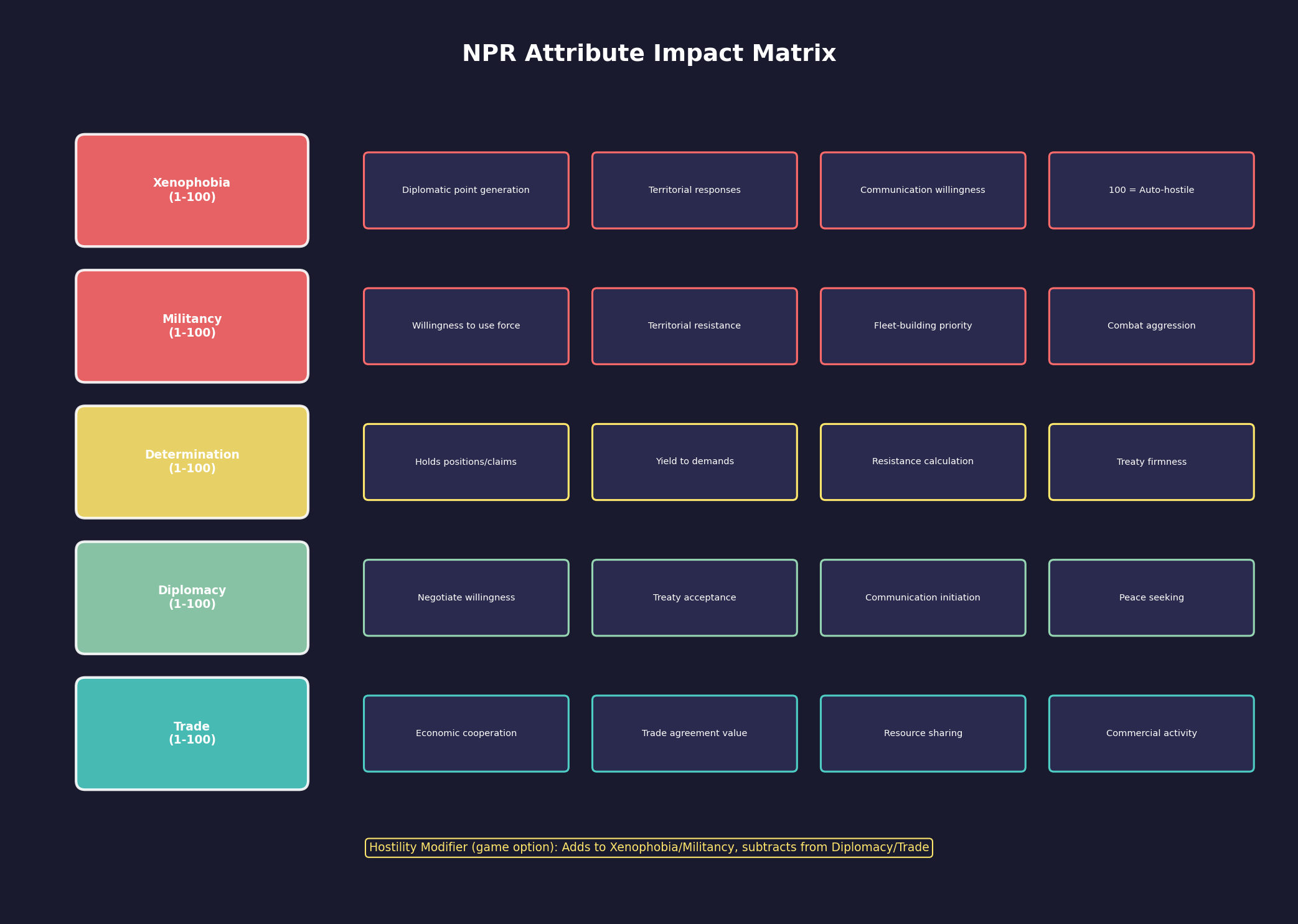
Each NPR is generated with a complete set of attributes that govern its behavior:
- Government Type: Affects diplomatic tendencies, starting installations, and ground force composition. Government type is selected during race creation for player races and randomly assigned for NPRs. See Section 2.2.7 Government Type for the complete list and their effects.
- Xenophobia (1-100): Measures how much the NPR distrusts alien races. Affects diplomatic point generation, territorial responses, and communication willingness. An NPR with Xenophobia of 100 will automatically assign any other race as hostile and cease all communication attempts. \hyperlink{ref-15.1-4}{[4]}
- Militancy (1-100): Determines how willing the NPR is to use force. Affects territorial resistance calculations and fleet-building priorities.
- Determination (1-100): Measures how stubbornly the NPR holds its positions and claims. Higher values make the NPR less likely to yield to demands.
- Diplomacy (1-100): Controls willingness to negotiate, trade, and form agreements. Higher values make the NPR more receptive to diplomatic overtures.
- Trade (1-100): Affects willingness to engage in economic cooperation with other races.
- Expansion Drive: Controls how actively the NPR colonizes new worlds and builds fleets.
- Technology Focus: NPRs may emphasize different tech paths – some focus on beam weapons while others develop missiles, and their ship designs reflect these preferences.
- Fleet Doctrine: Determines ship sizes, fleet compositions, and tactical behavior in combat.
These characteristics are persistent throughout the game, though an NPR’s behavior will also respond dynamically to its strategic situation (being at war, losing territory, or encountering a much stronger power).
15.1.1.5 Hostility Modifier (Game Option)
The Hostility Modifier is a game-wide option set during game creation that adjusts all NPR diplomatic tendencies simultaneously:
- The modifier value is added to each NPR’s Xenophobia and Militancy attributes.
- The same value is subtracted from each NPR’s Diplomacy and Trade attributes.
- Default setting: zero (no modification).
- All attribute values remain capped between 1 (minimum) and 100 (maximum), regardless of the modifier size.
Higher positive values make all NPRs more aggressive and xenophobic while reducing their willingness to trade or negotiate. Negative values have the inverse effect, making NPRs more amenable to peaceful relations.
15.1.1.6 Viewing NPR Information
You can view known NPR information through the Race Intelligence window (accessible from the main toolbar). This window shows all races you have detected, along with whatever information your intelligence efforts have gathered. Initially, you will know very little about a newly discovered race – further contact and intelligence operations reveal more details over time.
Tip: Pay close attention to the atmospheric requirements of alien races. If they breathe the same atmosphere as your species, you are competing for the same worlds. Races with incompatible atmospheres may be easier to coexist with, as you will not be fighting over the same planets.
15.1.2 NPR Behavior
Updated: v2026.01.30
NPR civilizations are not static – they actively pursue their own goals, build ships, research technology, and expand their territory. Understanding NPR behavior patterns helps you anticipate threats and opportunities.
15.1.2.1 Economic Activity
NPRs manage their own economies, including:
- Mining Operations: NPRs exploit mineral deposits on their worlds and may establish mining colonies on resource-rich bodies. As of v2.5.0, NPR orbital miners correctly assign to their parent population, and NPR fuel harvesters properly associate with a population for resource accounting.
- Construction: They build installations, shipyards, and orbital facilities.
- Research: NPRs advance through the tech tree (see Section 7.1 Technology Tree), though their rate of progress depends on their population, research facilities, and tech focus. NPR research uses a time-scaling formula: Tech Years = Game Years + 20, and Research Points = Research Labs x Tech Years x 300. This means NPRs become progressively more capable researchers as the game continues. As of v2.0.0, NPRs no longer have a 50-lab starting limit, allowing larger NPR civilizations to research more effectively. NPRs also now research fuel efficiency technologies, improving their operational logistics over time.
- Population Growth: NPR populations grow over time, providing more labor and enabling further expansion.
15.1.2.2 Fuel Mechanics
NPR ships consume fuel and require refueling infrastructure, following the same rules as player ships:
- Fuel Consumption: NPR ships consume fuel identically to player ships and must refuel using the same infrastructure (fuel transfer stations, refueling systems).
- Logistics: NPR tankers move fuel from harvesters and populations with excess fuel to populations with logistical infrastructure that require fuel.
- Low Fuel Behavior: When NPR ships run low on fuel, they automatically return to the nearest population or tanker with available fuel.
- Mission Capable Status: NPR fleets have a mission capable status metric affected by fuel levels, damage, and ordnance. When fuel becomes critically low, fleets cannot perform combat operations and focus exclusively on locating refueling options.
- Emergency Movement: To prevent logic failures, NPR ships can still move with zero fuel while traveling to refueling points – a necessary gameplay concession.
This system adds operational constraints to NPR behavior and creates strategic opportunities for players: fuel supply lines become potential attack targets, disrupting NPR logistics without direct fleet engagement.
15.1.2.3 Military Behavior
NPR military behavior is driven by their Militancy, fleet doctrine, and strategic circumstances:
- Fleet Building: NPRs continuously design and construct warships (see Section 8.1 Design Philosophy). Their designs evolve over time as they research new technologies.
- Patrols: NPRs typically maintain patrol fleets in their home systems and along their borders.
- Expansion: Based on their expansion drive, NPRs will send colony ships to suitable worlds within their reach.
- Response to Threats: When NPRs detect your ships in their territory, their response depends on their Xenophobia, Militancy, and your diplomatic relationship. See Section 15.1.4 Territory and Intrusion for detailed territory intrusion mechanics.
- Capital Protection Zone: NPRs respect a zone of ten million kilometers around the capital planets of alien races who are non-hostile when investigating contacts. They will not approach within this zone unless relations deteriorate to hostile.
- System Withdrawal (v1.12.0+): NPRs will withdraw their forces from a system both when it is controlled by an alien race with whom they have neutral or better relations, and when they are isolated from their own territory by alien-controlled systems. This prevents NPR fleets from lingering in strategically untenable positions.
- Active Sensors (v1.12.0+): Non-player ground forces always activate their active sensors, ensuring they contribute to detection regardless of other tactical considerations.
15.1.2.4 NPR Ship Design Philosophy (v2.2.0+)
As of v2.2.0, Aurora uses an expanded design philosophy system for NPR ship generation rather than randomly selecting from fixed design themes. Individual aspects of NPR design are selected independently, producing significantly more varied opponents.
Key Features:
- Variable Ship Sizes: Ships range more widely in tonnage, potentially reaching up to 3x standard sizes in rare cases.
- Independent Design Aspects: Rather than a fixed template, each NPR selects its own weapon preferences, engine configurations, shield usage, and other design parameters independently.
- Shield Usage: More common among advanced NPR civilizations.
- Missile Strategies: Each NPR faction adopts specific missile design approaches (e.g., incorporating decoys or laser warheads), potentially increasing missile sizes to support their chosen strategy.
- Beam-Focused Races: May now use enhanced engines on warships for aggressive close-range tactics.
- Independent Tech Progressions: Each NPR selects its own technology categories based on its design philosophy, enabling more diverse advancement paths.
- Varied Group Compositions: Operational group compositions show greater variation in fleet organization.
- Missile Destroyer Role (v2.5.0+): NPRs can now design and deploy dedicated missile destroyers as part of their fleet doctrine, adding a missile-armed escort role to their potential ship mix.
- Precursor/Invader Diversity: Precursor and Invader factions also gain design diversity and may now employ shields.
15.1.2.5 Decision Making
NPR decision-making follows a priority system:
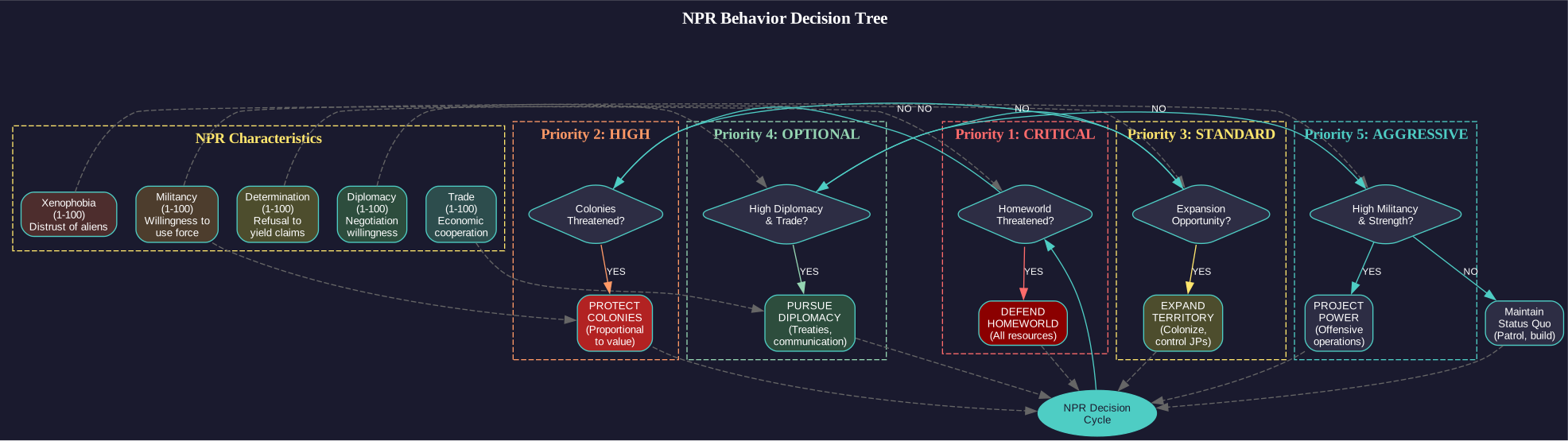
- Defend Homeworld: The NPR will always prioritize defense of its capital.
- Protect Colonies: Established colonies receive defensive attention proportional to their value.
- Expand Territory: NPRs seek to colonize new worlds and control jump points.
- Pursue Diplomacy: Based on disposition, NPRs may seek treaties or issue demands.
- Project Power: Aggressive NPRs may launch offensive operations against perceived rivals.
Tip: If you notice an NPR massing ships near a jump point connecting to your territory, take it seriously. NPRs do not bluff – fleet movements indicate intent.
15.1.2.6 NPR Diplomatic Behavior
NPRs actively pursue diplomatic relations using the same mechanics available to players.
Diplomatic Ship Deployment:
- NPRs build and deploy their own ships equipped with Diplomacy Modules (unverified — #701 – NPR diplomatic ship construction not directly confirmed in DB)
- These ships are used to establish contact with player races and other NPRs
- NPR diplomatic teams influence the player’s perception of the NPR empire, just as player diplomatic teams influence NPR perception of the player \hyperlink{ref-15.1-6}{[6]}
- The effectiveness of NPR diplomatic efforts is governed by the same formulas as player diplomacy, modified by the NPR’s Diplomacy attribute
NPR Communication Initiation:
- NPRs will set their communication status to “Attempting Communication” based on their Diplomacy and Xenophobia attributes (unverified — #701)
- Highly xenophobic NPRs (Xenophobia 100) automatically refuse communication
- NPRs with high Diplomacy values are more likely to initiate peaceful contact
Homeworld Security Priority:
- NPRs strongly prioritize keeping their home system clear of alien ships \hyperlink{ref-15.1-7}{[7]}
- Diplomatic overtures in an NPR’s capital system are more likely to be rejected or met with hostility
- Contact attempts in outlying colonies typically receive better responses than approaches to the homeworld
- This behavior reflects realistic territorial instincts – even diplomatically inclined NPRs are protective of their core systems
Transponder Usage:
- NPR transponder behavior is not explicitly documented, but NPRs appear to operate with transponders off by default (unverified — #701)
- Player detection of NPR ships relies on sensor capabilities rather than transponder broadcasts
- NPR civilian shipping may broadcast transponders to friendly races, similar to player civilian ships (unverified — #701)
15.1.2.7 NPR Awareness
NPRs have their own sensor networks and intelligence capabilities:
- They detect your ships using their own active and passive sensors (see Section 11.1 Thermal and EM Signatures).
- They track ship movements through their territory.
- They assess your military strength based on what they have observed.
- Their diplomatic and military decisions factor in their perception of your power relative to their own.
15.1.2.8 Banned Bodies
NPRs with neutral or higher relationships observe “banned body” restrictions. These are determined autonomously by each NPR based on the following rules:
Bodies designated as banned include:
- Bodies that have an alien race population of approximately ten million or more
- Moons orbiting any populated body meeting that threshold
- Moons sharing the same parent body as populated worlds
- Exception: An NPR’s own population sites are never banned for that NPR
Behavioral restrictions on banned bodies:
- NPRs will not create populations on banned bodies
- NPRs will not conduct geological surveys on banned bodies
- NPRs will not generate points of interest within several million kilometers of banned locations
- However, NPRs may still approach banned bodies when on an unrelated mission between other objectives
Update timing: The banned bodies list is recalculated during game launch and during each construction phase.
Relationship dependency: Banned body restrictions only apply when the NPR has a non-hostile relationship with the race occupying the body. If a planet hosts both hostile and neutral populations, the body remains accessible to the NPR.
Player implementation: Players can manually ban bodies through the system view toggle, with options to ban/unban entire moon systems at once. This primarily serves roleplay purposes since NPC reactions focus on system-level presence rather than proximity to specific bodies.
15.1.3 First Contact
Updated: v2026.01.30
The moment of first contact with an alien race is one of the most significant events in an Aurora campaign. How it unfolds depends on the circumstances of discovery and both parties’ characteristics.
15.1.3.1 Detection Methods
First contact can occur through several channels:
- Survey Ships: Your geological or gravitational survey vessels enter a system containing an NPR civilization. This is the most common method of discovery.
- Sensor Detection: Your passive or active sensors (see Section 11.1 Thermal and EM Signatures) pick up emissions from alien ships or installations.
- Jump point encounter: An NPR exploration vessel transits a jump point into one of your systems, or vice versa.
- Shared System Discovery: Both civilizations expand into the same unclaimed system simultaneously.
15.1.3.2 The First Contact Process
When first contact occurs, several things happen:
- Detection Event: A message alerts you that an alien race has been detected. The message includes the location and method of detection.
- Race Created: If this is a genuinely new race (not a previously known one encountered in a new location), the race is added to your intelligence database.
- Initial Relationship: The starting diplomatic relationship is set based on the NPR’s disposition and the circumstances of contact. Peaceful discovery typically starts at neutral, while contact through combat starts hostile.
- Communication Barrier: You cannot meaningfully communicate with the alien race until you develop sufficient understanding of their language (see Section 15.2 Communications).
15.1.3.3 Factors Affecting First Contact Outcome
Several factors influence how first contact plays out:
- Location: Discovering an NPR in unclaimed space is less provocative than being found deep in their territory.
- Military Presence: If your first contact involves a large warfleet, aggressive NPRs may feel threatened. Unarmed survey ships are less likely to provoke hostility.
- NPR Xenophobia: Highly xenophobic races (Xenophobia of 100) will automatically designate you as hostile on contact and refuse all communication attempts.
- NPR Tech Level: A primitive race that detects your advanced ships may react with fear or awe, while a technologically superior race may view you as insignificant.
15.1.3.4 Preparing for First Contact
Smart players prepare for the possibility of first contact:
- Arm Survey Ships: Even a token defensive armament can allow a survey ship to survive long enough to flee.
- Escort Fleets: Consider stationing warships at jump points along your exploration frontier.
- Diplomacy Ships: Equip ships with Diplomacy Modules (30 HS, 300 BP, 50 crew) \hyperlink{ref-15.1-1}{[1]} to enable effective communication and maximize diplomatic point generation during contact.
- Standing Orders: Decide in advance whether your exploration ships should flee, hold position, or attempt communication when encountering unknowns.
Tip: The galaxy in Aurora can be a dangerous place. Never send survey ships into unexplored space without at least considering what happens if they find something hostile. A destroyed survey ship not only costs you the vessel and crew, but also tells the alien race exactly where to find you.
15.1.3.5 NPR-Initiated Contact
First contact is not always initiated by the player. NPRs actively explore and may discover your civilization first.
NPR Survey Operations:
- NPRs conduct their own geological and gravitational surveys using AI-controlled survey ships
- An NPR survey ship entering your space triggers first contact just as your ships entering theirs would
- The NPR’s response depends on where contact occurs – discovering you in unclaimed space is different from finding your ships in what they consider their territory
NPR Diplomatic Approach:
- NPRs with high Diplomacy attributes may send diplomatic ships to initiate communication after first contact \hyperlink{ref-15.1-6}{[6]}
- The NPR’s diplomatic teams work to improve their standing with your empire, just as your teams work on them
- Whether an NPR pursues diplomacy or military options depends on their Xenophobia, Militancy, and Diplomacy attributes
When NPRs Discover You First:
- You receive a detection event when an NPR ship enters your sensor range, even if you have not yet explored their territory
- If the NPR ship is a diplomatic vessel, they may immediately begin communication attempts
- If the NPR ship is military, their response depends on their disposition – aggressive NPRs may attack, while diplomatic ones may withdraw and send proper diplomatic vessels later (unverified — #701)
Passive Contact Strategy:
An alternative to active exploration is waiting for NPRs to find you:
- Set transponders to “All” on a ship stationed near an unexplored jump point
- Eventually an NPR ship may transit and detect your broadcast \hyperlink{ref-15.1-7}{[7]}
- This approach allows first contact without risking survey ships in potentially hostile territory
- However, it provides no control over which NPR you encounter or when contact occurs
15.1.4 Territory and Intrusion
Updated: v2026.02.15
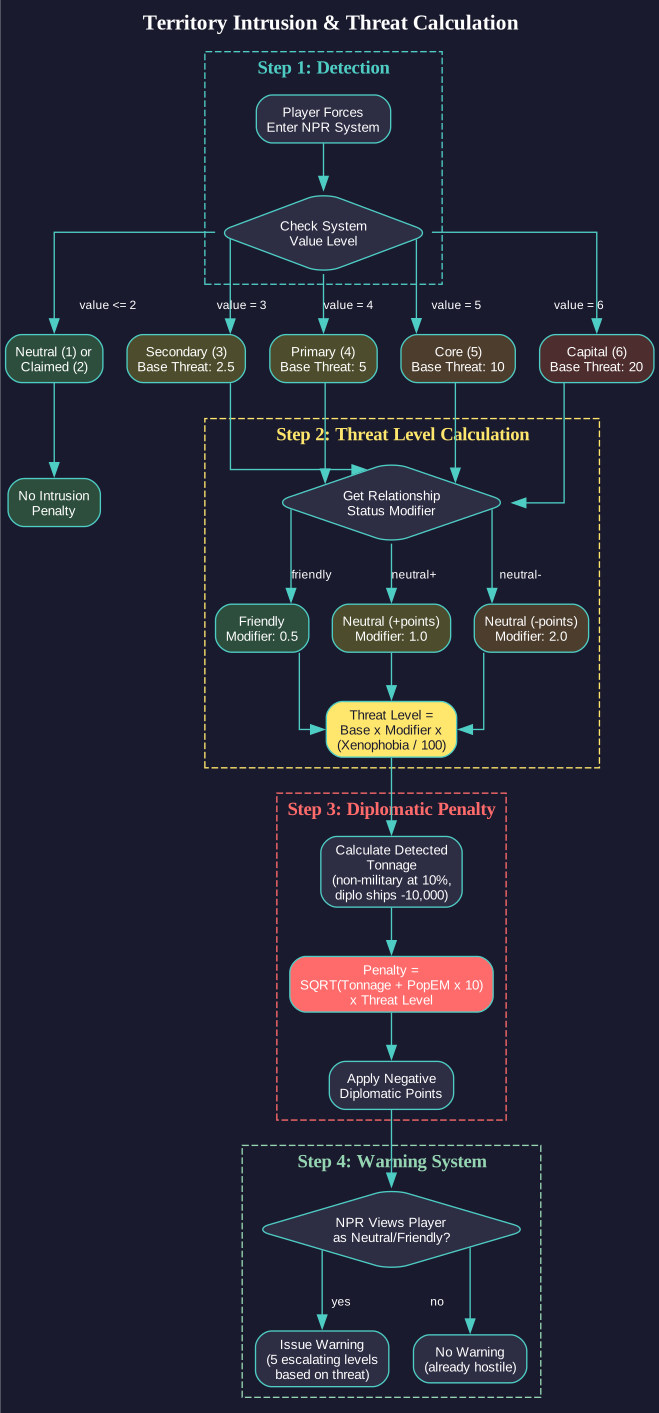
NPRs assign value levels to systems they consider part of their territory. When your forces enter these systems, the NPR’s response depends on the system’s importance, your relationship, and the size of your detected presence.
15.1.4.1 System Value Categories
NPRs categorize their systems using six value levels (from lowest to highest):
| Value Level | Numerical Value | Description |
|---|---|---|
| Neutral | 1 | No significant NPR interest |
| Claimed | 2 | NPR considers the system part of its sphere |
| Secondary | 3 | Moderate importance to the NPR |
| Primary | 4 | Significant strategic or economic value |
| Core | 5 | Critical system with major infrastructure |
| Capital | 6 | The NPR’s homeworld system |
Intrusion warnings are only generated for systems valued at Secondary (3) or higher. Systems valued as Neutral or Claimed do not trigger the intrusion mechanic.
15.1.4.2 Threat Level Calculation
When player forces or populations are detected in an NPR’s valued territory, the NPR calculates a threat level:
Threat Level = Base Threat Level x Status Modifier x (Racial Xenophobia / 100)
Base Threat Levels by System Value:
| System Value | Base Threat Level |
|---|---|
| Secondary | 2.5 |
| Primary | 5 |
| Core | 10 |
| Capital | 20 |
Status Modifiers:
| Relationship | Modifier |
|---|---|
| Friendly | 0.5 |
| Neutral (positive diplomatic points) | 1.0 |
| Neutral (negative diplomatic points) | 2.0 |
15.1.4.3 Diplomatic Penalty from Intrusion
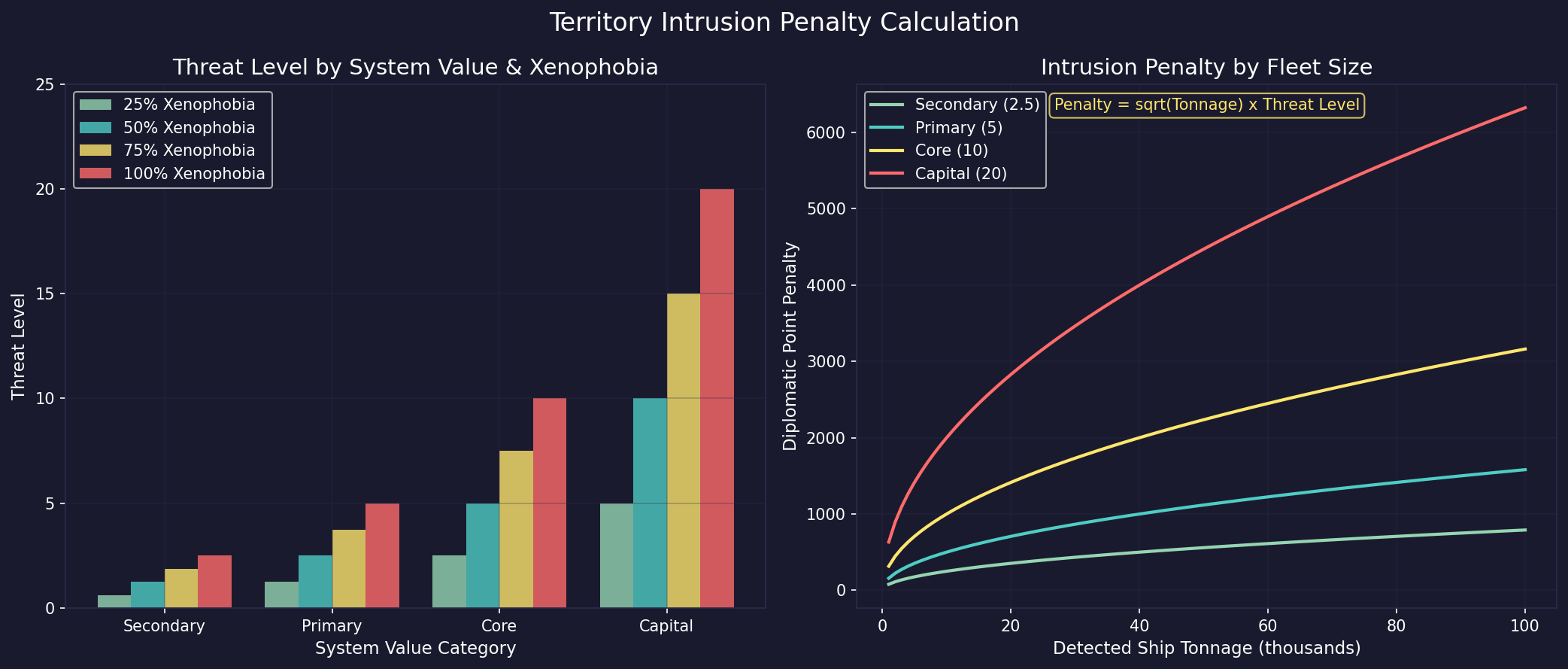
The intrusion penalty to diplomatic points is calculated as:
Diplomatic Point Penalty = SQRT(Total Detected Ship Tonnage + (Total Detected Population EM Signature x 10)) x Threat Level
Ship Tonnage Adjustments:
- Non-military vessels count at 10% of their normal tonnage
- Minimum tonnage is 1,000 tons if any ship is detected
- Diplomatic ships (those with Diplomacy Modules) receive a 10,000-ton deduction per system (unverified – #1257 – Section 15.4.4.3 states “per ship per system”; whether the deduction applies per ship or per system is unconfirmed)
Population EM Signature:
- Minimum 100 if any population is detected
- Population EM signature is multiplied by 10 for tonnage equivalency
15.1.4.4 Warning System
When viewing the player as neutral or friendly, the NPR issues warnings of escalating severity. Five warning levels exist, from mild suggestions to immediate departure demands. The severity of the warning corresponds to the calculated threat level.
15.1.4.5 Player Protection Status
Players can set protection statuses for their own systems to warn NPRs away:
| Protection Status | Demand Number | Demand Strength |
|---|---|---|
| No Protection | 0 | 0 |
| Suggest Leave | 1 | 1.00 |
| Request Leave | 1 | 1.41 |
| Request Leave Urgently | 1 | 1.73 |
| Demand Leave | 2 | 2.00 |
| Demand Leave with Threat | 2 | 2.24 |
The diplomatic relationship penalty from issuing demands is calculated as:
Relationship Penalty = (Demand Number^2) x (System Value^2) x (Xenophobia / 50)
15.1.4.6 Claim Acceptance Formula
An NPR will accept a withdrawal demand when:
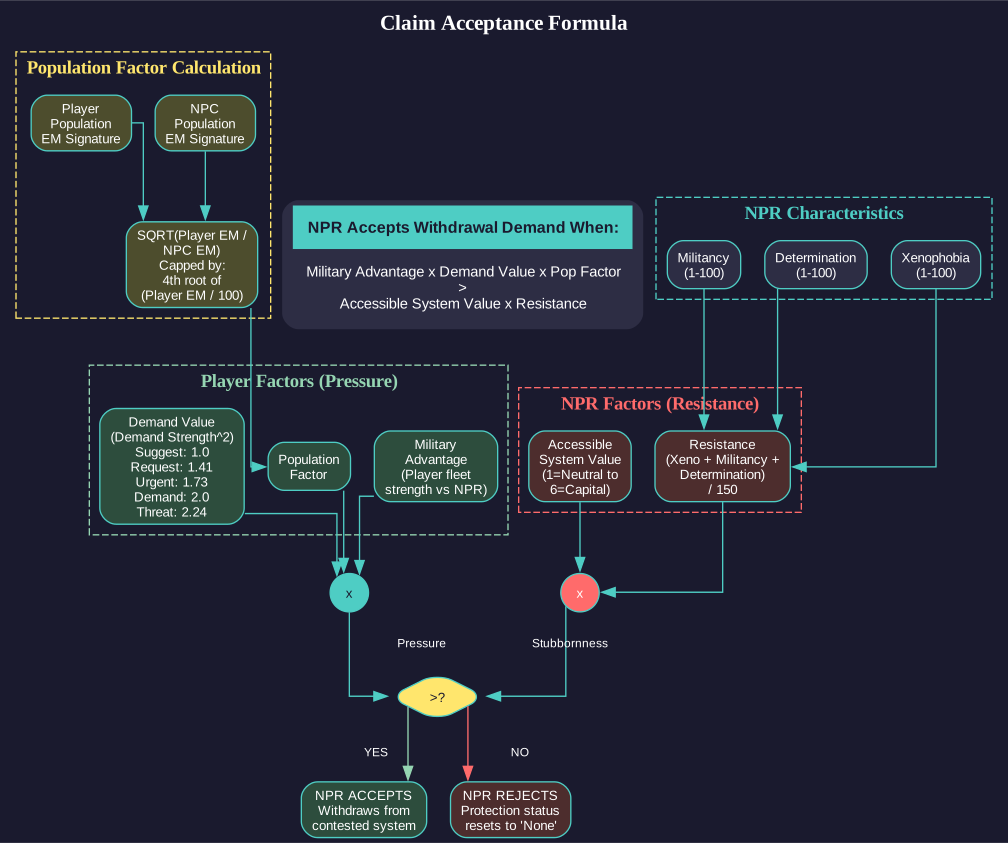
Military Advantage x Demand Value x Population Factor > Accessible System Value x Resistance
Key components:
- Population Factor: Calculated as
SQRT(Player EM Signature / NPC EM Signature), capped by the fourth root of(Player EM / 100). - Resistance:
(Xenophobia + Militancy + Determination) / 150
If an NPR rejects your demand, the protection status automatically resets to “No Protection,” preventing further diplomatic penalties until you reestablish a protection status.
15.1.4.7 NPR vs NPR Territory Claims
When two NPRs have competing territorial interests, the system operates as a hybrid of player-vs-NPR and NPR-vs-player mechanics:
- When NPR-A detects alien forces in a claimed system, it establishes a protection status matching the calculated threat level rather than sending direct messages.
- NPR-B evaluates withdrawal using the same acceptance formula as when responding to player demands.
- Key asymmetry: NPR-A suffers a diplomatic penalty for the intrusion detection, while NPR-B does not suffer a relationship penalty for rejecting the withdrawal demand. This prevents recursive relationship degradation between NPRs.
- If NPR-B rejects the demand, NPR-A’s protection status resets to “No Protection,” preventing compounding penalties.
This design enables NPRs to make competing territorial claims without mutual diplomatic collapse, allowing realistic geopolitical competition.
15.1.4.8 Restrictions on NPR Claims
NPRs will not make territorial claims in the following circumstances:
-
Capital System Protection: If the NPR and the alien race share a capital system, no claims will be made in the capital system or in any adjacent system. This creates a buffer zone preventing early territorial disputes around homeworlds.
-
Truce Countdown: NPRs will not make claims against races with whom they share a Fixed Relationship due to a Truce Countdown. The NPR will also ignore claims from such a race, and there will be no diplomatic penalty.
-
Population Threshold: The NPR will not claim a system if there are alien populations with a total EM signature greater than
10% x (Xenophobia / 100)of its own capital’s EM signature AND also greater than the total EM signatures of any NPR populations in that system. This creates a population-based deterrent.
Tip: Demanding that an NPR abandon what it regards as a primary system can work if you have a significant military advantage. However, be prepared for the diplomatic penalty if they refuse – and for the possibility of war if you press the issue with a highly militant race.
15.1.5 Diplomatic Points System
Updated: v2026.01.30
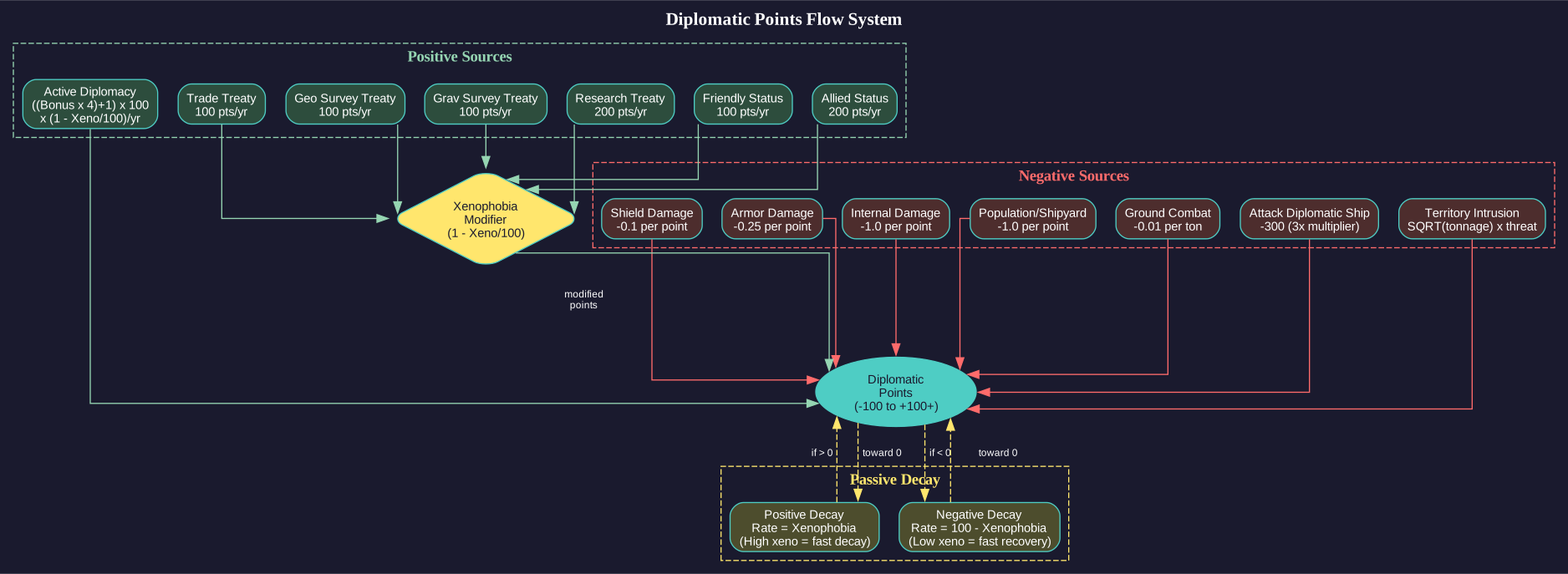
Diplomatic relations in Aurora C# are tracked through a numerical point system that determines your overall standing with each NPR. Points are generated actively through diplomatic engagement and passively through treaties and time.
15.1.5.1 Active Diplomacy Formula
When your diplomatic ships are in contact with an NPR, points are generated according to:
Points per Year = ((Diplomacy Bonus x 4) + 1) x 100 x (1 - (Target Xenophobia / 100))
\hyperlink{ref-15.1-3}{[3]}
For example, a commander with a 20% Diplomacy bonus operating against a race with 40% Xenophobia yields 108 diplomatic points annually.
Without a Diplomacy Module or commander bonus in any contact system, any positive gains are halved.
15.1.5.2 Treaty Point Generation
Active treaties generate diplomatic points per year, modified by the target race’s Xenophobia:
| Treaty/Status | Base Points per Year |
|---|---|
| Trade Agreement | 100 |
| Geological Survey Treaty | 100 |
| Gravitational Survey Treaty | 100 |
| Research Treaty | 200 |
| Friendly Status | 100 |
| Allied Status | 200 |
Applied modifier: Base x (1 - Xenophobia / 100)
15.1.5.3 Passive Point Decay
Without active contact, diplomatic points shift toward zero over time:
- Positive points decay at a rate determined by the observing race’s Xenophobia (higher Xenophobia = faster decay of positive feelings).
- Negative points decay at a rate determined by
(100 - Xenophobia)(lower Xenophobia = faster recovery from hostility).
15.1.5.4 Combat Diplomatic Penalties
Damage to NPR assets inflicts negative diplomatic points at the following rates:
| Damage Type | Points per Damage Point |
|---|---|
| Shield damage only (no armor penetration) | -0.1 |
| Armor damage (no internal damage) | -0.25 |
| Internal damage | -1.0 |
| Population/ground force/shipyard damage | -1.0 |
| Ground combat losses | -0.01 per ton destroyed |
A single point of damage drops relations to hostile (-100) if currently above that threshold, though subsequent non-interaction allows gradual recovery.
Attacks on diplomatic ships (those with Diplomacy Modules) receive a triple damage multiplier for diplomatic penalty calculations, regardless of whether the attacker recognizes the ship’s diplomatic status. Attacking a diplomatic ship without existing hostility results in a -300 relationship penalty (compared to the standard -100 for an unprovoked attack on a non-diplomatic vessel).
15.1.5.5 Relationship Thresholds
| Value Range | Status |
|---|---|
| Below -100 | Hostile |
| -100 to -25 | Unfriendly |
| -25 to +25 | Neutral |
| +25 to +75 | Friendly |
| Above +75 | Allied |
\hyperlink{ref-15.1-3}{[3]}
Tip: Diplomatic point generation is heavily penalized by the target’s Xenophobia. A race with 80% Xenophobia will generate diplomatic points at only 20% of the base rate from treaties and active diplomacy. Consider whether investing heavily in diplomacy with a highly xenophobic race is worth the effort, or whether military deterrence is a more practical strategy.
15.1.6 Intelligence Gathering (Summary)
Updated: v2026.01.30
Intelligence in C# Aurora is gathered through two passive methods: ELINT modules on ships and interrogation of survivors from destroyed vessels. For full details on both systems, see Section 15.5 Intelligence Gathering.
15.1.6.1 Key Points
- ELINT Modules: Ship-based Electronic Intelligence and Analysis Modules (10 HS, 15 crew, strengths 5-14) \hyperlink{ref-15.1-5}{[5]} passively gather intelligence at 1 point/day when in range of alien populations or active sensors. Modified by commander Intelligence bonus and target xenophobia.
- Prisoner Interrogation: Survivors from destroyed enemy ships provide intelligence points calculated as (Crew / 10) + (Rank^3). Modified by diplomatic relationship and language translation status.
- Racial Intelligence: Both sources contribute to a shared racial intelligence pool. At 100 accumulated points, automated checks can yield technologies, survey data, missile blueprints, or ship class details.
- No Active Espionage: C# Aurora has no active espionage missions, sabotage, or assassination operations. All intelligence gathering is passive and carries no diplomatic penalty.
15.1.7 Human NPRs
Updated: v2026.02.15
Human NPRs represent an optional feature allowing human populations to appear as non-player races in generated campaigns.
15.1.7.1 Activation
The feature is enabled through a game setting called “Human NPRs.” When active, newly generated NPRs (excluding starting NPRs) have a one-third probability of triggering a human species check.
15.1.7.2 Species Determination
The game defines “human” as the species of the oldest population belonging to the oldest player race. This allows players using non-human or modified human species to still encounter matching-species remnant populations as NPRs.
15.1.7.3 Key Characteristics
- Population Size: Human NPRs typically have about half the average population size of standard NPRs.
- Diplomatic Bonus: A +20 bonus to communication checks applies when two races share the same primary species, accelerating language development and diplomatic engagement.
- Habitat Requirements: Human NPRs only generate on worlds capable of supporting human life (matching the player species’ environmental requirements).
15.1.7.4 Campaign Context
This feature supports narratives depicting post-collapse galactic scenarios where a fallen human empire left scattered populations across distant systems. Players can roleplay as successor civilizations rediscovering these remnant communities. The diplomatic bonus makes peaceful integration more feasible than with fully alien NPRs.
15.1.8 Minor Races
Updated: v2026.02.15
Minor Races are a reduced-capability NPC faction type introduced in v2.4.0. They represent small civilizations that lack the ambition or capability for interstellar expansion.
15.1.8.1 Generation
The game setting “Minor Race % of New NPRs” (range 0-100%, default 25%) determines the probability that newly-generated Trans-Newtonian (TN) NPRs will be Minor Races rather than full-scale powers.
15.1.8.2 Key Characteristics
Minor Races have significantly reduced capabilities compared to standard NPRs:
- Population: Generated population is reduced by 75% compared to standard NPRs.
- Research Limitations: They will not research jump point theory and will not deploy gravitational survey or stabilization ships.
- Fleet Restrictions: Minor Races deploy very limited numbers of certain ship types, such as geological survey ships, diplomatic vessels, scouts, and tankers.
- Resource Dependency: They only deploy fuel harvesters and orbital miners when appropriate resources exist in their home system.
15.1.8.3 Expansion Constraints
The most significant limitation is their inability to expand beyond their home system independently. Minor Races can only leave their home system if another race builds a jump gate and the minor race detects a transit through it. This means they remain confined unless deliberately connected to the wider galaxy.
15.1.8.4 Strategic Role
Minor Races function as small NPRs without the threat of expansion. They offer:
- A different challenge level compared to major NPRs.
- Potential diplomatic partners or trade opportunities without the military threat.
- Systems to discover that contain civilizations but not aggressive competitors.
- Resources to contest on a local scale without triggering a galactic-level conflict.
UI References and Screenshots
Updated: v2026.02.15
- Diplomacy Window Layout — race relations, intelligence, and territory claims interface
Related Sections
- Section 2.1 New Game Options – Configuring NPR generation and game options at game start
- Section 11.1 Thermal and EM Signatures – How NPR ships and populations are detected
- Section 12.1 Fire Controls – Combat mechanics relevant to NPR engagements and diplomatic penalties
- Section 17.1 Geological Survey – Survey ships that trigger first contact encounters
- Appendix A: Formulas – Detailed formula references for diplomatic point calculations
- Appendix B: Glossary – Definitions of NPR, ELINT, and other key terms
- UI Reference: Diplomacy Window – Annotated interface diagram
References
\hypertarget{ref-15.1-1}{[1]}. Aurora C# game database (AuroraDB.db v2.7.1) – FCT_ShipDesignComponents. Diplomacy Module (ID 65902): Size=30.0 HS, Cost=300.0 BP, Crew=50. Minerals: Corbomite=150, Mercassium=75, Uridium=75.
\hypertarget{ref-15.1-2}{[2]}. Aurora C# game database (AuroraDB.db v2.7.1) – DIM_CommanderBonusType. Diplomacy (BonusID 17): Naval=1, Ground=0, MaximumBonus=1.5. Intelligence (BonusID 23): Naval=1, Ground=0. Both skills are naval-officer-only.
\hypertarget{ref-15.1-3}{[3]}. Aurora Forums – Steve Walmsley’s diplomacy and territory mechanics posts. Diplomatic point thresholds (Hostile below -100, Unfriendly -100 to -25, Neutral -25 to +25, Friendly +25 to +75, Allied above +75), active diplomacy formula, treaty point generation rates, combat damage penalties, territory intrusion mechanics, and claim acceptance formulas. (forum-sourced; specific post URLs unavailable)
\hypertarget{ref-15.1-4}{[4]}. Aurora C# game database (AuroraDB.db v2.7.1) – FCT_AlienRace table. Confirms DiplomaticPoints, TradeTreaty, TechTreaty, GeoTreaty, GravTreaty, AlienRaceIntelligencePoints, CommStatus, and CommModifier fields, validating the structural existence of these mechanics.
\hypertarget{ref-15.1-5}{[5]}. Aurora C# game database (AuroraDB.db v2.7.1) – FCT_ShipDesignComponents. Electronic Intelligence and Analysis Modules verified: Strength 5 (ID 65901) 10 HS/100 BP/15 crew; Strength 6 (ID 65903) 10 HS/120 BP; Strength 8 (ID 65904) 10 HS/160 BP; Strength 11 (ID 65905) 10 HS/220 BP; Strength 14 (ID 65906) 10 HS/280 BP. All 10 HS size, 15 crew.
\hypertarget{ref-15.1-6}{[6]}. Aurora Forums — http://aurora2.pentarch.org/index.php?topic=5114.0 — Steve Walmsley on NPR diplomatic behavior: “NPRs will create their own diplomatic teams to influence your perception of their Empire.” (VB6-era post ~2010; diplomacy system significantly redesigned in C# Aurora — requires verification #858)
\hypertarget{ref-15.1-7}{[7]}. Aurora Forums — https://aurora2.pentarch.org/index.php?topic=11220.0 — Community discussion on first contact strategies. NPRs prioritize homeland security and respond better to contact in outlying colonies than capital systems. Passive contact via transponder broadcast noted as alternative to active exploration.
\hypertarget{ref-15.1-8}{[8]}. Aurora C# game database (AuroraDB.db v2.7.1) – FCT_AlienRace table. RandomNameOrder field (INTEGER, default=1) controls whether NPR class names use randomized word order.