15.2 Communications
Updated: v2026.02.15

[Screenshot Pending — #1083] Diplomacy Window Communication Tab
Contents
Updated: v2026.02.15
- 15.2 Communications
15.2.1 Language Barriers
Updated: v2026.02.02
In Aurora C#, you cannot simply open a dialogue with an alien race the moment you discover them. A realistic language barrier exists that must be overcome through dedicated effort before meaningful diplomacy can begin.
15.2.1.1 Communication Rating
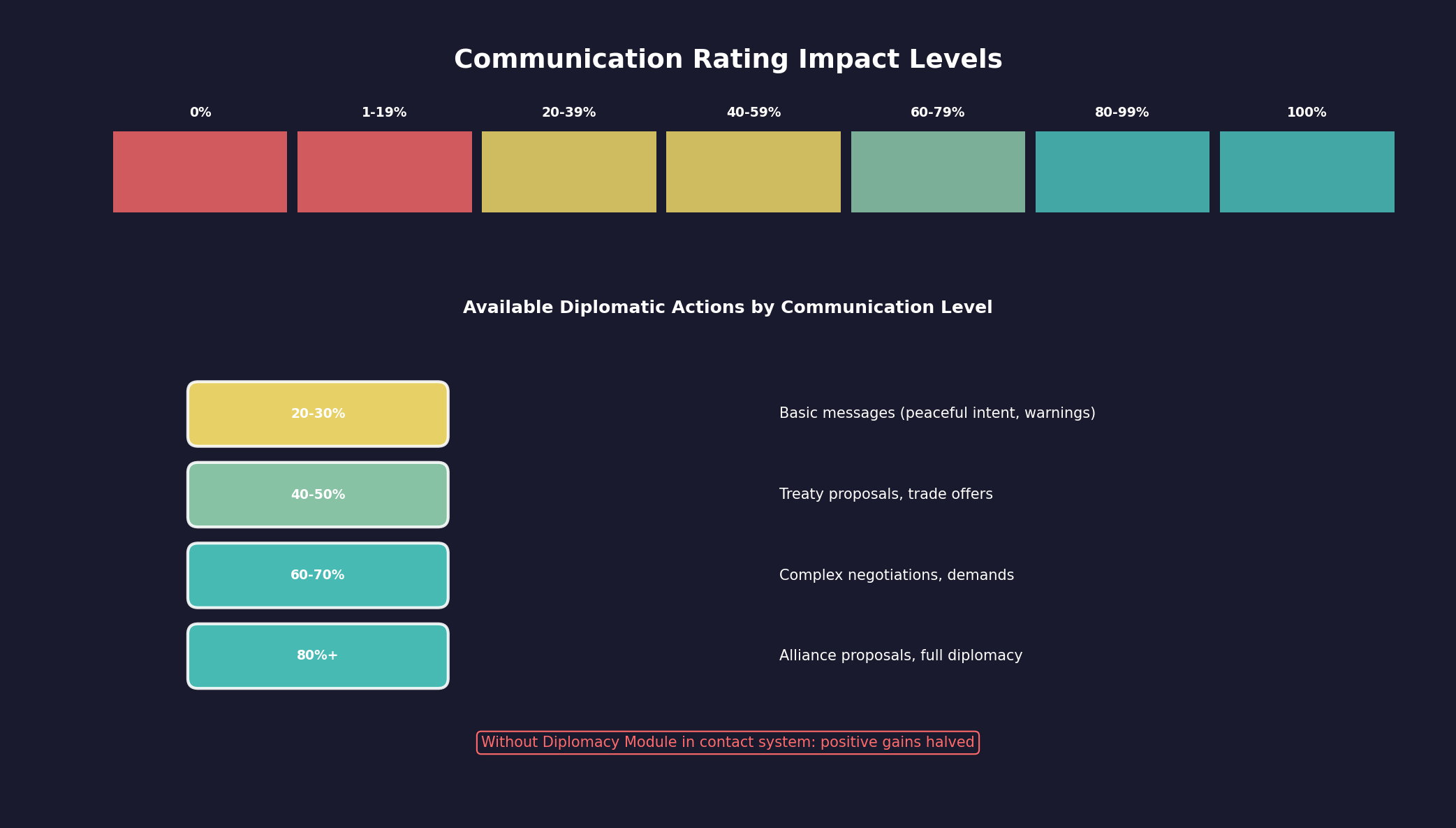
Your ability to communicate with each alien race is tracked as a percentage from 0% to 100%. This rating represents how well you understand their language and can make yourself understood:
- 0%: No communication possible. You can observe the aliens but cannot exchange any meaningful information.
- 1-19%: Extremely basic communication. Simple concepts like “stop” or “go away” might be conveyed, but misunderstandings are frequent.
- 20-39%: Basic communication. You can express simple intentions and understand broad responses, but nuance is lost.
- 40-59%: Functional communication. Diplomatic proposals can be made and understood, though complex negotiations remain difficult.
- 60-79%: Good communication. Most diplomatic options are available, and misunderstandings become rare.
- 80-99%: Excellent communication. Full diplomatic functionality with only occasional ambiguity.
- 100%: Perfect communication. Complete mutual understanding with no language barriers.
The communication rating directly affects which diplomatic options are available and the likelihood of diplomatic messages being correctly interpreted.
15.2.1.2 Building Communication
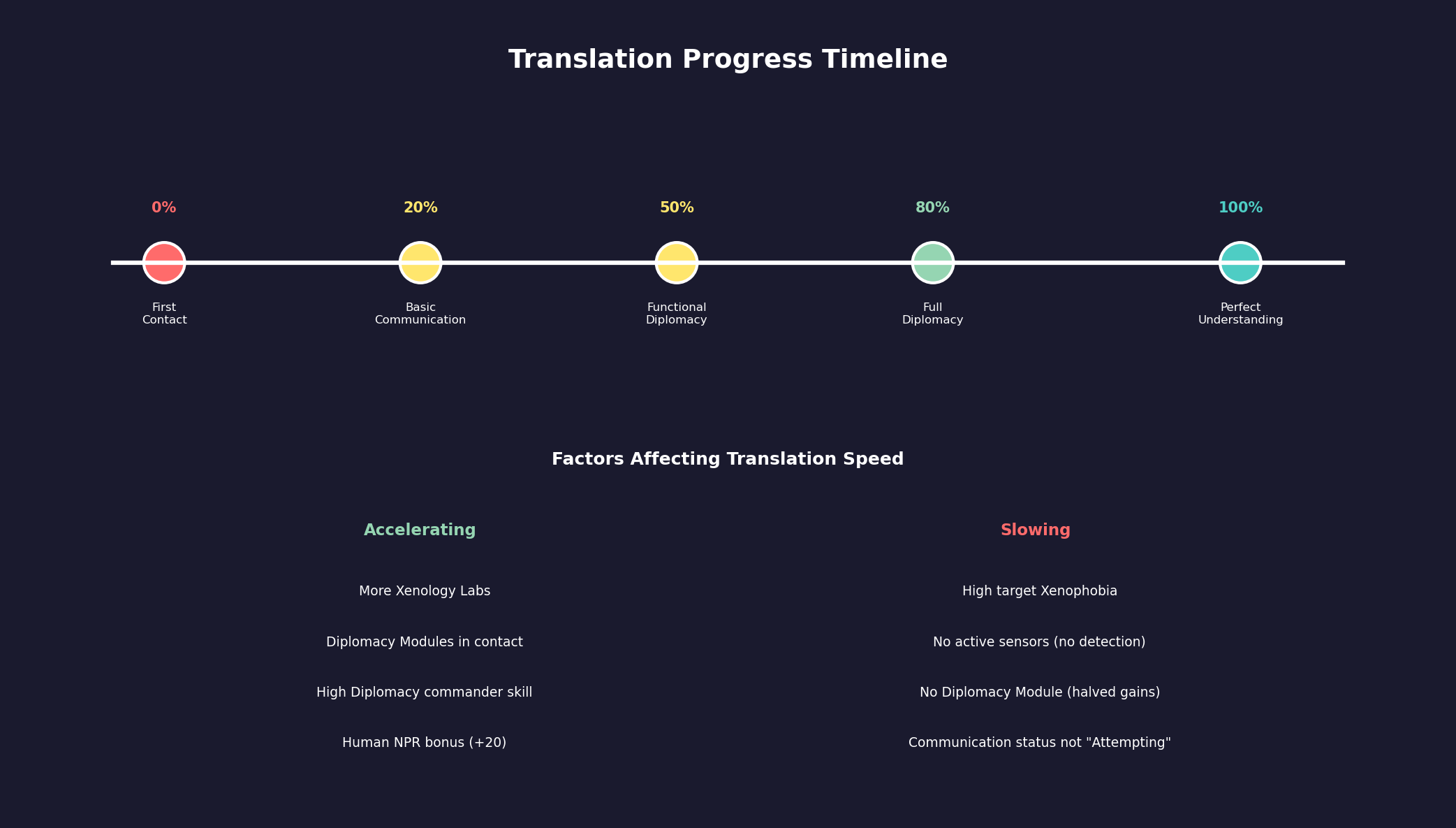
Communication ratings improve through several mechanisms:
- Xenology Labs: The primary method. Xenology labs (a type of research facility) are ground installations that work to decode alien languages. The more labs you have, the faster the rating increases. Each lab generates communication points per year toward understanding a specific race.
- Contact Time: Having ships in proximity to alien vessels or installations generates a small amount of passive communication progress, as your linguists can observe and analyze alien transmissions.
- Diplomacy Teams: Officers assigned to diplomatic roles can accelerate communication efforts based on their Diplomacy skill (naval officers only). \hyperlink{ref-15.2-2}{[2]}
- Communication Equipment: Ships can be equipped with specialized communication arrays that improve the rate of language acquisition during active contact.
15.2.1.3 Communication Technology
Several technologies affect your communication capabilities:
- Xenology: The base technology (see Section 7.1 Technology Tree) that enables construction of xenology labs. Higher levels improve lab efficiency.
- Alien Language Analysis: Improves the rate at which communication ratings increase.
- Universal Translator: Late-game technology that dramatically accelerates communication with all races.
Tip: Start building xenology labs early, even before you encounter aliens. When first contact does happen, you will want the infrastructure already in place to begin decoding their language immediately. The faster you can communicate, the better your chances of establishing peaceful relations before a misunderstanding triggers a war.
15.2.2 Communication Attempts
Updated: v2026.02.02
Before diplomatic relations can begin, both sides must actively attempt to communicate. This is not an automatic process – it requires deliberate effort and specific conditions.
15.2.2.1 Requirements for Translation Checks
Two key constraints must be met for translation attempts to occur:
-
Mutual Communication Status: Translation checks will only take place if both sides have a status of “Attempting Communication.” If either party has refused contact or has not set their status, no progress is made.
-
Physical Presence and Detection: Both factions require ships and/or populations in the same system, and both sides must be able to detect the other. The detection requirements are:
- Populations: Detected via thermal or EM sensors
- Ships: Detected via active sensors (see Section 11.1 Thermal and EM Signatures)
This means that interested parties must actively announce their presence and remain in contact for communication to progress. A ship running silently with sensors off will not contribute to translation attempts, as neither side can confirm the other’s presence.
15.2.2.2 Diplomacy Module Bonus
The highest Communication bonus from any commander operating a Diplomacy Module within contact systems enhances positive outcomes of translation checks. If no Diplomacy Module exists in any contact system, any positive gains from translation checks are halved.
This creates a strong incentive to maintain dedicated diplomatic vessels in systems where first contact has been made, rather than relying solely on ground-based xenology labs.
15.2.2.3 Strategic Implications
The communication system introduces realistic tension to first contact scenarios by requiring:
- Deliberate diplomatic intent from both parties (both must set “Attempting Communication”)
- Active sensor presence – you must be willing to reveal your own ships to make progress
- Committed station-keeping during communication windows – ships must remain in the system
- Specialized diplomatic infrastructure (Diplomacy Modules) for optimal results
Tip: If you discover an alien race and want to communicate, immediately set your status to “Attempting Communication” and ensure you have ships with active sensors in the system. The alien race may or may not reciprocate – a highly xenophobic race (Xenophobia 100) will automatically set themselves as hostile and refuse communication entirely.
15.2.2.4 Communication Framework
Added: v2.8.0
The communication system uses a structured framework to determine translation progress. Understanding this framework helps optimize diplomatic ship deployment and commander assignments. \hyperlink{ref-15.2-4}{[4]}
Contact Rating Calculation
The contact rating determines how effectively both races can make translation progress. It is calculated based on the following conditions:
| Condition | Contact Rating |
|---|---|
| Both races detect each other + diplomacy ship + commander bonus | 1 + commander bonus |
| Both races detect each other + diplomacy ship (no commander bonus) | 1.0 |
| Both races detect each other (no diplomacy ship) | 0.5 |
| Either race cannot detect the other | 0 |
Prisoner Processing Bonus: If you have captured prisoners from the target race, processing them adds to the contact rating:
- Bonus = processed prisoners / 200
- Maximum bonus from prisoners: +1.0
This means that even without a diplomatic ship, processing 200+ prisoners can provide the equivalent of a full commander bonus for translation progress.
Prisoner Processing and Communication
Added: v2.8.0
Prisoner processing operates differently depending on whether communication has been established with the prisoner’s race: \hyperlink{ref-15.2-5}{[5]}
Pre-Communication Processing:
- Up to 200 prisoners per colony are processed to aid communication attempts
- These prisoners contribute to the Contact Rating formula above
- No intelligence points are generated from pre-communication processing
- This represents linguistic analysis and cultural study rather than interrogation
Post-Communication Processing:
- Once communication is established, remaining prisoners are processed normally
- Standard interrogation rules apply, generating Race Intelligence Points
- Intelligence gain formula:
Crew / 10 + (Rank Number)³for any captured officers
Strategic Implications:
- Capturing alien crew early in first contact accelerates communication establishment
- The 200-prisoner threshold per colony means distributing prisoners across multiple colonies does not increase the communication bonus (each colony caps at +1.0)
- Prioritize establishing communication before processing large numbers of prisoners if intelligence gathering is your goal
Communication Roll Formula
Each communication attempt uses the following formula to determine progress:
Result = average translation skill + d100 + modifiers
Modifiers: | Condition | Modifier | |———–|———-| | Same species (e.g., human NPR) | +20 | | Spoiler races | -50 |
Roll Outcomes:
The roll result determines whether communication improves, degrades, or reaches a terminal state:
| Result | Outcome |
|---|---|
| >= 100 | Full communication established immediately |
| Positive | Communication rating improves |
| Negative | Communication rating decreases |
| <= -50 | Communication permanently impossible |
Critical Result: A roll result of 100 or higher immediately establishes full communication, bypassing the gradual progress system. This makes high-skill commanders valuable even early in first contact scenarios.
Permanent Failure: A roll result of -50 or lower permanently locks the communication status to “impossible.” This typically occurs when attempting communication with spoiler races (which have a -50 modifier) combined with low translation skill and an unlucky roll.
Progress Notifications
The game provides feedback on translation progress through event notifications:
| Notification | Condition |
|---|---|
| “significant progress” | Roll modification >= 10 |
| “glacial progress” | Positive modification < 10 |
| “communication attempts have failed” | Roll modification < -3 |
Note: “Glacial progress” notifications were added in v2.8.0 to provide feedback when translation is advancing slowly but still positively.
Strategic Implications
The communication framework rewards:
- High-skill Commanders: The translation skill directly adds to the roll, making skilled diplomats significantly more effective
- Diplomatic Ship Presence: Without a diplomacy module in the contact system, the contact rating is halved (0.5 vs 1.0+)
- Prisoner Acquisition: Processing prisoners provides a substantial bonus that stacks with commander skill
- Same-Species Contact: Human NPRs are 20 points easier to communicate with, making them significantly more likely to achieve breakthrough communication quickly
Warning: Avoid early communication attempts with spoiler races unless your translation skill is exceptionally high. The -50 modifier combined with a poor roll can permanently lock communication status before you have a chance to improve your capabilities.
15.2.3 Transponders
Updated: v2026.02.15
Transponders provide a mechanism for ships to broadcast their identity and affiliation to other races, affecting how they are perceived in diplomatic contexts.
15.2.3.1 Transponder Modes
Ships in Aurora C# operate transponders with three distinct modes:
| Mode | Visibility |
|---|---|
| Off | Ship identity is not broadcast; detection relies solely on sensors |
| Friendly | Transponder signal is only detected by Friendly or Allied races |
| All | Transponder signal is visible to all races, including hostile ones |
15.2.3.2 Default Settings
- Military Ships: Default transponder setting depends on player configuration and standing orders.
- Civilian Shipping: Civilian ships have transponders set to “Friendly” by default, meaning merchant vessels automatically broadcast their identity only to friendly and allied factions.
15.2.3.3 Diplomatic Implications
Transponder settings interact with the diplomacy system in several ways:
- Ships broadcasting transponders are easier to identify, which can prevent accidental hostilities between non-hostile races.
- Setting transponders to “All” when entering a neutral race’s territory demonstrates transparency and may reduce the perceived threat level (since the NPR can confirm the ships are non-military or diplomatic in nature).
- Running with transponders off in another race’s territory may increase suspicion if the ships are otherwise detected by sensors.
15.2.3.4 NPR Transponder Behavior
NPR transponder usage is not explicitly documented in the game mechanics, but observed behavior suggests the following:
- Default Off: NPR military ships generally operate with transponders off, requiring player sensors to detect them (unverified — #705)
- Civilian Traffic: NPR civilian shipping may broadcast transponders to friendly races, similar to player civilian ships (unverified — #705)
- Detection Reliance: Players should not rely on transponder broadcasts to detect NPR presence – active and passive sensors remain the primary detection method (see Section 11.1 Thermal and EM Signatures)
This behavior means that first contact with NPRs typically occurs through sensor detection rather than transponder identification. Your survey ships may detect an NPR’s thermal or EM signature before any transponder broadcast reveals their identity or affiliation.
15.2.4 Diplomatic Ships
Updated: v2026.02.02
A diplomatic ship is any vessel equipped with a Diplomacy Module. These ships serve as the primary tool for active diplomatic engagement with alien races.
15.2.4.1 The Diplomacy Module
- Size: 30 HS (Hull Spaces) (see Section 8.1 Design Philosophy)
- Cost: 300 BP (Build Points)
- Crew: 50
- Required Minerals: Corbomite (150), Mercassium (75), Uridium (75) (see Appendix D: Reference Tables)
- Availability: Starting technology for both TN (Trans-Newtonian) and conventional starts
\hyperlink{ref-15.2-1}{[1]}
The Diplomacy Module is a dedicated component that enables communication attempts and diplomatic influence operations. It is the foundational requirement for effective diplomacy.
15.2.4.2 Identification and Communication
When a diplomatic ship engages in diplomacy or communication attempts, the opposing race learns specific information about the source:
- If the ship appears on enemy sensors: The ship’s parent class becomes flagged as diplomatic, and the ambassador’s (commander’s) name is revealed to the other race.
- If the ship does not appear on sensors: Only the signal’s location is communicated – this may be identified as a system body, jump point, or specific space coordinates, but the ship class and commander remain unknown.
This means that diplomatic ships operating in stealth may still conduct translation attempts, but the other race will not know who is communicating with them.
15.2.4.3 Enhanced Protection Status
Diplomatic ships receive special consideration in the diplomatic penalty system:
- Triple Damage Multiplier: When an NPR’s diplomatic ship is damaged, the diplomatic penalty is tripled compared to damage against a standard vessel, regardless of whether the attacking race recognizes the ship’s diplomatic status.
- Unprovoked Attack Penalty: Attacking a diplomatic ship without existing hostility results in a -300 relationship penalty, compared to the standard -100 for an unprovoked attack on a non-diplomatic vessel.
- Universal Application: These enhanced penalties apply even if the attacker did not know the ship was diplomatic. The diplomatic status is inherent to the ship’s design, not dependent on recognition.
15.2.4.4 Tonnage Deductions for Territory Intrusion
Diplomatic ships receive a favorable adjustment in the territory intrusion calculation (see Section 15.1 Alien Races):
- Each diplomatic ship receives a 10,000-ton deduction from the total detected ship tonnage used to calculate the intrusion diplomatic penalty.
- This means that small diplomatic vessels may effectively generate no intrusion penalty at all, while larger fleets accompanied by diplomatic ships have their calculated threat reduced.
15.2.4.5 Role in Active Diplomacy
Diplomatic ships with assigned commanders generate diplomatic points through the Active Diplomacy formula:
Points per Year = ((Diplomacy Bonus x 4) + 1) x 100 x (1 - (Target Xenophobia / 100))
The commander’s Diplomacy bonus is the key variable. The highest Communication bonus from any commander operating a Diplomacy Module within contact systems is used for translation checks. Without any Diplomacy Module in a contact system, positive diplomatic gains are halved.
15.2.4.6 Ship Transfer Mechanics
Added: v2.6.0
When ships change ownership through diplomatic transfer or capture, trade goods are automatically removed from the vessel. This applies to:
- Diplomatic Gifts: Ships transferred to another race as part of diplomatic agreements lose all trade goods in their cargo holds.
- Captured Vessels: Ships captured in combat or through boarding actions have trade goods stripped during the ownership change.
This mechanic prevents exploitation of trade good values through inter-empire transfers and ensures that trade goods remain tied to domestic economic activity. When planning diplomatic ship gifts, account for the loss of any cargo value.
15.2.4.7 Design Considerations
When designing diplomatic ships, consider:
- Speed: Diplomatic ships need to reach first contact locations quickly (see Section 8.3 Engines). A fast diplomatic courier can be invaluable.
- Sensors: Active sensors allow the diplomatic ship to detect alien vessels, satisfying the mutual detection requirement for communication attempts.
- Endurance: Diplomatic missions may require extended time in a system. Adequate fuel and maintenance supplies are important.
- Defense: While not warships, diplomatic ships are high-value targets. Some defensive capability or escort arrangements are prudent.
- Stealth vs. Visibility: A diplomatic ship that cannot be detected can still attempt communication, but the other race will not know who is speaking. Visible diplomatic ships establish clearer diplomatic channels.
Tip: The 10,000-ton deduction per diplomatic ship for intrusion calculations means that sending a small diplomatic vessel into an NPR’s territory generates significantly less diplomatic friction than sending a warship of equivalent size. A dedicated diplomatic corvette of 10,000 tons or less could enter NPR space with effectively zero intrusion penalty from the ship itself.
15.2.5 Diplomacy Window
Updated: v2026.02.02
The Diplomacy window is your primary interface for managing relationships with alien races. It is accessed from the main toolbar and provides a comprehensive view of your diplomatic status and available actions.
15.2.5.1 Window Layout
The Diplomacy window is organized into several sections:
- Race List: The left panel displays all known alien races. Selecting a race shows detailed information in the other panels.
- Relationship Status: Shows the current diplomatic standing (hostile, unfriendly, neutral, friendly, allied) along with the numerical relationship value.
- Communication Level: Displays the current communication rating as a percentage.
- Treaty Status: Lists any active treaties between you and the selected race.
- Action Panel: Provides buttons for available diplomatic actions based on your communication level and current relationship.
15.2.5.2 Relationship Values
The diplomatic relationship is tracked as a numerical value that determines the overall standing:
| Value Range | Status | Description |
|---|---|---|
| Below -100 | Hostile | Active conflict likely or in progress |
| -100 to -25 | Unfriendly | Tensions high, limited diplomatic options |
| -25 to +25 | Neutral | No strong feelings either way |
| +25 to +75 | Friendly | Positive relations, most options available |
| Above +75 | Allied | Strong partnership, full cooperation |
Relationship values shift based on diplomatic actions, treaty compliance, military encounters, territorial disputes, and trade interactions. See Section 15.1.5 Diplomatic Points System for detailed point generation and decay mechanics.
15.2.5.3 Available Actions
Depending on your communication level and current standing, the following actions may be available:
- Propose Treaty: Offer a treaty of a specific type (see Section 15.3 Treaties).
- Offer Trade: Propose a trade agreement for minerals or technology.
- Send Message: Transmit a diplomatic message expressing intent.
- Issue Demand: Make a specific demand of the alien race.
- Set Protection Status: Establish territorial protection levels for your systems (see Section 15.1 Alien Races).
- Declare War: Formally declare hostilities (always available regardless of communication level).
- Sue for Peace: Attempt to end an active conflict.
15.2.5.4 Relationship Modifiers
Many in-game events affect relationship values:
- Positive: Successful treaties (see Section 15.3 Treaties), trade, non-aggression in shared space, active diplomacy with diplomatic ships, providing aid.
- Negative: Ships in their territory without permission (scaled by tonnage and system value), military buildups near their borders, treaty violations, attacking their assets (scaled by damage type), attacking diplomatic ships (triple penalty).
Tip: Monitor relationship values carefully. A slow decline from neutral toward unfriendly often precedes an NPR deciding to attack. If you see the trend, address it diplomatically before it reaches the point of no return.
15.2.6 Boarding Combat Intelligence
Updated: v2026.02.15
Boarding combat provides a unique opportunity for intelligence gathering beyond the tactical objectives of capturing enemy vessels.
15.2.6.1 Alien Portrait Revelation
When boarding combat occurs between two races, both participants gain visual intelligence about the other \hyperlink{ref-15.2-3}{[3]}:
- The alien race portrait becomes visible to both the boarding race and the boarded race
- This occurs regardless of which side wins the boarding action
- The portrait remains permanently visible in the Diplomacy window after the encounter
- This represents the close-quarters encounter revealing what the other species looks like
Strategic Implications:
- Boarding operations, even unsuccessful ones, provide intelligence value
- Races that have never established communication can still learn each other’s appearance through combat
- This mechanic reflects the inevitable information exchange that occurs during physical contact between species
For boarding combat mechanics, see Section 13.3 Ground Combat.
15.2.7 Messages and Demands
Updated: v2026.02.15
Once you have achieved sufficient communication with an alien race, you can exchange diplomatic messages and make demands. NPRs will also send you messages and demands of their own.
15.2.7.1 Sending Messages
Diplomatic messages allow you to express intent without formal treaty negotiations:
- Peaceful Intent: Signal that you have no hostile intentions. Can help improve relations with nervous NPRs.
- Territorial Claim: Assert ownership of a system or region. NPRs may respect this or ignore it depending on their disposition.
- Warning: Advise the NPR to withdraw from a contested area. May be effective against less aggressive races.
- Threat: Promise military action if demands are not met. Can backfire with aggressive races who view threats as provocation.
Messages require a minimum communication level to send (typically 20-30%) and a higher level for the nuance to be properly conveyed. Sending a complex diplomatic message with low communication may result in misinterpretation.
15.2.7.2 Receiving Messages
NPRs will send you messages expressing their own intentions and demands. These appear in your event log and should be taken seriously:
- Greeting: A neutral or friendly contact message. Usually a good sign.
- Warning: The NPR is unhappy about something – often your ships in their space. The severity corresponds to the threat level calculated from your presence (see Section 15.1 Alien Races).
- Demand: The NPR wants something specific from you. Compliance improves relations; refusal may worsen them.
- Ultimatum: A serious threat usually backed by military force. Ignoring this often leads to war.
- Declaration of War: Hostilities have begun. This is not a negotiating position.
15.2.7.3 Making Demands
You can make specific demands of alien races through the protection status system:
- Suggest Leave: Mild request with minimal diplomatic impact (Demand Strength 1.0).
- Request Leave: Firmer request (Demand Strength 1.41).
- Request Leave Urgently: Emphatic request (Demand Strength 1.73).
- Demand Leave: Formal demand (Demand Strength 2.0).
- Demand Leave with Threat: Strongest demand with implied military action (Demand Strength 2.24).
The likelihood of an NPR complying with demands depends on the Claim Acceptance Formula (see Section 15.1 Alien Races):
- Your military advantage relative to theirs
- The demand strength value
- Your population presence relative to theirs
- The NPR’s Resistance value (derived from Xenophobia + Militancy + Determination)
- The system’s value to the NPR
15.2.7.4 NPR Demands
NPRs will also make demands of you through escalating warning levels when you intrude into their valued territory. You can choose to comply or refuse:
- Compliance: Removes your ships from the system, eliminating the intrusion penalty and preserving relations.
- Refusal: The NPR’s threat level and diplomatic penalty continue to accumulate each increment check. However, if the NPR values the system only as Secondary, the penalty may be manageable.
- Military Presence: Maintaining a superior military force in the system may eventually cause the NPR to accept your presence, particularly if your military advantage outweighs their resistance.
Tip: When an NPR makes a demand, evaluate the system’s value to them and your military advantage. Demanding withdrawal from a Capital system (Base Threat Level 20) is a much more serious diplomatic event than the same demand regarding a Secondary system (Base Threat Level 2.5). The diplomatic penalty scales quadratically with the system value.
Related Sections
- Section 8.1 Design Philosophy – Designing diplomatic ships with Diplomacy Modules
- Section 11.1 Thermal and EM Signatures – Detection requirements for communication attempts
- Section 16.2 Skills and Bonuses – Officer Diplomacy skill affecting communication rates
- Section 9.1 Shipyards – Organizing diplomatic fleets and standing orders
- Appendix A: Formulas – Diplomatic point calculation formulas
References
\hypertarget{ref-15.2-1}{[1]}. Aurora C# game database (AuroraDB.db v2.7.1) – FCT_ShipDesignComponents. Diplomacy Module (ID 65902): Size=30.0 HS, Cost=300.0 BP, Crew=50. Minerals: Corbomite=150, Mercassium=75, Uridium=75. All values confirmed.
\hypertarget{ref-15.2-2}{[2]}. Aurora C# game database (AuroraDB.db v2.7.1) – DIM_CommanderBonusType. Diplomacy (BonusID 17): Naval=1, Ground=0. Communications (BonusID 22): Naval=1, Ground=0. Both are naval-only skills with MaximumBonus=1.5.
\hypertarget{ref-15.2-3}{[3]}. Aurora Forums, “v2.7.0 Changes List” (aurora2.pentarch.org/index.php?topic=13814.0) – Boarding combat reveals alien race portraits to both sides
\hypertarget{ref-15.2-4}{[4]}. Aurora Forums – Steve Walmsley post, January 31, 2026 – Communication framework mechanics: contact rating calculation, communication roll formula, and notification tiers
\hypertarget{ref-15.2-5}{[5]}. Aurora Forums – Steve Walmsley post, February 2, 2026 – v2.8.0 Changes List thread: Pre-communication prisoner processing (up to 200 per colony) aids communication attempts without generating intelligence points