6.5 Civilian Economy
Updated: v2026.02.15

[Screenshot Pending — #1091] CMC Management Tab showing civilian mining
[Screenshot Pending — #1086] Civilian Shipping Lines Window
Aurora C# features an autonomous civilian economy that operates alongside your government-controlled military and industrial operations. Civilian entities build ships, establish mining colonies, and run trade routes without direct player orders. Understanding how to encourage and leverage the civilian sector is key to efficient empire management.
Contents
Updated: v2026.02.15
- 6.5 Civilian Economy
- Contents
- 6.5.1 Civilian Shipping Lines
- 6.5.1.1 Game Settings
- 6.5.1.2 Shipping Line Names
- 6.5.1.3 How They Form
- 6.5.1.4 What They Do
- 6.5.1.5 Income Model (v2.6.0 Overhaul)
- 6.5.1.6 Trade Route Algorithm
- 6.5.1.7 Civilian Repairs (updated v2.1.1)
- 6.5.1.8 Movement Restrictions
- 6.5.1.9 Range and Jump Gate Requirements
- 6.5.1.10 Subsidizing Shipping Lines
- 6.5.1.11 Civilian Ship Construction
- 6.5.1.12 Ship Selection Rules (v2.6.0)
- 6.5.1.13 Ship Retirement and Lifecycle
- 6.5.1.14 Civilian Contract Standing Order (v2.8.0)
- 6.5.1.15 Civilian Ship Types
- 6.5.1.16 Civilian Fuel Harvesting Economics
- 6.5.1.17 Encouraging Civilian Growth
- 6.5.2 Civilian Mining
- 6.5.2.1 Establishment Mechanics
- 6.5.2.2 Location Selection Criteria
- 6.5.2.3 Scoring and Selection
- 6.5.2.4 Mining Company Names
- 6.5.2.5 Highlighted Civilian Mining Colonies
- 6.5.2.6 Expansion of Existing Colonies
- 6.5.2.7 Key Design Differences from VB6
- 6.5.2.8 Benefits of Civilian Mining
- 6.5.2.9 Limitations
- 6.5.2.10 CMC Management Tab
- 6.5.3 Civilian Destinations
- 6.5.4 Managing Civilians
- Related Sections
- References
6.5.1 Civilian Shipping Lines
Updated: v2026.02.01
Civilian shipping lines are autonomous companies that build and operate commercial vessels within your empire. They appear naturally as your civilisation develops.
6.5.1.1 Game Settings
Two game-creation flags control civilian shipping behaviour:
- Active Civilian Shipping Lines: When disabled, shipping lines will not produce ships
- Civilian Harvesters: When disabled, shipping lines will not build fuel harvesters
6.5.1.2 Shipping Line Names
Players can rename shipping lines to give their civilian fleets distinct identities:
- Select the “Admin Command” representing the shipping line in the Naval Organization window
- Choose the Rename option
- The system requires two distinct name inputs:
- A full name for the shipping line itself (e.g., “Evenson Interstellar Logistics”)
- A short name designation used for ship naming purposes (e.g., “EIL”)
This dual-name approach allows for both formal organizational naming and practical abbreviated designations used in vessel nomenclature, distinguishing between multiple shipping lines and the vessels operating under each.
6.5.1.3 How They Form
- Civilian shipping lines begin forming once your empire reaches a certain level of development (typically when you have multiple colonies with significant population) (unverified — #707 – formation threshold not directly confirmed in DB)
- New shipping lines appear periodically as your economy grows (unverified — #707)
- Each shipping line operates independently, building ships and establishing routes based on economic opportunity
- The number of active shipping lines scales with your empire’s overall economic development (unverified — #707)
6.5.1.4 What They Do
Civilian shipping lines perform several valuable functions:
- Cargo Transport: They move minerals, supplies, and goods between your colonies, supplementing (or replacing) your government freighter fleet
- Passenger Transport: They move population between colonies, helping to distribute citizens to where they are needed. Civilian shipping detects bodies with work-generating installations and autonomously transports workers there
- Trade: They generate wealth through commercial trade operations between colonies
- Infrastructure Production & Delivery: Civilians produce infrastructure for colonies that need it (colony cost > 0) and deliver it free of charge to the government. Production rate equals 2x population in millions per year. (unverified — #707 – production rate formula from changelog) This generates wealth for the shipping line while costing the player nothing. They also transport existing infrastructure (both normal and LG-Infrastructure), matching the correct type to the destination body.
- Fuel Harvesting: They can build and operate fuel harvesters at gas giants (if the game setting is enabled)
Warning: If you accidentally deploy work-generating installations (e.g., fuel refineries, mines) to an unprepared body, civilian fleets will autonomously begin moving population there because they detect available work. This can create unintended colonies on bodies without proper infrastructure support. Correct installation placement mistakes quickly before civilian population transfers begin. See also Section 6.2.3 Automated Mines for deployment procedures.
6.5.1.5 Income Model (v2.6.0 Overhaul)
As of v2.6.0, shipping line income is based on distance traveled rather than fixed amounts. The income per unit per billion km (updated in v2.7.0 with a 50% increase):
| Activity | Rate per unit per billion km |
|---|---|
| Colonist transport | 0.00015 per colonist |
| Passenger transport | 0.006 per passenger |
| Trade goods | 0.375 per trade good |
| Cargo transport | 0.00015 per cargo point |
\hyperlink{ref-6.5-5}{[5]}
Tax System: A configurable tax rate (0-100%) can be applied to shipping line profits, providing government revenue from civilian activity.
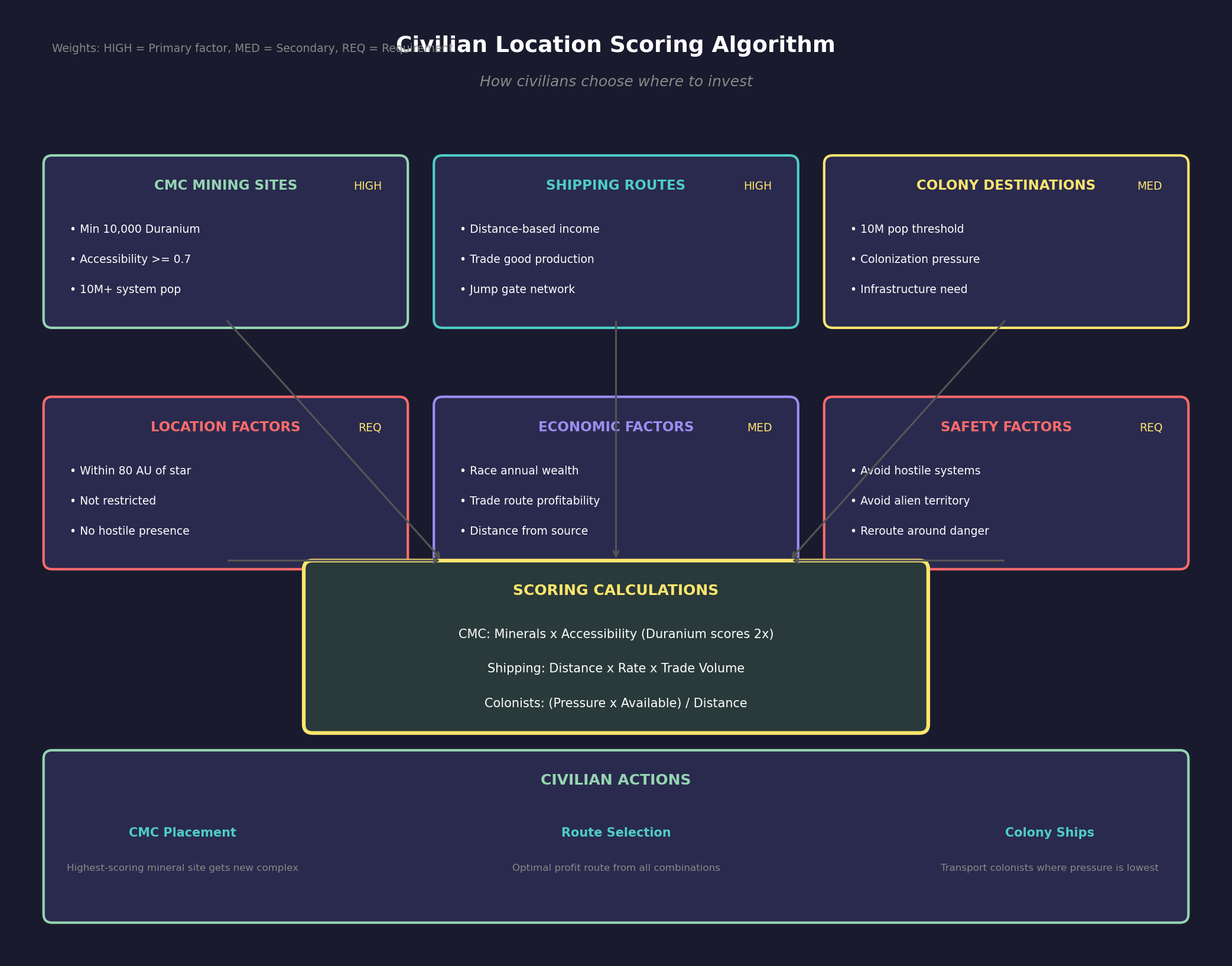
Colonization Pressure: Population willingness to emigrate is now determined by a colonization pressure mechanic based on colony cost, radiation levels, infrastructure availability, overcrowding, and protection levels. Colonists are drawn from a restricted pool rather than an unlimited supply, and shipping lines no longer deliver colonists to high-pressure (undesirable) colonies.
Colonist Generation Formula: (unverified — #707 – formula from changelog)
Available Colonists = (Construction Phase Length / Year) * Population * Colonization Pressure
NPR Shipping Lines (v2.7.0): NPR shipping lines are reduced to one freighter and one colony ship per 200 million population (down from 100 million). Harvesters are removed for NPRs. NPR payment modifier is 0.5x. \hyperlink{ref-6.5-6}{[6]}
6.5.1.6 Trade Route Algorithm
The C# civilian trade algorithm is significantly improved over VB6. Freighters without active orders search known space systematically:
- Identify the closest population with export trade goods, accounting for other freighters already en route
- Find the nearest population requiring that trade good as an import
- If no suitable destination exists, check other trade goods, then expand to next-closest populations
- The system checks every possible combination of populations and trade good routes in known space
Infrastructure transport is prioritised before other trade goods, and routes include Lagrange point shortcuts where beneficial.
6.5.1.7 Civilian Repairs (updated v2.1.1)
Civilian ships have a simplified repair mechanic:
- Instant Repair in Orbit: Civilian ships instantly repair themselves if they are in orbit of a population with shipyards. (unverified — #707 – instant repair mechanic from changelog) This abstraction avoids requiring player-owned shipyard facilities or explicit civilian shipyard structures.
- Deep Space Stranding: As of v2.1.1, when civilian ships become stranded without movement capability, they are transferred to their parent player race for potential recovery or abandonment. The player can then choose to:
- Retrieve and repair the ship for its own operational use
- Abandon the vessel entirely
- NPR Behavior: Non-player races handle repairs identically, maintaining their own shipyard infrastructure for repair operations.
The stranding scenario is rare, justifying the abstracted approach rather than implementing full civilian shipyard mechanics.
6.5.1.8 Movement Restrictions
Systems and populations can be flagged to restrict civilian movement:
- System-Level Restriction: The “Military Restricted” flag prevents all civilians from entering that system
- Population-Level Restriction: The “Military Restricted” flag on a population prevents civilians from visiting that specific colony
- Alien-Controlled Systems: Civilians automatically avoid systems flagged as alien-controlled
- Hostile Fleet Presence: Civilian pathfinding accounts for danger when selecting routes. A hostile fleet positioned in a system or at a jump point causes civilian ships to reroute around the threat, effectively creating a trade blockade without requiring any formal blockade mechanic. This means an enemy can cut off civilian trade to a colony simply by stationing warships along the route, even without engaging any ships. See Section 10.2.6 Blockade and Jump Point Denial for the military perspective on blockades.
Behavioural Responses: When restrictions are activated or danger is detected, existing civilian operations are disrupted immediately. Any colony ships en route are diverted to other destinations. Freighters en route abandon their cargo and seek new trade runs. Players receive a warning popup before confirming manually-set restricted status.
Design Note: Restrictions could theoretically enable players to exercise direct control over civilian colonization by restricting all systems except desired targets. Since Aurora already permits exploitation through various means, enforcement of roleplay-appropriate civilian restrictions is left to player discretion.
6.5.1.9 Range and Jump Gate Requirements
Civilian ships require Jump Gates for inter-system travel – they will never build jump-capable ships or use Jump Tenders. \hyperlink{ref-6.5-7}{[7]} Shipping range is unlimited in C# Aurora, though distance-based income mechanics mean longer routes are more profitable.
Jump Gate Network Implications:
- All civilian inter-system shipping requires a complete Jump Gate network (gates on both sides of each jump point)
- Civilian ships cannot cross ungatted jump points under any circumstances
- Distance-based income means longer routes generate more wealth for shipping lines
- Civilian ships will avoid dangerous systems, potentially routing around threats via longer paths
(Community Tip) Prioritize gating strategic routes early to enable civilian logistics. The civilian economy cannot serve colonies cut off by ungated jump points, regardless of distance.
6.5.1.10 Subsidizing Shipping Lines
Shipping lines require wealth to build new ships and maintain operations. When a shipping line lacks funds – particularly early in the game or after losses – you can inject wealth directly.
Subsidize Button:
- Located in the Civilian Economy tab of the Economics window
- Each click of the Subsidize button adds 1,000 wealth to the selected shipping line’s coffers \hyperlink{ref-6.5-8}{[8]}
- Multiple clicks can provide larger subsidies as needed
- The wealth is deducted from your government treasury
When to Subsidize:
- Early game when shipping lines have just formed and lack capital for their first ships
- After wartime losses when a shipping line needs to rebuild its fleet
- When you want to accelerate civilian ship construction for a specific line
- Ship build cost equals the ship’s BP (Build Points) in wealth, so a 5,000 BP freighter costs 5,000 wealth to construct (unverified — #707 – wealth-based build cost from changelog)
(Community Tip) A few early subsidies of 5,000-10,000 wealth can dramatically accelerate your civilian economy. The return on investment is substantial – civilian ships provide free logistics indefinitely once built.
6.5.1.11 Civilian Ship Construction
- Civilian shipping lines build their own ships at commercial shipyards (unverified — #707)
- They pay for construction using their own profits (this does not cost you minerals or wealth directly); the build cost equals the ship’s Build Points in wealth (unverified — #707)
- Ship designs are generated automatically based on available technology and commercial needs
- Naming Convention: Civilian ships use a letter-number designation where the number indicates the commercial engine technology level installed (e.g., “C1” = first-generation commercial engines, “C8” = eighth-generation). This allows players to identify the tech level of civilian ships at a glance without inspecting individual designs
- Civilian ships use commercial engines (larger but cheaper than military engines; see Section 8.3 Engines) and do not carry weapons (unverified — #707)
- Civilian ships cannot build jump-capable ships; inter-system civilian shipping requires a Jump Gate network (see Section 4.4 Jump Points) (unverified — #707)
- Over time, civilian fleets can become quite large, providing substantial logistical capacity
6.5.1.12 Ship Selection Rules (v2.6.0)
Shipping lines prioritize ship type selection based on fleet size:
- When below six civilian ships or when all existing orders are assigned, shipping lines prioritize freighters and colony ships
- Otherwise, they randomly select from permitted ship types with specific weighting for liners and harvesters
6.5.1.13 Ship Retirement and Lifecycle
Civilian shipping lines manage their fleet age through a retirement system (updated v2.7.0):
- The retirement flag persists in the database, allowing ships to retire after completing current orders
- Ships are selected for retirement based on being the oldest ship of the same type, with a minimum age of 10 years \hyperlink{ref-6.5-9}{[9]}
- All civilian ships are scrapped when they reach 15 years old, regardless of condition \hyperlink{ref-6.5-10}{[10]}
- This ensures civilian fleets gradually adopt newer technology as it becomes available
6.5.1.14 Civilian Contract Standing Order (v2.8.0)
A fleet standing order allows player-controlled fleets to seek and fulfill civilian contracts, effectively turning government ships into supplementary civilian haulers. (unverified — #707 – standing order mechanics from v2.8.0 changelog)
How It Works:
- Assign the “Civilian Contract” standing order to a fleet with cargo capacity (see Section 9.4 Fleet Organization for fleet order assignment)
- The fleet automatically picks up and delivers cargo using the same route-finding algorithm as civilian freighters
- Functions identically to civilian contract fulfillment (same routes, same cargo types)
Key Differences from Civilian Operations:
- No payment received: Government fleets fulfill contracts at no charge (civilians earn income for the same work)
- Own fuel: The fleet consumes its own fuel reserves rather than being self-sustaining
- Refuelling: The fleet refuels at colonies or ships designated as “Destination for Automated Refuel” in the fleet order system
When to Use:
- During wartime when civilian shipping has been disrupted or destroyed
- When civilian capacity is insufficient for a rapid buildup at a new colony
- To supplement logistics to frontier colonies that civilians may not reach efficiently
- When you need guaranteed delivery of critical cargo that civilians may deprioritize
6.5.1.15 Civilian Ship Types
- Freighters: Carry minerals, installations, and trade goods between colonies
- Colony Ships: Transport population to new or growing colonies
- Fuel Tankers: Move fuel between production sites and consumers
- Fuel Harvesters: Harvest Sorium from gas giants (if enabled)
- Luxury Liners: Transport passengers between colonies (rare)
6.5.1.16 Civilian Fuel Harvesting Economics
Civilian fuel harvesters operate at gas giants with Sorium. The economics work as follows:
- Refuelling Cost: Military ships refuelling from civilian harvesters pay 1 wealth per 10,000 litres of fuel \hyperlink{ref-6.5-12}{[12]}
- Tax Revenue: Excess fuel produced by civilian harvesters generates tax revenue at 20% of the fuel price \hyperlink{ref-6.5-12}{[12]}
- This provides a self-sustaining fuel infrastructure that generates wealth rather than consuming it
6.5.1.17 Encouraging Civilian Growth
You can accelerate civilian economy development by:
- Establishing multiple colonies (more trade endpoints = more opportunity)
- Building commercial shipyards (civilian lines need yards to build ships)
- Maintaining safe shipping lanes (civilian ships avoid dangerous areas)
- Developing colony infrastructure (more developed colonies attract more trade)
- Having a stable economy (wealth and mineral availability influence civilian confidence)
Tip: The civilian economy is essentially free logistical capacity. Every ton of cargo moved by civilian ships is a ton your government freighters do not need to haul. Invest in commercial shipyard capacity early and the civilian sector will eventually handle most of your routine logistics.
6.5.2 Civilian Mining
Updated: v2026.02.02
In addition to trade, civilian entities can establish their own mining colonies on resource-rich bodies within your empire. The C# system uses a probability-based algorithm to determine when and where new mining complexes appear.
6.5.2.1 Establishment Mechanics
Civilian mining colonies are created through an automated system checked each construction phase:
Eligibility: A race must have at least two colonies with population or infrastructure to be eligible for civilian mining.
Probability Check: Each construction phase, the system rolls 1-50,000 against: (unverified — #707 – probability check from changelog)
Annual Wealth x (Construction Phase Seconds / Year Seconds)
For example, a race with 20,000 wealth during a five-day construction cycle needs to roll under 274 (approximately 0.55% chance per cycle). \hyperlink{ref-6.5-1}{[1]} Wealthier empires generate civilian mining colonies more frequently.
6.5.2.2 Location Selection Criteria
Potential civilian mining sites must meet all of the following requirements:
- Minimum Duranium: At least 10,000 tons of Duranium present \hyperlink{ref-6.5-11}{[11]}
- Minimum Accessibility: At least 0.7 accessibility rating \hyperlink{ref-6.5-11}{[11]}
- System Population: Located in a system with a population of 10 million or more \hyperlink{ref-6.5-11}{[11]}
- Distance from Star: Less than 80 AU from the parent star \hyperlink{ref-6.5-11}{[11]}
Note: CMC spawn distance from the star is calculated using the body’s aphelion (farthest orbital distance), not its current orbital position. \hyperlink{ref-6.5-13}{[13]}
- Multi-Star Systems: If orbiting a non-primary star, that star must be within 80 AU of the primary or connected via Lagrange Points (unverified – changelog does not specify Lagrange Point exception)
6.5.2.3 Scoring and Selection
Each qualifying location receives a score based on:
- Total minerals with accessibility of 0.5 or higher
- Duranium scores double in the calculation
- The highest-scoring location receives the new mining complex
This scoring system ensures civilians prefer locations with both good accessibility AND valuable mineral diversity, with a bias toward Duranium-rich sites.
6.5.2.4 Mining Company Names
Civilian mining operations receive procedurally generated company names:
- The system combines a family name from the racial naming theme with a company designation (e.g., “Smith Minerals & Ores” or “Jones Resources Group”)
- Applied automatically when civilian mining companies are created
- The company name becomes the population name for the mining outpost
- Purely cosmetic with no gameplay impact, but serves to differentiate civilian mining settlements visually
Population names remain separate from system body names. The Economics window provides an option to display both names when they differ, allowing players to track locations by either designation.
6.5.2.5 Highlighted Civilian Mining Colonies
Civilian mining colonies from which the player purchases minerals receive special visual highlighting:
- Light blue colouring is applied to colonies actively selling minerals to the player
- This highlighting does not apply if the colony has a population greater than zero, as green text is used instead for populated colonies
- The feature provides quick visual identification of active mineral suppliers within the game interface
6.5.2.6 Expansion of Existing Colonies
For each existing civilian mining colony, a similar probability check is made each construction phase to determine if an additional mining complex is added to that colony:
- The expansion roll is 1-100,000 (half the probability of new colony establishment) (unverified — #707 – expansion probability from changelog)
- This allows established civilian mining sites to grow over time
6.5.2.7 Key Design Differences from VB6
The C# civilian mining system is more location-agnostic than VB6:
- It prevents high-population systems from blocking better mining sites elsewhere
- The 10 million population threshold for system eligibility aligns with civilian destination mechanics
6.5.2.8 Benefits of Civilian Mining
- High Production Rate: Each Civilian Mining Complex produces at 10x the rate of a single government mine (100 tons/year at base tech vs 10 tons/year per mine) \hyperlink{ref-6.5-2}{[2]}. This makes even a few civilian mining complexes a significant source of minerals.
- Free Mineral Income: Minerals extracted by civilian mines cost you nothing to produce
- No Workers Required: Civilian Mining Complexes do not require workers to operate \hyperlink{ref-6.5-2}{[2]}
- Broader Coverage: Civilians exploit deposits you may have overlooked
- Automatic Transport: Civilian freighters handle mineral transport from civilian mines
- Empire Mining Tab: Civilian mining production appears alongside government mining in the Economics window
6.5.2.9 Limitations
- You cannot directly control where civilians choose to mine
- Civilian mining output is generally smaller than a dedicated government mining colony
- Civilians may not prioritise the minerals you most urgently need
- New colony probability is wealth-dependent – poor empires generate fewer civilian mines
- Requires minimum infrastructure (10M+ population in the system, 10,000+ Duranium at 0.7+ accessibility)
Tip: Civilian mining is a wealth-driven bonus that grows with your economy. The wealthier your empire, the more frequently new civilian mining colonies appear. Maintain good survey coverage and keep systems safe to maximise civilian mining opportunities. Since Duranium scores double in site selection, civilians will naturally gravitate toward your most structurally important mineral deposits.
6.5.2.10 CMC Management Tab
Added: v2026.01.28
The Economics window includes a dedicated CMC Management tab for monitoring and managing Civilian Mining Complexes across your empire. \hyperlink{ref-6.5-4}{[4]}
Tab Contents:
The CMC Management tab displays system-level logistics for civilian mining operations:
- Active Colonies: Lists all civilian mining colonies currently operating in each system
- Available Sites: Shows eligible mining locations that meet civilian establishment criteria but do not yet have complexes
- Blocked Sites: Identifies potential mining sites that are currently unavailable (e.g., due to hostile presence, restricted status, or unmet prerequisites)
- Financial Data: Displays revenue and operational costs associated with civilian mining activities
This centralised view allows players to track civilian mining expansion across their empire without manually inspecting individual systems or colonies. The tab complements the existing civilian mining information shown in the Empire Mining tab by providing operational and logistical context rather than raw production figures.
6.5.3 Civilian Destinations
Updated: v2026.02.15
The civilian destination system determines where civilian shipping lines send population and trade goods. Understanding this system helps you guide civilian development.
6.5.3.1 Population Threshold
In C# Aurora, the threshold for player control over civilian destinations has been lowered to the lower of 10 million or half the system body’s capacity (down from 25 million in VB6). (unverified — #707 – threshold from changelog)
6.5.3.2 Automatic vs. Player-Controlled Destinations
Below the threshold (automatic):
- Populations function as automatic destinations requiring no player input (unverified — #707)
- Civilian shipping lines service these colonies without intervention (unverified — #707)
- All trade goods become available at the 10 million population level
Above the threshold (player-controlled):
- Players gain control over colony designation options (unverified — #707 – designation controls from community knowledge):
- Destination for colonists: The colony will receive civilian population transfers
- Source of colonists: The colony will send population to other destinations
- Neither: The colony is excluded from civilian population movement
6.5.3.3 Destination and Stable Status
Colonies transition between two key states that control civilian population transfers:
Destination Status:
- The colony actively receives civilian colonist shipments
- Civilian colony ships will route population here from source colonies
- Set via the colony designation controls in the Economics window (Population & Production tab)
- Requires the colony to have reached the 10 million population threshold (or half system body capacity, whichever is lower)
Stable Status:
- Stops automated civilian population transfers to this colony
- The colony retains all other civilian activity (trade goods, freight, mining)
- Use this when a colony has reached its desired population level and you want colonists directed elsewhere
- Toggle in the same colony designation interface where Destination is set
Toggling Between States:
To change a colony’s status, open the Economics window, select the colony, and use the population designation controls. The Destination checkbox enables or disables civilian colonist deliveries. Unchecking it effectively sets the colony to Stable – civilian trade continues but population transfers stop.
(Community Tip) Set established colonies to Stable once they reach your target workforce level. This prevents civilian shipping from sending excess colonists to fully-developed worlds when newer colonies need the population more.
6.5.3.4 Population Thresholds and Trade
Key population levels affect civilian economic behaviour:
| Threshold | Effect |
|---|---|
| 10,000 | Infrastructure trade goods become available |
| 3 million | Basic trade goods unlock (Textiles, Machinery, Construction Materials) |
| 5 million | Additional trade goods unlock (Precious Metals, Consumer Electronics, Pharmaceuticals, etc.) |
| 10 million | Colony becomes eligible as civilian destination; remaining trade goods unlock (Spices, Luxury Food, Wines, etc.) |
| 25 million | Trade goods production becomes viable for sustained commercial routes (unverified – #1257) |
Trade goods begin unlocking as early as 10,000 population, with most basic goods available at 3-5 million and all standard goods available at 10 million (see Section 5.2.4.2 Population Milestones for the full verified breakdown). At 25 million, the colony produces enough trade goods volume that civilian freighters consistently service it, generating meaningful wealth for shipping lines.
6.5.3.5 Design Rationale
The 10 million threshold was chosen to align with:
- The point at which civilians begin considering mining colony creation in the same system
- The expanded universe layout in C# Aurora, where populations develop more slowly due to altered jump point generation
- The original 25 million threshold was considered impractical for C# gameplay pacing
6.5.3.6 Trade Goods
Per the database, trade goods have varying population thresholds (0.01M, 3M, 5M, and 10M – see Section 6.4.3 for the complete table). \hyperlink{ref-6.5-3}{[3]} The highest-tier goods (Entertainment Products, Furs, Luxury Food, Recreational Drugs, Spices, Wines) unlock at 10 million population, while many goods become available at lower thresholds.
6.5.4 Managing Civilians
Updated: v2026.02.15
While the civilian economy operates autonomously, the player has several indirect tools to influence and benefit from civilian activity.
6.5.4.1 Installation Transport Contracts
Civilians transport installations for player races using a distance-based pricing model:
Cost Formula:
Cost = 5 x Number of Installations x Systems Travelled x (Installation Type Cargo Points / 25,000)
Example: Moving one Construction Factory (25,000 cargo points) four systems away costs 20 wealth: 5 x 1 x 4 x (25,000 / 25,000) = 20. Same-system destinations count as half a system in calculations.
Pathfinding: Civilian ships apply the same intelligence to installation transport as they do for trade goods. The system prioritises player contracts before seeking trade opportunities, allowing players to commandeer civilian shipping during emergencies, though this disrupts normal civilian operations and infrastructure movement.
Management Interface: The Civilian Economy tab in the Economics window features three lists:
- Left panel: Available installations for transport
- Centre panel: Demanded installations at destination colonies
- Right panel: Currently supplied installations in transit
Players can set supply and demand contracts with Amount columns showing required quantities and Assigned columns tracking active freighter contracts.
Civilian Economy Controls:
- Commercial Shipyard Priority: You can prioritize civilian construction orders at your commercial shipyards. Government orders can be set to take priority, or you can allow civilians to use excess capacity. (unverified — #707 – priority controls from community knowledge)
- Subsidies: You can subsidize shipping lines via the Subsidize button (1,000 wealth per click) to accelerate fleet growth. See Subsidizing Shipping Lines above for details.
- Shipping Line Contracts: Civilian shipping can be contracted for specific government tasks (troop transport, mineral hauling) at a wealth cost.
Monitoring the Civilian Economy:
The civilian economy status is visible in several game windows:
- Civilian Shipping Lines: Shows all active shipping lines, their fleet sizes, and current operations.
- Civilian Trade Routes: Displays active trade routes and their income.
- Civilian Mining: Lists active civilian mining colonies and their output.
- Civilian Fleet: Shows all civilian ships, their types, locations, and current orders.
Protecting Civilian Assets:
Civilian ships and colonies are vulnerable to attack. Player responsibilities include:
- Providing military escorts in potentially dangerous systems.
- Maintaining sensor coverage (see Section 11.1 Thermal and EM Signatures) to detect threats before they reach trade lanes.
- Garrisoning systems with civilian mining colonies.
- Responding quickly to distress signals from civilian ships under attack.
- Clearing hostile forces from systems before civilian traffic resumes.
Civilian Economy and Expansion:
The civilian economy naturally supports expansion:
- When you establish a new colony, civilian shipping lines begin servicing it (assuming safe routes exist).
- As colonies grow, civilian trade income increases.
- Civilian population transport can supplement your colony ships.
- In mature empires, the civilian economy can handle the majority of inter-colony logistics, freeing your government ships for military purposes.
Civilian Economy Pitfalls:
- Over-reliance: Do not depend entirely on civilian logistics for critical military supply chains. Civilians may reroute away from dangerous areas precisely when you need supplies most.
- Shipyard Competition: Civilian orders at commercial shipyards compete with government orders. If you need a freighter urgently, civilian orders may delay it.
- Vulnerability: A single raider in a trade lane can devastate civilian shipping, cutting off colony supply lines. Maintain patrol coverage.
- Uncontrollable Priorities: Civilians optimise for profit, not for your strategic needs. They may ignore critical mineral shortages in favour of more profitable routes.
Warning: The civilian economy is a powerful ally but an unreliable one in wartime. Maintain enough government logistical capacity to sustain critical operations independently of civilian trade. Use the civilian economy as a peacetime efficiency multiplier, not a strategic dependency.
Related Sections
- Section 6.4 Wealth and Trade – Trade goods, revenue, and wealth mechanics
- Section 6.2 Mining – Government mining compared to civilian mining complexes
- Section 9.1 Shipyards – Commercial shipyards used by civilian shipping lines
- Section 4.4 Jump Points – Jump gate networks required for inter-system civilian trade
- Section 14.2 Maintenance – Government freight operations supplementing civilian transport
- Section 5.1 Establishing Colonies – Creating new civilian trade and mining destinations
References
\hypertarget{ref-6.5-1}{[1]} Verified mathematically: 20,000 wealth x (5 days x 86,400 sec/day) / (365.25 days x 86,400 sec/day) = 20,000 x 0.01369 = 273.8, rounds to 274. Probability: 274/50,000 = 0.548% per cycle. Confirms the worked example.
\hypertarget{ref-6.5-2}{[2]} AuroraDB.db: DIM_PlanetaryInstallation “Civilian Mining Complex” (ID 39) shows Workers=0.0 (no workers required), MiningProductionValue=10.0 (10 mine-equivalents). Note: each complex produces at 10x the rate of a single conventional mine.
\hypertarget{ref-6.5-3}{[3]} AuroraDB.db: DIM_TradeGoods table confirms trade goods have 4 distinct population thresholds (0.01M, 3M, 5M, 10M), not a single unified 10M threshold. See Section 6.4.3 reference [5] for complete breakdown.
\hypertarget{ref-6.5-4}{[4]} Aurora Forums — https://aurora2.pentarch.org/index.php?topic=13884.msg176533 — Steve Walmsley, January 24, 2026
\hypertarget{ref-6.5-5}{[5]} Aurora Forums v2.7.0 Changes List — https://aurora2.pentarch.org/index.php?topic=13814.0 — Income rates per billion km: colonists 0.00015, passengers 0.006, trade goods 0.375, cargo 0.00015 (50% increase from v2.6.0 baseline rates).
\hypertarget{ref-6.5-6}{[6]} Aurora Forums v2.7.0 Changes List — https://aurora2.pentarch.org/index.php?topic=13814.0 — NPR shipping lines: one freighter and colony ship per 200M population (down from 100M), harvesters removed, 0.5x payment modifier.
\hypertarget{ref-6.5-7}{[7]} AuroraWiki Commercial Shipping — https://aurorawiki2.pentarch.org/index.php?title=Commercial_Shipping — “As of v7.0, Shipping range is unlimited.” Civilian ships never build jump-capable vessels; inter-system trade requires Jump Gates.
\hypertarget{ref-6.5-8}{[8]} Aurora Forums — https://aurora2.pentarch.org/index.php?topic=11099.0 — Subsidize button adds 1,000 wealth per click from government treasury to shipping line coffers.
\hypertarget{ref-6.5-9}{[9]} Aurora Forums v2.7.0 Changes List — https://aurora2.pentarch.org/index.php?topic=13814.0 — Ships must be “constructed at least ten years previously” before becoming retirement candidates.
\hypertarget{ref-6.5-10}{[10]} AuroraWiki Commercial Shipping — https://aurorawiki2.pentarch.org/index.php?title=Commercial_Shipping — “All civilian ships will be scrapped when they reach 15 years old.”
\hypertarget{ref-6.5-11}{[11]} Aurora Forums v2.7.0 Changes List — https://aurora2.pentarch.org/index.php?topic=13814.0 — Civilian mining location criteria: minimum 10,000 Duranium, 0.7+ accessibility, 10M+ system population, within 80 AU of parent star.
\hypertarget{ref-6.5-12}{[12]} AuroraWiki C-Civilian Economy — Civilian harvester refuelling costs 1 wealth per 10,000 litres. Excess fuel sold to private sector generates tax revenue at 20% of fuel price.
\hypertarget{ref-6.5-13}{[13]} Aurora Forums — Steve Walmsley (developer), September 2025 — CMC spawn distance check uses aphelion distance, not current orbital position.