15.4 Diplomacy
Updated: v2026.02.15

[Screenshot Pending — #1108] Protection Status Selection Interface
Contents
Updated: v2026.02.15
- 15.4 Diplomacy
- Contents
- 15.4.1 Diplomatic Status Levels
- 15.4.2 Communication and First Contact Protocols
- 15.4.3 Trade Treaties and Their Effects
- 15.4.4 Military Access Agreements
- 15.4.5 How Diplomatic Status Affects Gameplay
- 15.4.6 Managing Relations with NPR
- 15.4.7 Diplomatic Incidents and Their Effects
- 15.4.8 Fixed Relationships and Truces
- 15.4.9 NPR Military Aid Processing
- Related Sections
- References
15.4.1 Diplomatic Status Levels
Updated: v2026.01.30
Diplomacy in Aurora C# governs how your empire interacts with NPRs (Non-Player Races) and, in multiplayer, with other human players. The diplomatic system uses a numerical point value to determine your relationship status with each race, which in turn controls what actions are available and how the AI responds to your presence.
15.4.1.1 Relationship Status Hierarchy
Your standing with each alien race falls into one of five categories, determined by your accumulated diplomatic points:
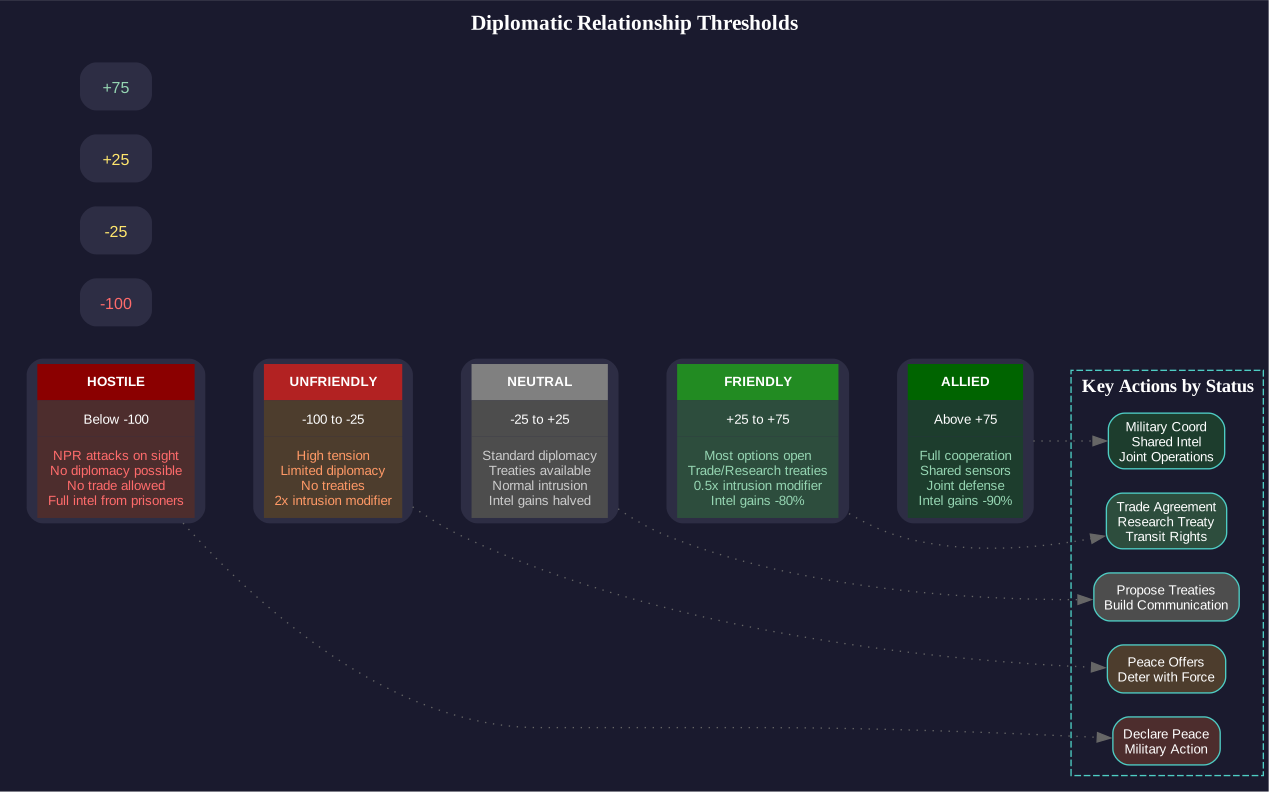
| Diplomatic Points | Status | Description |
|---|---|---|
| Below -100 | Hostile | Active conflict. The race treats you as an enemy. Military action is expected. |
| -100 to -25 | Unfriendly | High tensions. Limited diplomatic options. The race is suspicious and may be preparing for conflict. |
| -25 to +25 | Neutral | No strong feelings either way. The default starting position for most first contacts. |
| +25 to +75 | Friendly | Positive relations. Most diplomatic options are available. Trade and cooperation are possible. |
| Above +75 | Allied | Full partnership. Maximum cooperation, shared intelligence, and mutual defence commitments. |
\hyperlink{ref-15.4-3}{[3]}
15.4.1.2 Status Effects on Gameplay
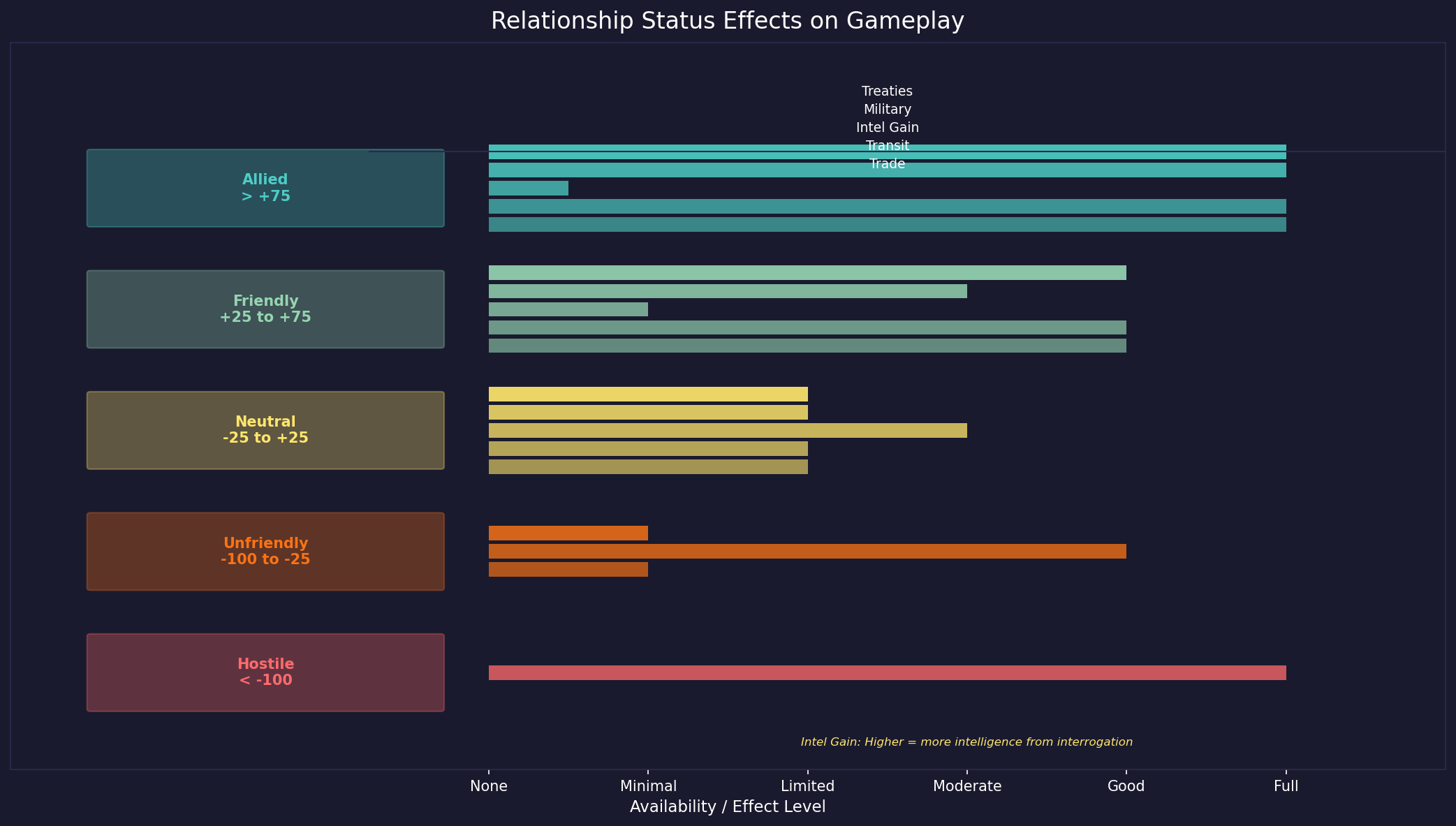
Each diplomatic status level affects multiple gameplay systems:
Hostile:
- NPR fleets will attack your ships on sight.
- No diplomatic communication is possible (though you can still declare peace).
- Trade is impossible.
- The NPR actively builds military forces against you.
- Interrogation of captured crew yields full intelligence (no relationship reduction).
Unfriendly:
- NPR may not attack immediately but is preparing for potential conflict.
- Limited diplomatic actions available (primarily peace offers).
- No trade or treaties possible.
- The NPR views your ships in their territory with extreme suspicion.
- Intrusion penalties are calculated with a 2.0 status modifier.
Neutral:
- Standard diplomatic interactions available.
- Treaties can be proposed (subject to communication level requirements).
- Ships in their territory generate intrusion penalties scaled normally.
- The NPR evaluates your actions without strong bias.
- Intelligence from interrogation is halved.
Friendly:
- Most diplomatic options available.
- Trade agreements and research treaties possible.
- Reduced intrusion penalties (0.5 modifier) for ships in their territory.
- The NPR is willing to cooperate on shared threats.
- Intelligence from interrogation reduced by 80%.
Allied:
- Full diplomatic cooperation.
- Shared sensor data provides visibility into allied territory.
- Military coordination against mutual enemies.
- NPR fleets may assist in defending your territory.
- Expansion coordination to avoid territorial disputes.
- Intelligence from interrogation reduced by 90%.
15.4.1.3 Transitioning Between Status Levels
Relationships shift based on accumulated diplomatic points from multiple sources. Positive actions (treaties, active diplomacy, non-aggression) increase points, while negative actions (territorial intrusion, combat damage) decrease them.
Key transition mechanics:
- Neutral to Friendly (+25): Requires sustained diplomatic engagement. Stacking multiple treaties and maintaining diplomatic ships in contact accelerates this.
- Friendly to Allied (+75): Requires significant investment in diplomacy. High communication level (80%+) and active diplomatic ships with skilled commanders.
- Any status to Hostile (below -100): A single point of combat damage drops relations to -100 if currently above that threshold. Recovery is possible but slow.
- Hostile to Neutral (above -25): Negative points decay over time at a rate proportional to (100 - Xenophobia). Less xenophobic races forgive more quickly.
Note: C# Aurora does not have active espionage missions, sabotage operations, or assassination attempts. Intelligence gathering is entirely passive, conducted through ELINT modules and prisoner interrogation (see Section 15.5 Intelligence Gathering). References to “espionage detection” penalties in earlier Aurora documentation do not apply to C# Aurora.
Tip: Relationship management is not just about your actions – it is about the alien race’s characteristics. A race with 80% Xenophobia generates diplomatic points at only 20% of normal rates from treaties and active diplomacy. Against such races, deterrence through military strength may be more practical than investing heavily in diplomacy that yields minimal returns.
15.4.2 Communication and First Contact Protocols
Updated: v2026.01.30
Before diplomacy can begin, a communication barrier must be overcome. You cannot negotiate with a race whose language you do not understand.
15.4.2.1 Communication Rating
Your ability to communicate with each alien race is tracked as a percentage from 0% to 100% (see Section 15.2 Communications for full details). This rating determines which diplomatic options are available:
| Communication Level | Available Actions |
|---|---|
| 0% | No meaningful exchange possible |
| 20-30% | Basic diplomatic messages (peaceful intent, warnings) |
| 40-50% | Treaty proposals, trade offers |
| 60-70% | Complex negotiations, demands |
| 80%+ | Full diplomatic functionality, alliance proposals |
| 100% | Perfect communication, no ambiguity |
15.4.2.2 First Contact Requirements
For initial communication to develop between two races, both must satisfy these conditions simultaneously:
- Mutual Communication Status: Both sides must set their status to “Attempting Communication.” If either party refuses contact, no progress occurs.
- Physical Presence: Both races must have ships or populations in the same system.
- Mutual Detection: Both sides must be able to detect each other (populations via thermal/EM sensors, ships via active sensors).
This means you must be willing to reveal your own presence (active sensors) to make diplomatic progress. Ships running silently will not contribute to communication attempts.
15.4.2.3 Accelerating Communication
Several factors speed up the communication rating:
- Xenology Labs: Ground installations that decode alien languages. More labs means faster progress.
- Diplomacy Modules: Ships equipped with Diplomacy Modules (30 HS, 300 BP, 50 crew) \hyperlink{ref-15.4-1}{[1]} significantly improve translation check outcomes. Without a Diplomacy Module in any contact system, positive gains are halved.
- Commander Diplomacy Skill: Officers with high Diplomacy bonuses applied through diplomatic ships accelerate the process.
- Human NPR Bonus: If both races share the same species, a +20 bonus to communication checks applies, dramatically accelerating mutual understanding.
15.4.2.4 First Contact Outcomes
The initial relationship depends on the circumstances of discovery and the NPR’s characteristics:
- Peaceful discovery (survey ships, sensor detection): Typically starts at Neutral.
- Territorial intrusion (your fleet in their home system): May start below Neutral depending on NPR Xenophobia and Militancy.
- Combat contact (shots fired during first meeting): Starts at Hostile (-100 or below).
- Xenophobia 100: The NPR automatically designates you Hostile and refuses all communication.
Tip: Always set your communication status to “Attempting Communication” immediately upon first contact, unless the race is clearly hostile. Every increment of delay costs potential communication progress. The faster you establish dialogue, the more options you have before tensions escalate to violence.
15.4.3 Trade Treaties and Their Effects
Updated: v2026.01.30
Trade treaties represent formal economic cooperation between empires. They require a minimum communication level and friendly relations, but their benefits compound over time.
15.4.3.1 Establishing Trade
A Trade Agreement requires:
- Communication level of at least 50%
- Relationship status of Friendly or better (+25 diplomatic points)
- Proposal through the Diplomacy window
- NPR acceptance (based on their Trade attribute and your relationship)
15.4.3.2 Trade Mechanics
Once a Trade Agreement is active (see Section 15.3 Treaties for full treaty details):
- Mineral Exchange: Surplus minerals can be traded between empires. Exchange rates depend on relative abundance.
- Wealth Generation: Active trade routes generate wealth for both parties through shipping taxes and sales.
- Civilian Shipping Access: Trade treaties allow foreign civilian shipping to operate within your territory, expanding trade route options.
- Infrastructure Support: Trade can sustain remote colonies lacking local mineral deposits.
15.4.3.3 Trade Revenue Structure
Trade with alien races uses the same civilian shipping infrastructure as domestic trade (see Section 6.4 Wealth and Trade):
| Revenue Type | Amount |
|---|---|
| Sales Tax | 0.5 wealth per good delivered |
| Shipping Tax (inter-system) | 0.5 wealth per good per jump traversed |
| Shipping Tax (intra-system) | 0.25 wealth per good |
15.4.3.4 Trade Requirements
For inter-empire trade to function:
- Both empires must have populations above trade good unlock thresholds.
- Civilian shipping capacity must exist.
- A two-way Jump Gate network must connect the trading colonies (civilian ships cannot use jump drives).
- Trade goods must be available for export and import.
15.4.3.5 Diplomatic Point Generation from Trade
A Trade Agreement generates 100 base diplomatic points per year, modified by the target race’s Xenophobia:
Points per Year = 100 x (1 - Xenophobia / 100)
This means trade with a race that has 30% Xenophobia generates 70 diplomatic points per year – a meaningful contribution to relationship maintenance.
15.4.3.6 Other Treaty Types Enabling Commerce
Beyond the Trade Agreement, other treaties support economic cooperation:
- Geological Survey Treaty: Shared mineral survey data reveals trade opportunities.
- Gravitational Survey Treaty: Shared jump point data enables new trade routes.
- Transit Rights: Allows ships to pass through alien territory, enabling trade between your colonies separated by NPR space.
- Research Treaty: While not directly economic, technology sharing accelerates your industrial capabilities.
Tip: Trade treaties are one of the most cost-effective ways to maintain positive diplomatic relations. The 100 base points per year from a trade agreement costs you nothing once established (assuming you have the shipping infrastructure), and the mutual economic benefit gives both parties incentive to maintain peace.
15.4.4 Military Access Agreements
Updated: v2026.02.15
Military access determines whether your ships can enter another race’s territory without triggering hostile responses or diplomatic penalties.
15.4.4.1 Transit Rights
Transit Rights are the primary mechanism for military access:
- Requirements: Communication level of at least 40%. Relationship must be Neutral or better.
- Effect: Your ships can move through the alien race’s systems without generating intrusion penalties.
- Limitations: Transit Rights do not grant permission to station forces permanently or establish bases.
Without Transit Rights, any ships detected in another race’s territory generate diplomatic point penalties calculated by the intrusion formula (see Section 15.1 Alien Races):
Diplomatic Point Penalty = SQRT(Total Detected Ship Tonnage + (Total Detected Population EM x 10)) x Threat Level
15.4.4.2 Threat Level by System Value
NPRs assign value levels to their systems. The base threat level for intrusion scales with importance:
| System Value | Base Threat Level |
|---|---|
| Secondary | 2.5 |
| Primary | 5.0 |
| Core | 10.0 |
| Capital | 20.0 |
15.4.4.3 Tonnage Considerations
The intrusion penalty is calculated from detected ship tonnage with the following adjustments:
- Non-military vessels count at 10% of their normal tonnage.
- Minimum tonnage is 1,000 tons if any ship is detected.
- Diplomatic ships (with Diplomacy Modules) receive a 10,000-ton deduction per ship per system. (unverified – #1257 – Section 15.1.4.3 states “per system” without “per ship”; whether the deduction applies per ship or per system is unconfirmed)
- Larger fleets generate quadratically larger penalties (due to the square root function).
15.4.4.4 Alliance-Level Military Cooperation
At Allied status (+75 diplomatic points), military cooperation goes beyond transit:
- Shared Sensor Data: You gain visibility into allied sensor contacts.
- Coordinated Defence: Allied NPR fleets may move to defend your territory during an attack.
- Joint Operations: Allied forces may operate alongside yours against mutual enemies.
- Reduced Friction: Allied ships in each other’s territory generate minimal diplomatic impact.
15.4.4.5 Protection Status System
You can set protection statuses for your own systems to warn NPRs away, escalating from mild suggestions to forceful demands:
| Protection Status | Demand Strength |
|---|---|
| Suggest Leave | 1.00 |
| Request Leave | 1.41 |
| Request Leave Urgently | 1.73 |
| Demand Leave | 2.00 |
| Demand Leave with Threat | 2.24 |
The diplomatic penalty for issuing demands is:
Relationship Penalty = (Demand Number^2) x (System Value^2) x (Xenophobia / 50)
Stronger demands are more likely to convince an NPR to withdraw, but carry greater diplomatic cost if refused.
Warning: Demanding that an NPR leave their Capital system (base threat level 20) is an extreme diplomatic provocation. Even if your military advantage is overwhelming, the relationship penalty from the demand itself may push you to Hostile. Reserve capital-system demands for situations where conflict is already inevitable.
15.4.5 How Diplomatic Status Affects Gameplay
Updated: v2026.01.30
Diplomatic status permeates nearly every aspect of Aurora C#’s gameplay. Understanding these interactions helps you make informed decisions about relationship management.
15.4.5.1 Effects on Trade
| Status | Trade Effect |
|---|---|
| Hostile | No trade possible. Civilian ships of both races are valid targets. |
| Unfriendly | No trade possible. Civilian ships may be turned away from ports. |
| Neutral | Trade possible only with active Trade Agreement. |
| Friendly | Trade Agreement available. Full civilian shipping access. |
| Allied | Enhanced trade with priority shipping and shared infrastructure. |
15.4.5.2 Effects on Transit
| Status | Transit Effect |
|---|---|
| Hostile | Any ship in their space will be attacked. |
| Unfriendly | Ships generate maximum intrusion penalties. Engagement possible. |
| Neutral (negative) | Intrusion penalties calculated with 2.0 modifier. |
| Neutral (positive) | Intrusion penalties calculated with 1.0 modifier. |
| Friendly | Intrusion penalties calculated with 0.5 modifier. Transit Rights usually available. |
| Allied | Minimal or no intrusion penalties. Free movement assumed. |
15.4.5.3 Effects on Intelligence
| Status | Intelligence Effect |
|---|---|
| Hostile | Full intelligence gain from interrogation. |
| Unfriendly | Reduced interrogation gains (relationship modifier applies). |
| Neutral | Interrogation gains halved. |
| Friendly | Interrogation gains reduced 80%. |
| Allied | Interrogation gains reduced 90%. See Section 15.5 Intelligence Gathering. |
15.4.5.4 Effects on Military Operations
| Status | Military Effect |
|---|---|
| Hostile | Full combat permitted. NPR actively targets your forces. |
| Unfriendly | Combat may occur. NPR is defensive and suspicious. |
| Neutral | Combat unlikely unless provoked. NPR patrols borders. |
| Friendly | No combat expected. NPR may warn of mutual threats. |
| Allied | Military cooperation. Shared sensor data. Joint defence. |
15.4.5.5 Diplomatic Point Flow Summary
For a consolidated view of how points accumulate and decay:
Positive Sources:
- Active Diplomacy (with module): ((Bonus x 4) + 1) x 100 x (1 - Xenophobia/100) per year
- Trade Agreement: 100 x (1 - Xenophobia/100) per year
- Survey Treaties: 100 x (1 - Xenophobia/100) per year each
- Research Treaty: 200 x (1 - Xenophobia/100) per year
- Friendly Status (passive): 100 x (1 - Xenophobia/100) per year
- Allied Status (passive): 200 x (1 - Xenophobia/100) per year
Negative Sources:
- Combat damage: -0.1 to -1.0 per damage point (depending on damage type)
- Attacking diplomatic ships: -300
- Unprovoked attack on non-diplomatic ships: -100
- Territory intrusion: SQRT(Tonnage + PopEM x 10) x Threat Level
Detected espionage: Not applicable in C# Aurora (espionage teams removed; ELINT is undetectable)
Decay:
- Positive points decay toward zero proportional to target Xenophobia
- Negative points decay toward zero proportional to (100 - target Xenophobia)
Tip: The decay mechanics mean that maintaining positive relations requires ongoing effort. Even with multiple treaties generating points, a highly xenophobic race’s positive point decay can match or exceed your income. If you notice your relationship slowly drifting negative despite active treaties, you likely need diplomatic ships with skilled commanders to supplement treaty-based point generation.
15.4.6 Managing Relations with NPR
Updated: v2026.01.30
Non-Player Races operate autonomously according to their characteristics (Xenophobia, Militancy, Determination, Diplomacy, Trade). Effective relationship management requires understanding their priorities and adapting your strategy accordingly.
15.4.6.1 NPR Personality Assessment
When you encounter a new NPR, assess their key characteristics through intelligence gathering:
- High Xenophobia (70+): Diplomacy will be slow and difficult. Consider military deterrence.
- High Militancy (70+): The NPR is likely to use force. Maintain strong border defences.
- High Diplomacy (70+): The NPR is receptive to negotiations. Prioritise diplomatic engagement.
- High Trade (70+): Economic cooperation is valued. Trade treaties will be well-received.
- High Determination (70+): The NPR will not yield to demands easily. Avoid ultimatums unless prepared for war.
15.4.6.2 Strategies by NPR Type
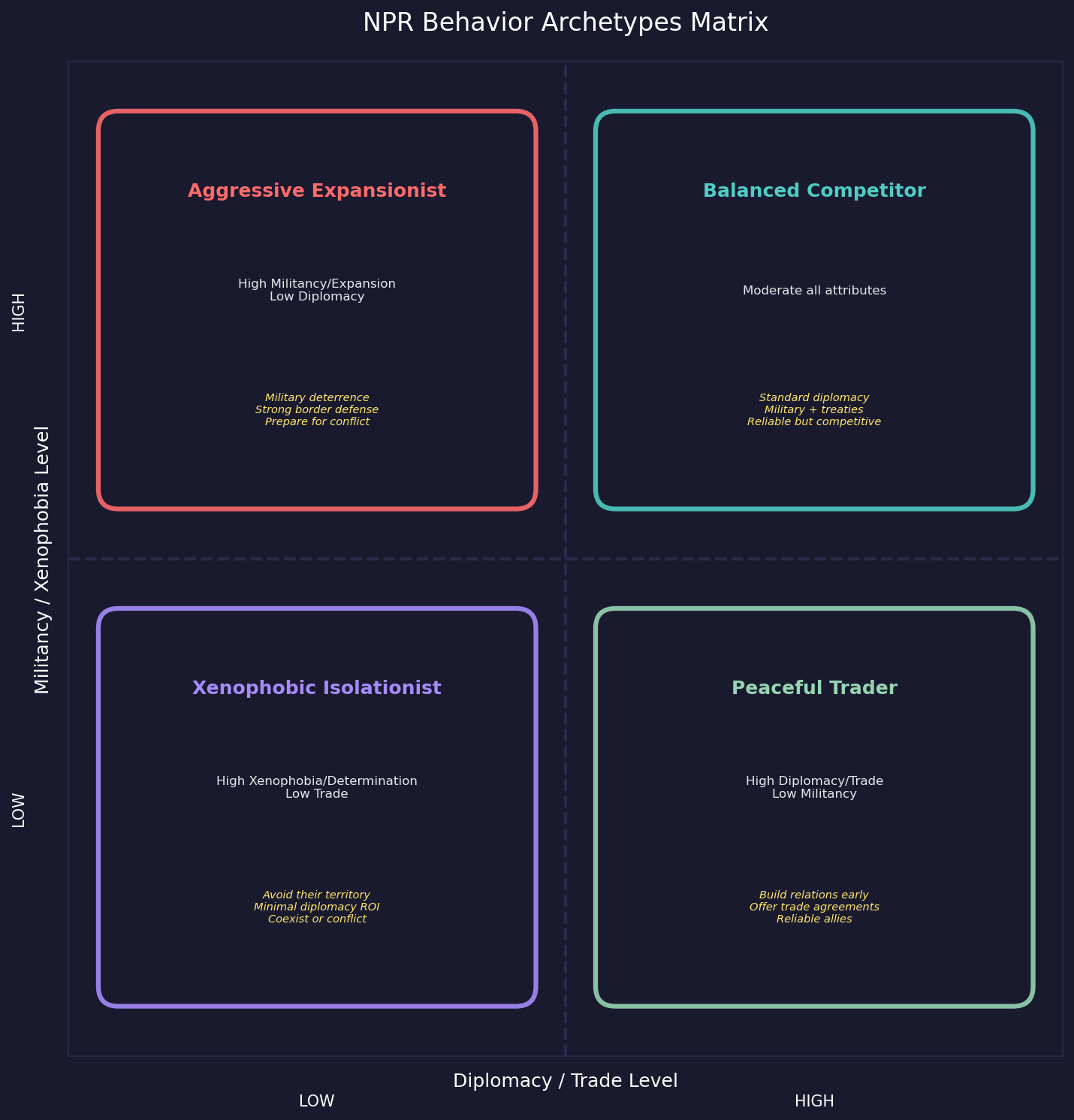
Peaceful Trader (High Diplomacy, High Trade, Low Militancy):
- Establish communication quickly.
- Propose Trade Agreement as first treaty.
- Build toward Research Treaty and Alliance.
- This NPR type is an ideal long-term partner.
Aggressive Expansionist (High Militancy, High Expansion, Low Diplomacy):
- Military deterrence is primary strategy.
- Maintain strong fleet presence at shared borders.
- Trade may work if you demonstrate strength first.
- Be prepared for eventual conflict regardless of diplomatic efforts.
Xenophobic Isolationist (High Xenophobia, High Determination, Low Trade):
- Diplomatic progress will be extremely slow.
- Avoid entering their territory – even small intrusions generate massive penalties.
- Consider whether peaceful coexistence is achievable or whether conflict is inevitable.
- Do not waste diplomatic resources on relationships that yield minimal returns.
Balanced Competitor (Moderate across all attributes):
- Standard diplomatic approach works well.
- Respond proportionally to their actions.
- Treaties and military balance in combination are effective.
- These NPRs make reliable treaty partners but may compete for the same resources.
15.4.6.3 Active Diplomacy Best Practices
To maximise diplomatic point generation:
- Deploy Diplomatic Ships: Equip ships with Diplomacy Modules and assign commanders with high Diplomacy skill.
- Maintain Contact: Keep diplomatic ships in systems where the NPR is present.
- Stack Treaties: Multiple simultaneous treaties compound point generation.
- Avoid Provocations: Keep military ships away from their valued territory.
- Communication First: Invest in Xenology Labs to build communication quickly.
15.4.6.4 Handling Diplomatic Crises
When relations deteriorate unexpectedly:
- Identify the Cause: Check the event log for intrusion warnings or combat events.
- Withdraw Offending Forces: If ships in their territory are causing intrusion penalties, pull them back immediately.
- Deploy Diplomats: Send diplomatic ships to the NPR’s space (using Diplomacy Module tonnage deduction to minimise intrusion impact).
- Offer Treaties: Even low-level treaties generate positive points that can offset negative events.
- Time: Negative points decay naturally. Sometimes the best response is patience combined with non-aggression.
Tip: The single most common cause of relationship deterioration with NPRs is unintentional territorial intrusion. Survey ships, mining vessels, or patrol fleets operating in an NPR’s valued systems generate ongoing diplomatic penalties every increment check. Regularly review where your ships are operating relative to known NPR territory.
15.4.7 Diplomatic Incidents and Their Effects
Updated: v2026.01.30
Diplomatic incidents are events that cause sudden shifts in your relationship with an NPR. Unlike the gradual point generation from treaties and active diplomacy, incidents create immediate and often severe diplomatic consequences.
15.4.7.1 Types of Diplomatic Incidents
Combat Incidents:
Any damage inflicted on an NPR’s assets generates negative diplomatic points scaled by damage type:
| Damage Type | Points per Damage Point |
|---|---|
| Shield damage only | -0.1 |
| Armor damage (no internal) | -0.25 |
| Internal damage | -1.0 |
| Population/ground force/shipyard | -1.0 |
| Ground combat losses | -0.01 per ton destroyed |
A single point of damage drops relations to Hostile (-100) if currently above that threshold. This means even accidental engagement (friendly fire, sensor errors, or standing order conflicts) can immediately destroy a relationship.
Territorial Incidents:
Intrusion into valued NPR territory generates ongoing diplomatic penalties. The severity escalates with:
- System value (Secondary through Capital)
- Fleet tonnage detected
- Current relationship (negative neutrals suffer 2x modifier)
- NPR Xenophobia
Intelligence Note:
C# Aurora does not have active espionage missions. ELINT intelligence gathering is entirely passive and carries no diplomatic penalty (see Section 15.5 Intelligence Gathering).
Diplomatic Ship Attacks:
Attacking a ship equipped with a Diplomacy Module carries a triple damage multiplier for diplomatic penalties, regardless of whether you knew the ship was diplomatic. Unprovoked attacks on diplomatic ships generate a -300 relationship penalty.
15.4.7.2 Incident Recovery
Recovery from diplomatic incidents depends on severity and the NPR’s characteristics:
- Minor Incidents (small intrusions): Recoverable through active diplomacy and time. Negative points decay naturally.
- Moderate Incidents (significant intrusion, accidental combat): Requires sustained diplomatic effort. Multiple treaties and diplomatic ships needed to generate sufficient positive points.
- Major Incidents (deliberate combat, diplomatic ship attacks): May permanently damage the relationship. Highly xenophobic races may never forgive combat damage.
- Treaty Violations: Breaking a treaty while it is active generates additional penalties and a “treaty-breaker” modifier affecting future negotiations with all races.
15.4.7.3 Preventing Incidents
Proactive measures to avoid diplomatic crises:
- Standing Orders: Configure fleet standing orders to avoid engaging neutral or friendly vessels.
- Patrol Boundaries: Keep patrol routes clear of NPR-valued systems.
- Sensor Awareness: Monitor where your ships are relative to known NPR territory.
- Intelligence Awareness: ELINT operations are undetectable in C# Aurora and carry no diplomatic risk.
- Diplomatic Escorts: When traversing NPR space, include diplomatic ships to reduce intrusion penalties.
- Communication Priority: Establish communication quickly after first contact to enable diplomatic options before incidents occur.
15.4.7.4 The Hostility Spiral
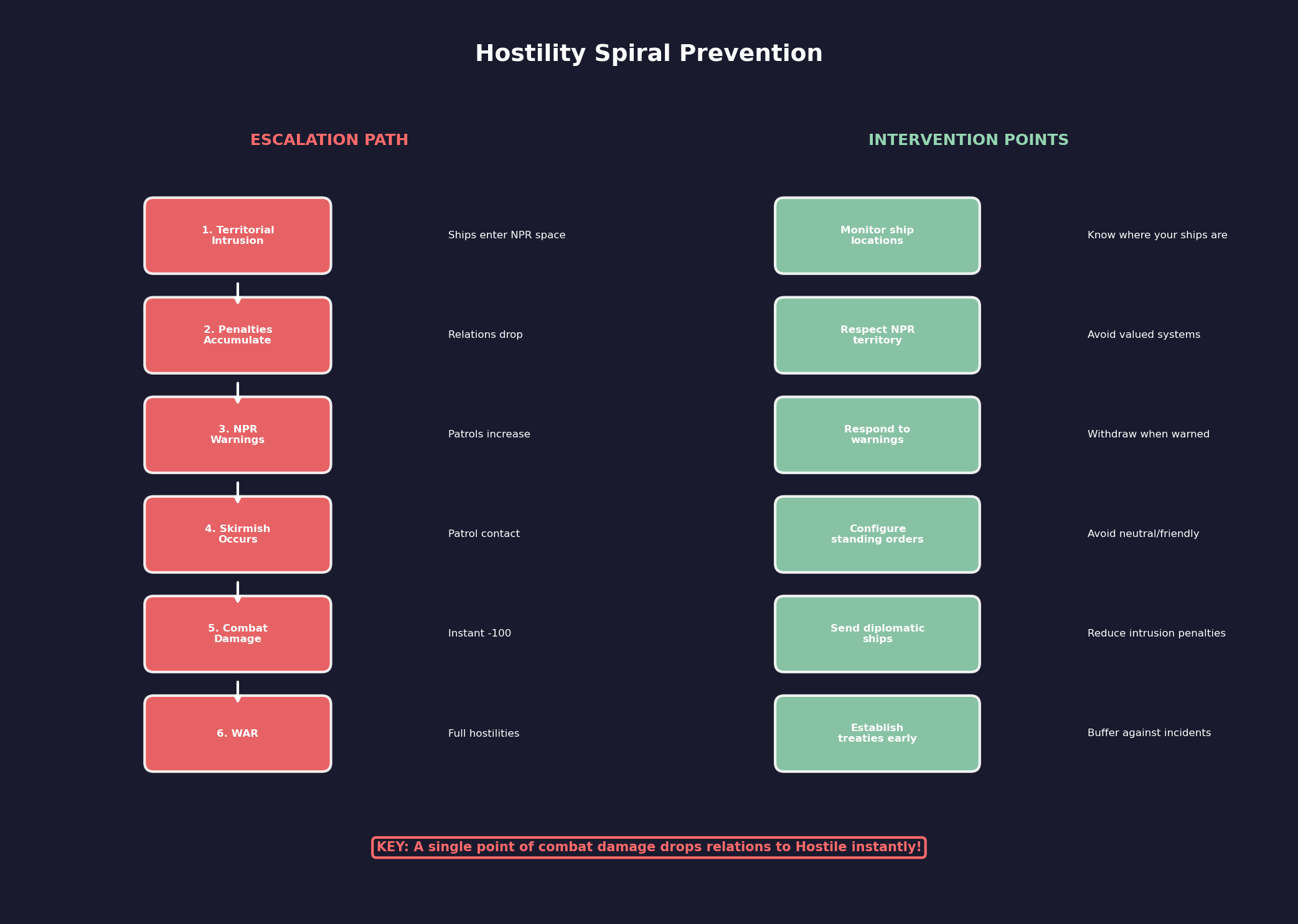
A common failure mode in Aurora diplomacy is the hostility spiral:
- Your ships intrude into NPR territory (perhaps unknowingly).
- Intrusion penalties accumulate, dropping relations toward Unfriendly.
- The NPR increases patrols and issues warnings.
- Your patrols encounter NPR patrols. A skirmish occurs.
- Combat damage drops relations to Hostile instantly.
- The NPR declares war.
This spiral can progress from first contact to full war in a matter of months if left unmanaged. The key intervention point is Step 1 – recognising and correcting territorial intrusion before it escalates.
Warning: Aurora’s AI does not bluff. If an NPR masses ships near a jump point connecting to your territory, they intend to use them. Similarly, if an NPR issues escalating territorial warnings, they will eventually follow through with force. Take NPR diplomatic messages seriously – they represent genuine AI decision-making, not theatrical posturing.
15.4.8 Fixed Relationships and Truces
Updated: v2026.01.30
In some circumstances, the diplomatic relationship between two races is fixed and cannot change through normal point accumulation or decay.
15.4.8.1 Truce Countdown
When a war ends through peace negotiations, a Truce Countdown period begins:
- During the countdown: The relationship is fixed at the agreed level (typically Neutral).
- Territorial protection: Neither side will make claims against the other during the truce.
- Claim immunity: Both sides ignore territorial claims from the other, with no diplomatic penalty.
- Purpose: Provides a cooling-off period after conflict, preventing immediate re-escalation.
15.4.8.2 Player-Set Fixed Relationships
Players can set fixed relationship levels through the Diplomacy window (in Space Master mode or certain game configurations):
- Useful for scenario design where specific diplomatic configurations are desired.
- Overrides normal point-based relationship calculation.
- Can be removed at any time to return to normal diplomatic mechanics.
15.4.8.3 Implications
Fixed relationships prevent both improvement and deterioration:
- Treaties still generate points, but the relationship level does not change until the fixed period ends.
- Intrusion penalties still accrue but do not shift the displayed relationship.
- Once the fixed period ends, accumulated points (positive or negative) take immediate effect, potentially causing a sudden shift.
Tip: A truce after a war is a double-edged sword. While it prevents immediate re-escalation, any territory intrusion or other negative events during the truce still accumulate points – they just do not take effect until the truce expires. If you have been intruding in the NPR’s space during the truce, the relationship may collapse the instant the countdown ends.
15.4.9 NPR Military Aid Processing
Updated: v2026.02.15
When players transfer military assets to NPRs through diplomatic agreements, the receiving NPR processes these gifts according to its own military doctrine.
15.4.9.1 Ground Formation Analysis
When ground formations are gifted to an NPR:
- The NPR analyzes the received formation’s composition and capabilities.
- The NPR assigns its own templates to the gifted forces, reorganizing them to match NPR military doctrine.
- Original player unit designations and organization may be replaced with NPR equivalents.
This means that gifted ground forces become fully integrated into the NPR’s military structure rather than operating as distinct foreign units. The practical effect is that military aid strengthens NPR capabilities but does not preserve player-defined force organization.
15.4.9.2 Sensor Buoy Elimination
Added: v2.8.0
NPRs actively eliminate sensor buoys belonging to neutral races found within their controlled territory:
- Territorial Defense: NPRs treat foreign sensor buoys in their space as potential reconnaissance threats.
- Neutral Status Insufficient: Being at neutral relations does not protect sensor buoys from elimination – only allied status may prevent destruction.
- Strategic Implications: Players deploying sensor networks near NPR borders should expect buoys in NPR-controlled systems to be destroyed. Position sensor networks outside NPR territorial claims or establish allied status before deployment.
This behavior reflects NPR counterintelligence priorities and affects reconnaissance strategies near NPR space.
Related Sections
- Section 15.1 Alien Races – NPR generation, behaviour, territory, and intelligence mechanics
- Section 15.2 Communications – Language barriers, transponders, and diplomatic ships
- Section 15.3 Treaties – Treaty types, effects, and consequences of breaking agreements
- Section 15.5 Intelligence Gathering – ELINT operations and intelligence mechanics
- Section 6.4 Wealth and Trade – Trade mechanics and wealth generation
- Section 16.2 Skills and Bonuses – Diplomacy and Intelligence officer skills
- Section 16.3 Assignments – Assigning commanders to diplomatic ships
- Section 11.1 Thermal and EM Signatures – Detection mechanics for communication attempts
References
\hypertarget{ref-15.4-1}{[1]}. Aurora C# game database (AuroraDB.db v2.7.1) – FCT_ShipDesignComponents. Diplomacy Module (ID 65902): Size=30.0 HS, Cost=300.0 BP, Crew=50. Confirms specs referenced in communication and active diplomacy sections.
\hypertarget{ref-15.4-2}{[2]}. Aurora C# game database (AuroraDB.db v2.7.1) – FCT_AlienRace table. Confirms DiplomaticPoints, TradeTreaty, TechTreaty, GeoTreaty, GravTreaty fields, and FixedRelationship column validating the truce/fixed relationship mechanics.
\hypertarget{ref-15.4-3}{[3]}. Aurora Forums – Steve Walmsley’s diplomacy mechanics posts. Diplomatic point thresholds, active diplomacy formula, treaty point generation values, combat damage penalty rates, territory intrusion formula, and protection status demand strengths. (forum-sourced; specific post URLs unavailable)