12.2 Beam Weapons
Updated: v2026.02.15

Beam weapons are direct-fire energy systems that hit their targets instantly at the speed of light. Unlike missiles, they require no ammunition (though some use capacitor-based recharge cycles) and cannot be intercepted by point defense. Their main limitations are range and accuracy against fast-moving targets. Aurora features several beam weapon types, each with distinct tactical roles.
Contents
Updated: v2026.02.15
- 12.2 Beam Weapons
- Contents
- 12.2.1 Laser Types
- 12.2.2 Range and Damage
- 12.2.2.1 Damage Falloff by Weapon Type
- 12.2.2.2 Laser Damage Falloff Formula
- 12.2.2.3 Damage Gradient (Armor Column Spread)
- 12.2.2.4 Focal Size, Maximum Range, and the Damage Curve
- 12.2.2.5 Practical Range Management in Combat
- 12.2.2.6 Range and Armor Penetration
- 12.2.2.7 Implications for Ship Design
- 12.2.3 Tracking Speed
- 12.2.4 Power Allocation and Recharge
- 12.2.5 Weapon Failure
- 12.2.6 Specific Weapon Types
- 12.2.7 Beam Weapon Reference Tables
- 12.2.8 Atmospheric Effects
- References
- Related Sections
12.2.1 Laser Types
Updated: v2026.02.15
Lasers are the most common and versatile beam weapon in Aurora. They come in several variants, each offering different trade-offs between size, range, damage, and rate of fire.
Standard Lasers
Standard lasers are the baseline beam weapon. They are available in sizes from 10 cm (0.25 HS) up to 50+ cm caliber. Key characteristics:
- Damage and range scale with caliber (size)
- Rate of fire: one shot every 5 seconds (base recharge time)
- Capacitor recharge technology can reduce this to as low as every 5 seconds per 3 shots
- Armor penetration: equal to the weapon’s damage rating at point-blank range
| Caliber | Size (HS) | Base Damage | Max Range (base) |
|---|---|---|---|
| 10 cm | 1 | 3 | 10,000 km |
| 12 cm | 1.5 | 4 | 12,000 km |
| 15 cm | 2.5 | 5 | 15,000 km |
| 20 cm | 3.5 | 8 | 20,000 km |
| 25 cm | 4.5 | 10 | 25,000 km |
| 30 cm | 6 | 12 | 30,000 km |
| 35 cm | 7 | 14 | 35,000 km |
| 40 cm | 8 | 16 | 40,000 km |
| 50 cm | 10 | 20 | 50,000 km |
Note: The above table shows approximate base values assuming Infrared wavelength (lowest range multiplier) and Capacitor Recharge Rate 1 (base recharge). These values are illustrative starting points only. Exact size, damage, and range depend on Laser Focal Size, Laser Wavelength, and Capacitor Recharge Rate technologies researched.\hyperlink{ref-12.2-1}{[1]} Higher-frequency wavelength tech (UV, X-Ray, etc.) increases range; higher capacitor tech increases size and power requirements. See Section 12.2.7 Beam Weapon Reference Tables for verified reference examples at specific tech levels (e.g., 10cm C3 Far UV = 3 HS, 50,000 km range).\hyperlink{ref-12.2-18}{[18]}
Reduced-Size Lasers
Reduced-size lasers sacrifice recharge rate for a smaller hull footprint. Two reduction options are available \hyperlink{ref-12.2-11}{[11]}:
- 0.75x size, 4x recharge time: 25% smaller but recharges 4 times slower
- 0.50x size, 20x recharge time: Half the size but recharges 20 times slower
These are valuable for:
- Fighter/FAC armament (where hull space is at a premium)
- Close-range brawler ships
- Point defense installations where range beyond 10,000 km is less critical
Spinal Mount Lasers
Spinal mount technology allows mounting oversized weapons. Two levels are available: Spinal Mount (1.25x damage multiplier) and Spinal Mount - Advanced (1.5x damage multiplier) \hyperlink{ref-12.2-12}{[12]}. Characteristics:
- Increases weapon damage by the spinal mount multiplier
- Only one spinal weapon per ship
- Occupies a significant percentage of the hull
- Same rate of fire as standard lasers
- Must be built into the ship design from the start (cannot be refitted) (unverified — #837 – requires live testing)
- The ship can only fire the spinal mount at targets within its forward arc (unverified — #837 – requires live testing)
Spinal lasers are devastating on large warships designed for decisive engagements. A single spinal mount can crack through heavy armor in one or two shots where standard weapons would require many volleys.
Infrared and Ultraviolet Lasers
Wavelength technology affects laser performance:\hyperlink{ref-12.2-2}{[2]}
- Infrared: Longer wavelength, shortest range of all wavelength options (lowest range multiplier in the database)
- Ultraviolet/X-Ray/Gamma: Shorter wavelength, progressively longer range (higher range multiplier in the database)
- Visible/Standard: Baseline range between infrared and ultraviolet
Wavelength technology affects range only, not damage. All wavelengths deal the same base damage for a given focal size. The choice depends on engagement doctrine: stand-off ships benefit from higher-frequency wavelengths (UV and above), while shorter-range combatants can use infrared to save research costs.
12.2.2 Range and Damage
Updated: v2026.02.15
Beam weapon effectiveness diminishes with range. Understanding the damage falloff mechanics is essential for designing effective combat ships and choosing engagement distances. Aurora C# uses two related but distinct concepts: the damage gradient (how damage is distributed across armor columns) and damage falloff (how damage reduces with range).
12.2.2.1 Damage Falloff by Weapon Type

Not all beam weapons lose damage at range. Each weapon type has its own falloff behavior:
| Weapon Type | Damage Falloff | Behavior at Max Range |
|---|---|---|
| Lasers | Linear falloff | Reduced damage (see formula below) |
| Particle Beams | None | Full damage at all ranges |
| Plasma Carronades | None | Full damage at all ranges |
| Railguns | None (unverified — #1210 — may have falloff similar to lasers) | Full damage at all ranges (unverified) |
| Mesons | None | Always 1 damage (bypasses armor/shields) |
| Microwaves | None | Full damage at all ranges |
| Gauss Cannons | None | 1 damage per shot at all ranges |
Lasers are the primary weapon type affected by damage falloff. For weapons with no falloff, the weapon deals its full base damage at any range within its maximum envelope. Note: damage falloff (whether damage decreases with range) and damage gradient (how damage spreads across armor columns, see Section 12.2.2.3) are independent properties.
12.2.2.2 Laser Damage Falloff Formula
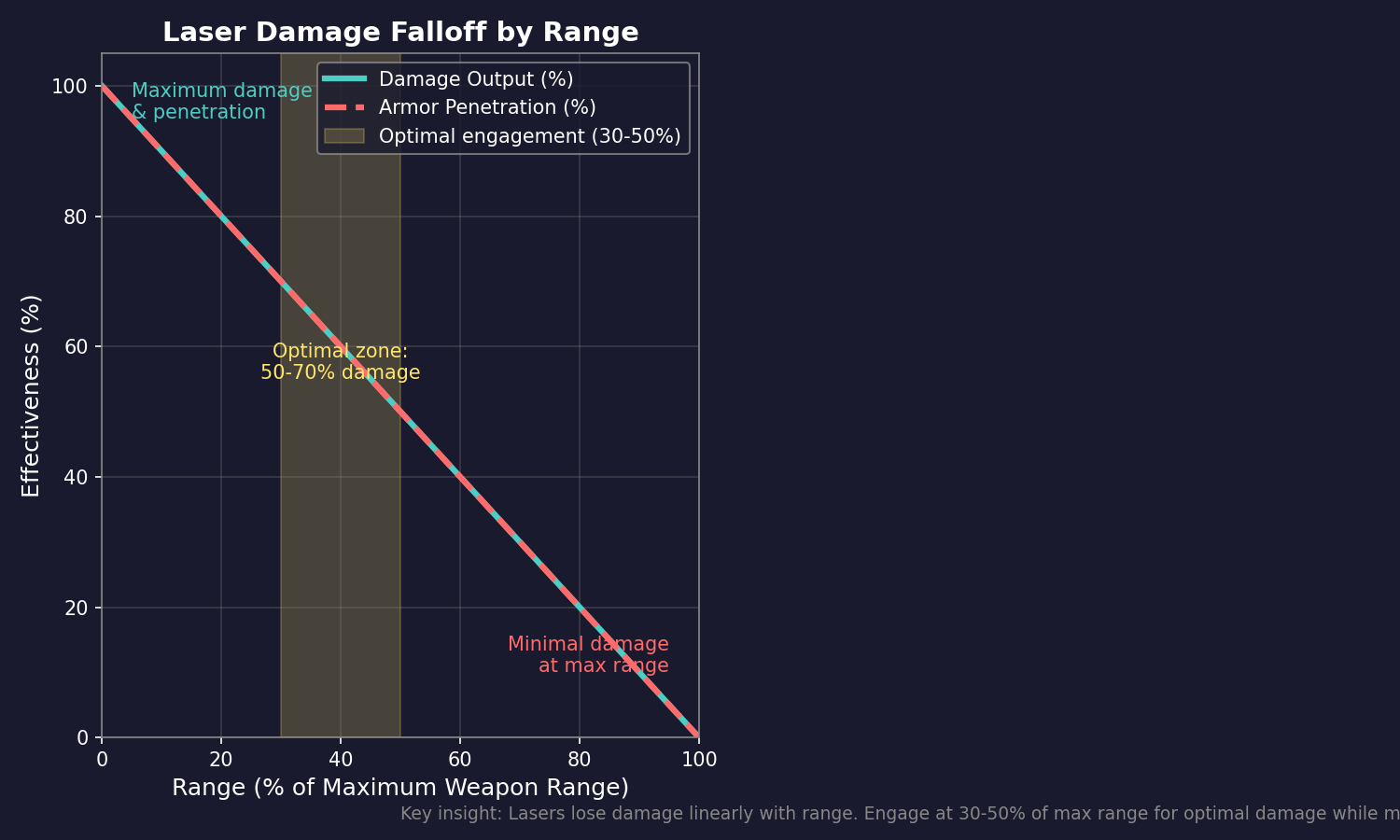
For lasers and other weapons with a damage gradient greater than 1, damage decreases linearly with range: (unverified — #837 – requires live testing to confirm formula)
Damage_at_Range = Base_Damage * (1 - Range / Max_Range)
This linear relationship means:
- At point-blank range (Range = 0): full base damage
- At 50% of max range: 50% of base damage
- At maximum range: minimal damage (typically 1 point)
The damage is divided into discrete range brackets, with damage stepping down at each increment (typically 10,000 km steps). For a weapon with 20 base damage and 250,000 km max range (e.g., a 50 cm Far Ultraviolet laser):
| Range (% of max) | Approximate Damage | Armor Penetration |
|---|---|---|
| 0-10% | 20 (100%) | 20 layers |
| ~25% | 15 (75%) | 15 layers |
| ~50% | 10 (50%) | 10 layers |
| ~75% | 5 (25%) | 5 layers |
| ~90% | 2 (10%) | 2 layers |
| 100% (max range) | 1 (minimum) | 1 layer |
Beyond maximum range, the weapon cannot fire at all.
Tip: Effective engagement range for lasers is generally 30-50% of maximum range, where you deal significant damage with good armor penetration. Firing at 80%+ of max range wastes shots against armored targets.
12.2.2.3 Damage Gradient (Armor Column Spread)
The damage gradient value is a separate concept from range falloff. It determines how damage is distributed across the target’s armor columns on each hit. \hyperlink{ref-12.2-21}{[21]}
- Gradient 1 (Missiles, Plasma Carronades, Ramming): Damage pattern example:
1,2,3,4,5,4,3,2,1— a pyramid shape with gentle slopes. - Gradient 2 (Railguns, Particle Beams): Damage pattern example:
1,3,5,7,5,3,1— steeper penetration than gradient 1. - Gradient 3 (Standard Lasers): Deepest-penetrating pattern for any given damage amount. The gradient value means the gap between adjacent armor columns cannot exceed 3 damage.
Laser penetration depth is approximately equal to the square root of triple the damage. For missiles and carronades, penetration depth is approximately the square root of the damage. For railguns and particle beams, penetration is approximately the square root of double the damage.
Higher gradient values mean deeper penetration but damage spread across more columns. Lower gradient values concentrate damage but penetrate fewer layers.
Example: A 10cm laser doing 3 damage spreads across multiple columns following the gradient-3 pattern — it does NOT deal 3 damage to a single column. A missile with 9 damage and gradient 1 creates a 1,2,3,2,1 pattern, penetrating 3 layers deep at the center column.
12.2.2.4 Focal Size, Maximum Range, and the Damage Curve
A beam weapon’s maximum range is primarily determined by its focal size (caliber) and wavelength technology. The focal size establishes both the ceiling of your range envelope and the shape of the damage curve:
- Larger focal size = greater max range = more room for the damage curve to operate
- A 50 cm laser has a much longer max range than a 10 cm laser, but at the same absolute distance (e.g., 100,000 km), the 50 cm laser is at a lower percentage of its max range and therefore deals proportionally more damage
- Reduced-size laser variants cut max range (0.75x or 0.50x), which compresses the damage curve into a shorter distance
Example comparison at 60,000 km (Far Ultraviolet wavelength):
- 50 cm laser (max 250,000 km): firing at 24% of max -> ~76% damage
- 25 cm laser (max 125,000 km): firing at 48% of max -> ~52% damage
- 10 cm laser (max 50,000 km):  out of range entirely
This means larger-caliber lasers are not just longer-ranged – they also deal proportionally more damage at any given absolute range where both weapons could fire.
Tip: When choosing between calibers, consider not just the max range but the range at which you expect to fight. A larger laser at 50% of its range deals the same percentage damage as a smaller laser at 50% of its range, but the larger one reaches that percentage at a much greater absolute distance.
12.2.2.5 Practical Range Management in Combat
Understanding damage falloff creates important tactical decisions:
Closing vs. Kiting
- Against lightly armored targets: Long-range fire is viable even at reduced damage, since low armor penetration thresholds are still exceeded
- Against heavily armored targets: You must close range to deal enough damage per hit to penetrate armor layers
- Against no-falloff weapons (particle beams, plasma carronades): The enemy deals full damage at any range, so closing gives you no advantage unless your weapons also have no falloff
Range Selection Guidelines
| Situation | Recommended Range | Reasoning |
|---|---|---|
| Your lasers vs. their lasers | 30-50% of YOUR max range | You deal meaningful damage while staying in your comfort zone |
| Your lasers vs. their particle beams | Close rapidly or stay far | At mid-range, they deal full damage while you deal partial |
| Your particle beams vs. their lasers | Maintain max range of their weapons | Your damage is constant; theirs degrades with distance |
| Mixed fleet engagement | Varies by target priority | Focus fire at ranges where your heaviest weapons are effective |
Alpha Strike vs. Sustained Fire
- At close range (0-25% of max), lasers deliver devastating alpha strikes comparable to gradient-1 weapons
- At long range (70-100% of max), lasers deal chip damage that heavy armor shrugs off
- No-falloff weapons (particle beams, plasma carronades) provide consistent damage at all ranges but typically have shorter max ranges or lower base damage for their size
Tip: If your doctrine is to fight at knife-fight range, consider plasma carronades or reduced-size lasers. If you prefer standoff engagements, invest in large-caliber lasers with high wavelength tech – but accept that your per-hit damage at max range will be minimal.
12.2.2.6 Range and Armor Penetration
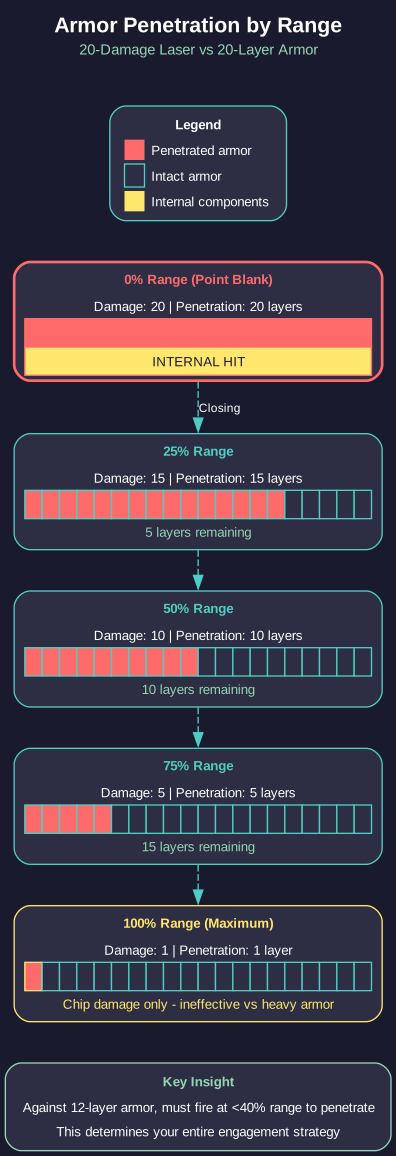
The damage value at a given range also determines armor penetration. A weapon dealing 8 damage at a particular range bracket has armor penetration of 8 – it can penetrate up to 8 layers of armor. If the target has more armor layers than the weapon’s damage, the shot is stopped without reaching internal components.
This creates a critical interaction for weapons with damage falloff: at long range, your weapons deal less damage AND have lower armor penetration. A ship with heavy armor can effectively ignore long-range laser fire. This does not apply to gradient-1 weapons, which maintain full penetration at all ranges.
Armor Penetration by Range (20-damage Laser Example):
| Range (% of max) | Damage | Penetrates Armor Layers |
|---|---|---|
| 0% (point-blank) | 20 | Up to 20 layers |
| 25% | 15 | Up to 15 layers |
| 50% | 10 | Up to 10 layers |
| 75% | 5 | Up to 5 layers |
| Max range | 1 | Only 1 layer |
Tip: When scouting an enemy fleet, check their armor depth. If they have 12 layers of armor, your 20-damage lasers need to fire at less than 40% of max range to penetrate. This single calculation can determine your entire engagement strategy.
12.2.2.7 Implications for Ship Design
- Long-range kiting ships (large-caliber lasers): Best against lightly armored targets; their damage degrades but still penetrates thin armor
- Close-range brawlers (reduced-size lasers, plasma carronades): Deliver devastating damage per salvo but must survive the approach
- Constant-damage platforms (particle beams): Excellent against heavy armor at range, but typically fewer shots per combat tick (Note: railguns were previously listed here but may have damage falloff — unverified, #1210)
- Mixed batteries: Consider pairing lasers for volume-of-fire with particle beams for reliable penetration at range
- Consider the trade-off: a 50 cm laser at 50% range does 10 damage, while two 25 cm lasers at 50% range do 5+5=10 damage with more flexibility but less individual armor penetration
12.2.3 Tracking Speed
Updated: v2026.02.15
Tracking speed determines whether your beam weapons can reliably hit their targets. Fast-moving ships and missiles require high tracking speeds for consistent hits.
Hit Probability Formula
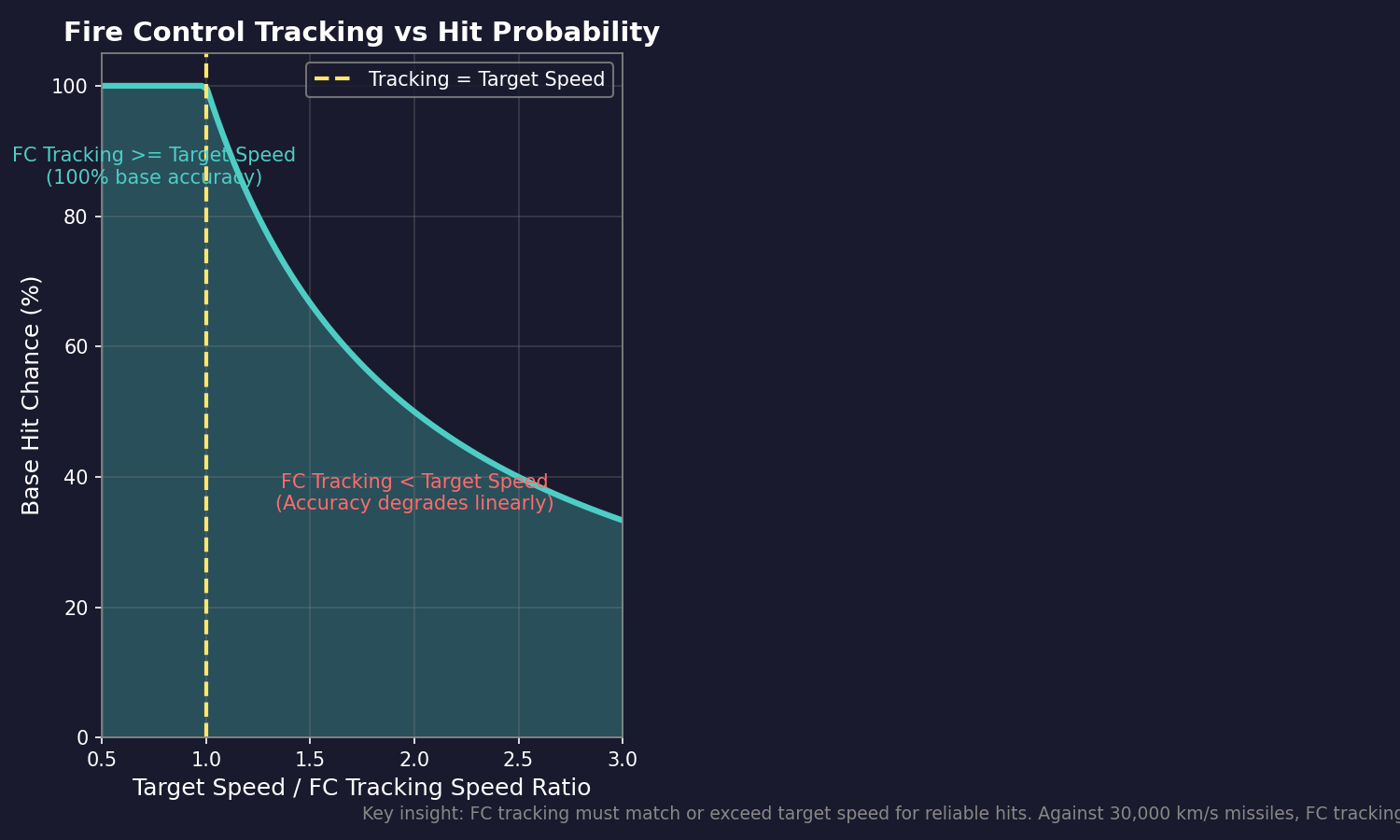
The full hit probability calculation for beam weapons is:\hyperlink{ref-12.2-3}{[3]}
Base_Chance = (1 - Range/Max_Range) * 100% *(unverified -- #1256)*
Tracking_Mod = min(1.0, Tracking_Speed / Target_Speed)
Final_Chance = Base_Chance * Tracking_Mod * Crew_Training * Commander_Bonus * ECM_ECCM_Mod
Note: This formula implies 0% base hit chance at maximum range for all beam weapons. If correct, weapons described as dealing “full damage at all ranges” (particle beams, railguns) would still miss entirely at their stated maximum range due to the tracking penalty. This interaction requires verification.
Where:
- Tracking Speed / Target Speed: Base accuracy (capped at 1.0)
- Range Modifier: Calculated as
(1 - Range/Max_Range). At point-blank range, this equals 1.0 (100%); at maximum range, it approaches 0. This is separate from damage falloff – range affects both hit chance AND damage for lasers, but only hit chance for other beam weapons. - Crew Training: Training grade from 0.1 (untrained) to 1.0 (fully trained), typically affecting overall combat effectiveness (unverified — #837 – requires live testing to confirm range)
- Commander Bonus: Tactical skill of the ship’s commanding officer
- ECM/ECCM Modifier: Electronic warfare effects (see Section 12.5 Electronic Warfare)
Target Speed Calculation
The “target speed” used in the tracking calculation is the target’s current velocity relative to the firing ship. Key points:
- A target approaching directly at 10,000 km/s has a relative speed of 10,000 km/s
- A target at the same velocity on a parallel course has relative speed of 0 km/s
- Crossing targets (perpendicular movement) use their full speed value
- The worst case for tracking is a target crossing at high speed at close range (high angular velocity)
In practice, Aurora uses the target’s absolute speed for this calculation in most cases, simplifying the geometry.
Tracking Speed Requirements by Target Type
| Target Type | Typical Speed | Required Tracking |
|---|---|---|
| Freighters/Transports | 1,000-3,000 km/s | Low (any FC works) |
| Warships | 3,000-8,000 km/s | Medium |
| Fast Escorts | 5,000-12,000 km/s | Medium-High |
| FACs | 8,000-15,000 km/s | High |
| Fighters | 5,000-20,000 km/s | Very High |
| Missiles | 10,000-50,000+ km/s | Extreme |
Tracking Time Bonus vs Missiles (C# Aurora):\hyperlink{ref-12.2-4}{[4]}
Energy weapons and beam fire controls gain a tracking speed bonus when engaging missiles that have been continuously tracked by active sensors. This represents the predictable trajectories of missiles making them easier to hit over time.
- Bonus: 1% tracking speed increase for every 5 seconds a missile remains continuously tracked by active sensors
- Maximum tracking time (and bonus) is determined by technology level
- The bonus applies only to tracking speed, not base-to-hit chance
- Provides no improvement if tracking speed already exceeds missile speed
- Applies exclusively to missiles (not ships) due to their predictable trajectories
Technology Progression:\hyperlink{ref-12.2-4}{[4]}
| Technology | Max Tracking Time | Max Bonus | Research Cost |
|---|---|---|---|
| Starting | 0 seconds | 0% | 500 RP |
| Level 1 | 30 seconds | 6% | 1,000 RP |
| Level 2 | 45 seconds | 9% | 2,000 RP |
| Level 3 | 60 seconds | 12% | 4,000 RP |
| Level 4 | 80 seconds | 16% | 8,000 RP |
| Level 5 | 120 seconds | 24% | 15,000 RP |
| Level 6 | 160 seconds | 32% | 30,000 RP |
| Level 7 | 200 seconds | 40% | 60,000 RP |
| Level 8 | 250 seconds | 50% | 120,000 RP |
| Level 9 | 320 seconds | 64% | 240,000 RP |
| Level 10 | 400 seconds | 80% | 480,000 RP |
Technologies follow the naming format: “Max Tracking Time for Bonus vs Missiles: [X] Seconds ([Y]%)”
Designing for Tracking
- Anti-ship fire controls need moderate tracking (matching enemy warship speeds)
- Point defense fire controls need maximum tracking speed (matching missile speeds)
- The same beam weapon can be assigned to different fire controls for different roles
- Higher tracking speed technology does not increase fire control size – always research it
- Tracking time bonus vs missiles provides significant point defense improvement at higher tech levels
Crew Training Effect
Poorly trained crews (see Section 16.2 Skills and Bonuses) suffer accuracy penalties. A green crew at 50% training effectively halves the fire control’s tracking capability. This makes crew training one of the most important “invisible” combat multipliers.
Multiple Shots and Rate of Fire
High rate of fire weapons (especially with capacitor recharge technology) get multiple chances to hit per combat tick. Even at low hit probability, throwing many dice improves the chance of at least one hit. This is why gauss cannons (which fire many projectiles per burst) are effective point defense despite their individually low accuracy against fast missiles.
12.2.3.1 Fractional Capacitor Technology (v1.13.0+)
As of v1.13.0, researching each capacitor recharge level also grants interpolated fractional capacitor technologies. For each capacitor level researched (up to capacitor 4), the game unlocks three intermediate recharge rates at 0.25 increments (e.g., researching capacitor 2 grants 1.25, 1.5, and 1.75 recharge rates). Additional fractional levels at 4.5, 5.5, 7, 9, 11, 13, 14, 15, 16, 20, and 25 become available at higher tech levels. The full progression across all 29 tiers is: 1, 1.25, 1.5, 1.75, 2, 2.25, 2.5, 2.75, 3, 3.25, 3.5, 3.75, 4, 4.5, 5, 5.5, 6, 7, 8, 9, 10, 11, 12, 13, 14, 15, 16, 20, 25.\hyperlink{ref-12.2-5}{[5]}
These fractional capacitor values allow finer tuning of beam weapon rate of fire, producing more efficient weapon designs with better cost-to-firepower ratios. Rather than committing to a full recharge rate upgrade, designers can select intermediate values that better match their power budget and tactical requirements.
12.2.4 Power Allocation and Recharge
Updated: v2026.01.30
In C# Aurora, the beam weapon recharge system has been fundamentally redesigned to handle damaged power plants more effectively.
Power Allocation Priority System:
When a ship’s power plants are damaged and cannot supply full power to all weapons simultaneously, power is allocated weapon by weapon until the available power is exhausted. This means some weapons may not be recharged at all, but those that do receive power are recharged at the maximum rate. (unverified — #837 – requires live testing to confirm C# mechanic)
The allocation order prioritizes weapons with the lowest power requirements first. Once a weapon is fully recharged and fires, it requires no additional power until its next recharge cycle, freeing power for other weapons.
This differs significantly from VB6 Aurora, where damaged power plants reduced recharge rates proportionally for all weapons simultaneously. The C# system ensures at least some weapons achieve maximum fire rate rather than all weapons being equally degraded.
Strategic Implications:
- Ships with mixed weapon sizes benefit: small weapons recharge first and keep firing
- A ship with one damaged reactor may still operate several weapons at full rate
- Large weapons with high power draws are the first to go offline when power is scarce
- Consider mixing weapon sizes to maintain some combat capability even when damaged
12.2.5 Weapon Failure
Updated: v2026.02.15
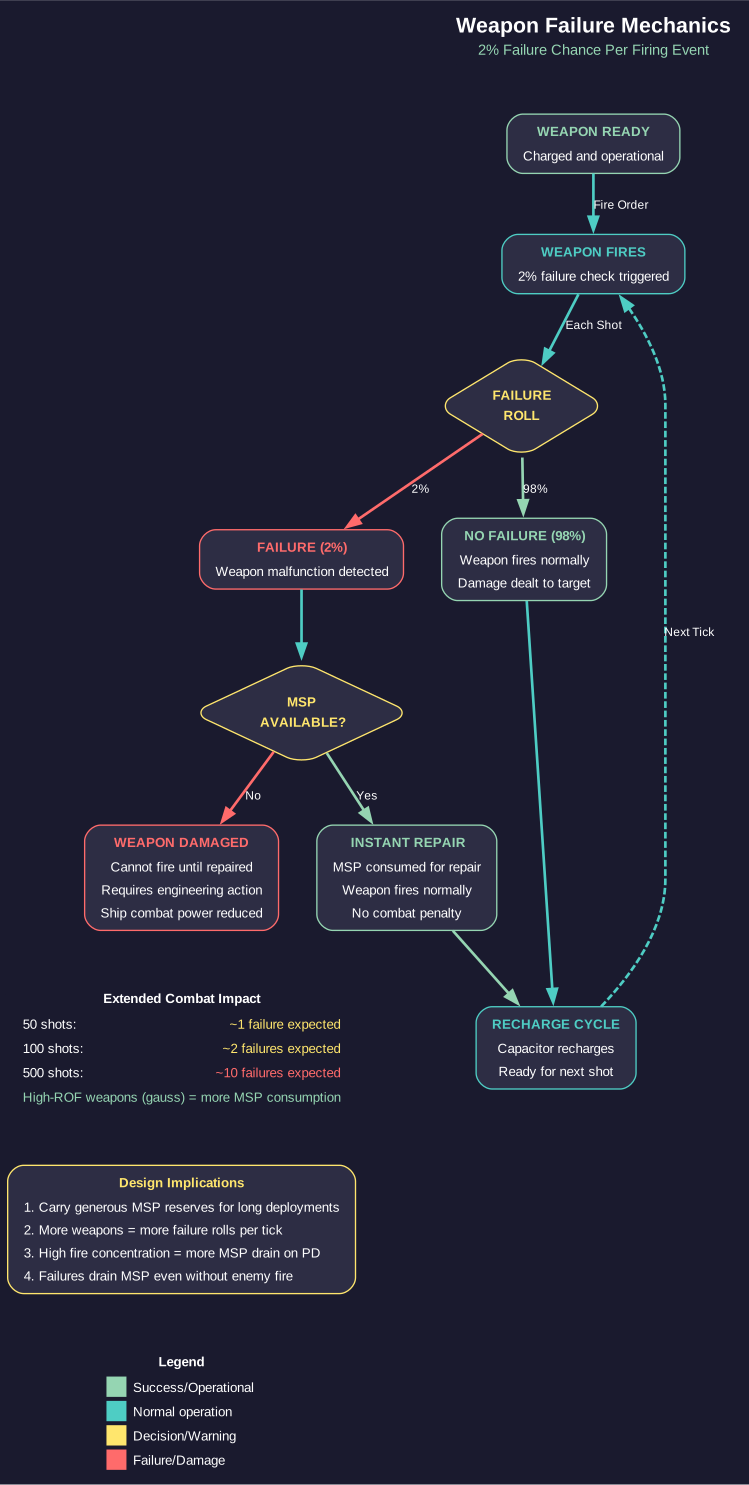
C# Aurora introduces a weapon failure mechanic that applies to all beam weapons and missile launchers:
Core Mechanic:
At the point when any weapon (energy-based or missile launcher) fires, there is a 2% chance the weapon will suffer a failure.\hyperlink{ref-12.2-6}{[6]}
Failure Resolution:
- With maintenance supplies (MSP) available: The weapon receives instant repair and fires normally. MSP is consumed for the repair.
- Without maintenance supplies: The weapon becomes damaged and cannot fire until repaired.
Design Implications:
- Maintenance supply management is strategically important during prolonged combat
- Ships with more weapons suffer more failures on average (more rolls per combat tick)
- Extended engagements drain MSP through weapon failures even without enemy fire
- Ships deploying far from resupply should carry generous MSP reserves
- For point defense, high fire concentration settings increase the chance of weapon failure on expensive systems
12.2.6 Specific Weapon Types
Updated: v2026.02.15
12.2.6.1 Gauss Cannons
Gauss cannons are kinetic projectile weapons primarily used for point defense. They fire multiple shots per combat tick and deal 1 damage per projectile, making them ideal for destroying unarmored missiles. Gauss cannons do not require reactor power.
Gauss Cannon Reference Examples: \hyperlink{ref-12.2-15}{[15]}
Database naming convention is R[range]-[velocity] (e.g., R100-100 = 10,000 km range, velocity 10,000). NumberOfShots indicates rate of fire.
| Stat | Gauss Cannon R100-100 | Gauss Cannon R400-100 |
|---|---|---|
| Damage | 1 per shot | 1 per shot |
| Rate of Fire | 2 shots/5 sec | 5 shots/5 sec |
| Range | 10,000 km | 40,000 km |
| Size | 6 HS | 6 HS |
| HTK | 2 | 2 |
| Power | None | None |
| Cost | 24 | 60 |
| Crew | 12 | 12 |
| Materials | 24 Vendarite | 60 Vendarite |
Research Category: Gauss cannon technologies are researched under the Gauss Cannon category (CategoryID=39 in the database), which is a dedicated research category separate from Lasers (CategoryID=2), Missile Launchers (CategoryID=3), and other weapon categories.\hyperlink{ref-12.2-16}{[16]}
Research Progression (C# Aurora):\hyperlink{ref-12.2-7}{[7]}
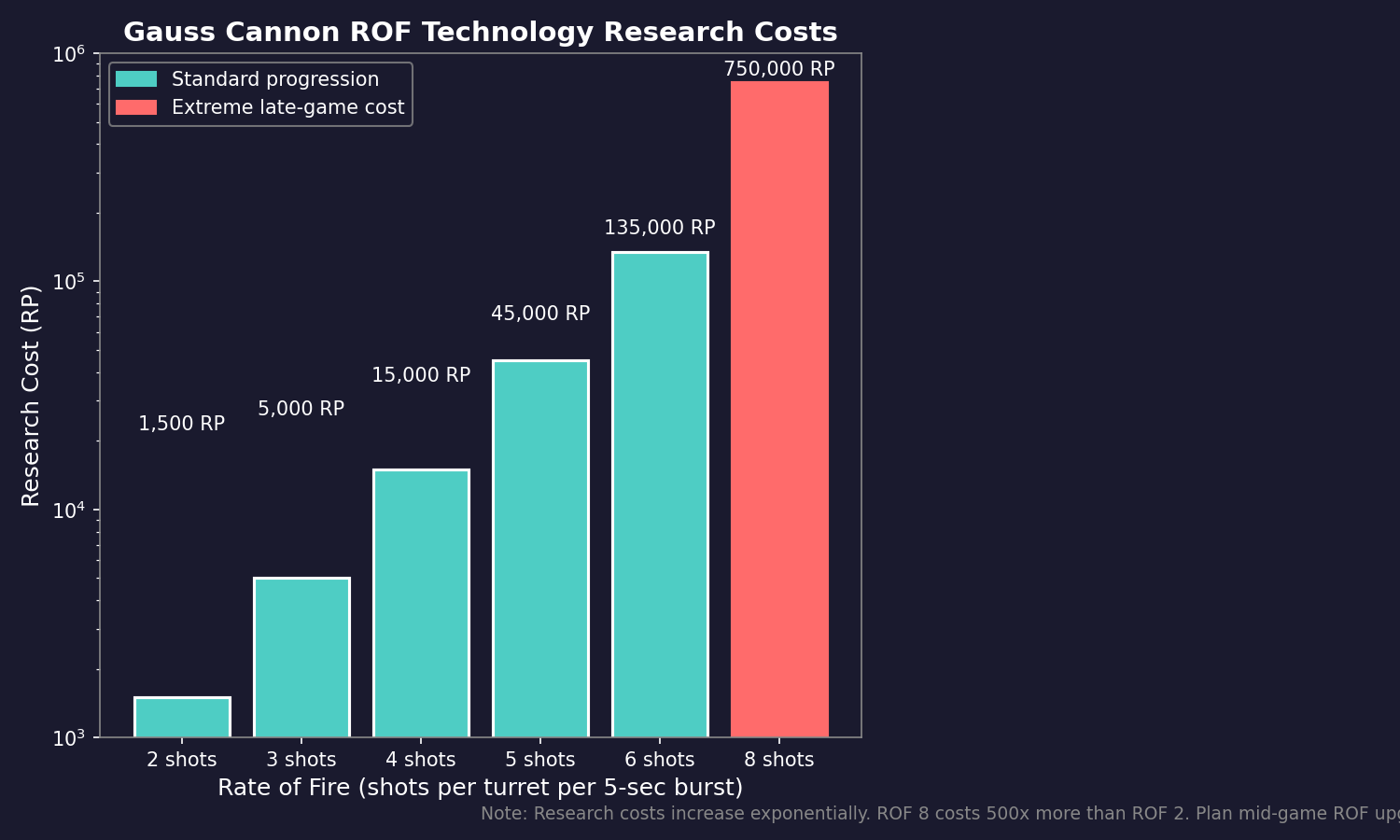
Rate of Fire technology determines the number of shots per turret per burst. The research costs were lowered in C# Aurora to make gauss cannons more accessible earlier in development:
| Rate of Fire | Research Cost |
|---|---|
| 2 shots | 1,500 RP |
| 3 shots | 5,000 RP |
| 4 shots | 15,000 RP |
| 5 shots | 45,000 RP |
| 6 shots | 135,000 RP |
| 8 shots | 750,000 RP |
Launch Velocity technology progression:\hyperlink{ref-12.2-8}{[8]}
| Level | Velocity | Research Cost |
|---|---|---|
| Level 1 | 10,000 | 500 RP |
| Level 2 | 20,000 | 1,500 RP |
| Level 3 | 30,000 | 5,000 RP |
| Level 4 | 40,000 | 15,000 RP |
| Level 5 | 50,000 | 45,000 RP |
| Level 6 | 60,000 | 135,000 RP |
12.2.6.2 Particle Beams
Particle beams are beam weapons that fire streams of charged particles. They occupy a middle ground between lasers and plasma carronades in terms of range and damage.
Key Properties:
- Size: 6 HS (300 tons) for standard particle beams; 12 HS for Particle Lance \hyperlink{ref-12.2-14}{[14]}
- Damage does not decrease with range (full damage within max range)
- Cannot be used for point defense (unverified — #1210 — may be assignable to PD fire controls but poorly suited due to inability to turret-mount)
- Damage is applied in a single column of armor, providing focused penetration
Particle Beam Reference Example: \hyperlink{ref-12.2-14}{[14]}
The database contains Particle Beam-2 components (tech level 2 strength). A Particle Beam-4 would require Strength 4 technology. Based on database patterns:
| Stat | Particle Beam-2 (verified) | Particle Lance-24 (verified) |
|---|---|---|
| Beam Strength | 2 | 24 |
| Rate of Fire | 10 sec | 10 sec |
| Range | 60,000 km | 320,000 km |
| Size | 6 HS | 12 HS |
| HTK | 3 | 6 |
| Power | 5 (recharge 2.5/5 sec) | 75 (recharge 6/5 sec) |
| Cost | 13.7-27.4 | 557.7 |
| Crew | 18 | 36 |
| Materials | 2.7 Duranium, 2.7 Boronide, 8.2 Corundium | 111.5 Duranium, 111.5 Boronide, 334.6 Corundium |
Particle Lance (C# Aurora only):\hyperlink{ref-12.2-9}{[9]}
The Particle Lance is an advanced variant of the Particle Beam available only in C# Aurora. It requires both “Particle Beam Range 200,000 km” and “Particle Beam Strength 6” technologies to unlock.
| Attribute | Modifier vs Standard Particle Beam |
|---|---|
| Damage | 2x |
| Size | 2x |
| Hit Points | 2x |
| Crew Requirements | 2x |
| Power Requirement | 2.5x |
| Build Cost | 3x |
| Development Cost | 2x (base 30,000 RP) |
The Particle Lance maintains the constant-damage-at-range property of particle beams while concentrating all damage into a single armor column, making it the premiere armor-cracking weapon for heavily armored targets.
12.2.6.3 Plasma Carronades (v2.2.0 Update)
Plasma carronades function identically to lasers with several important distinctions:\hyperlink{ref-12.2-10}{[10]}
Size and Design Parameters:
- No reduced-size variants available
- Cannot be mounted in turrets
- Minimum focal tech: 15 cm
- Maximum focal tech: 100 cm (compared to 80 cm for lasers)
- Research cost of each carronade focal tech is approximately half the cost of the equivalent laser focal tech
- Spinal-mount plasma carronades are now possible
Performance Characteristics:
- Same range modifier as infrared lasers (no wavelength tech variants)
- Damage gradient of 1 (matching missiles rather than typical beam weapons – no damage falloff with range within max range)
- Cost is double that of equivalent infrared lasers
- Physical size is half that of comparable laser systems
Plasma Carronade Reference Example: \hyperlink{ref-12.2-17}{[17]}
| Stat | 15.0cm C3 Plasma Carronade (verified) |
|---|---|
| Damage | 6 |
| Rate of Fire | 15 sec (C3) |
| Range | 10,000 km |
| Size | 2.5 HS |
| HTK | 1 |
| Power | 6 (recharge 3/5 sec) |
| Cost | 14.6 |
| Crew | 7 |
| Materials | 2.9 Duranium, 2.9 Boronide, 8.8 Corundium |
Note: Higher-tech carronades (30cm+, C5+) would scale accordingly but are not present in the current database snapshot.
Strategic Implications:
- Plasma carronades have no damage falloff within their range envelope (similar to particle beams). The damage gradient of 1 determines how damage spreads across armor columns (see Section 12.2.2.3), which is separate from range-based damage reduction.
- The half-size advantage makes them competitive for designs where tonnage is critical
- Higher cost but consistent damage delivery at all engagement ranges
- Particularly effective at maximum range where lasers would deal reduced damage
12.2.7 Beam Weapon Reference Tables
Updated: v2026.02.15
The following tables provide ground-truth specifications for representative beam weapons at various tech levels. These serve as design baselines and cost/performance benchmarks.
12.2.7.1 Laser Examples
\hyperlink{ref-12.2-18}{[18]}
| Stat | 10cm C3 Far Ultraviolet Laser (verified) |
|---|---|
| Damage | 3 |
| Rate of Fire | 5 sec (C3) |
| Range | 50,000 km |
| Size | 3 HS |
| HTK | 1 |
| Power | 3 (recharge 3/5 sec) |
| Cost | 26.0 |
| Crew | 9 |
| Materials | 5.2 Duranium, 5.2 Boronide, 15.6 Corundium |
Note: The database contains 10cm C3 Far UV lasers at 50,000 km range. Higher-tech examples (C5, 20cm+) would have longer ranges but are not present in the current snapshot.
12.2.7.2 Railgun Examples
\hyperlink{ref-12.2-19}{[19]}
| Stat | 10cm Railgun V40/C3 (verified) | 10cm Railgun V50/C3 (verified) |
|---|---|---|
| Damage per Shot | 1 | 1 |
| Rate of Fire | 5 sec (C3) | 5 sec (C3) |
| Range | 40,000 km | 50,000 km |
| Size | 3 HS | 3 HS |
| HTK | 1 | 1 |
| Power | 3 (recharge 3/5 sec) | 3 (recharge 3/5 sec) |
| Cost | 20.8 | 26.0 |
| Crew | 9 | 9 |
| Materials | 4.2 Duranium, 4.2 Boronide, 12.5 Neutronium | 5.2 Duranium, 5.2 Boronide, 15.6 Neutronium |
Note: Railgun damage does not decrease with range. (unverified — #1210 — community sources suggest railguns may have damage falloff similar to lasers; requires in-game testing) NumberOfShots field in database indicates shots per firing cycle.
12.2.7.3 Meson Cannon Examples
\hyperlink{ref-12.2-20}{[20]}
| Stat | R15/C3 Meson Cannon (verified) |
|---|---|
| Damage | 1 (ignores shields) |
| Rate of Fire | 5 sec (C3) |
| Range | 15,000 km |
| Size | 3 HS |
| HTK | 1 |
| Power | 3 (recharge 3/5 sec) |
| Cost | 5.2 |
| Crew | 15 |
| Materials | 1.0 Duranium, 1.0 Boronide, 3.1 Corundium |
| Armor Retardation | 0.4 (40% stop chance per armor layer) |
Note: Meson damage is always 1 regardless of weapon size. The advantage is bypassing shields entirely. Each armor layer has a per-layer stop chance determined by the ArmourRetardation field (e.g., 0.4 = 40% stop chance). Larger meson focal sizes have lower per-layer stop chance, making them more likely to penetrate thick armor. See Section 12.6.2 Internal Damage for the full Meson Armor Retardation table.
15cm Meson Cannon Size Increase (v2.8.0):
Added: v2026.02.03
As of v2.8.0, the 15cm Meson Cannon was increased from 200 tons (4 HS) to 250 tons (5 HS). This balance change affects ship design calculations for vessels using this weapon type. The size increase brings the 15cm Meson in line with balance adjustments made to similar-class weapons.
12.2.7.4 High Power Microwave Example
\hyperlink{ref-12.2-13}{[13]}
| Stat | R20/C5 High Power Microwave |
|---|---|
| Damage | 1 (3 vs shields; electronic systems only after shields down) |
| Rate of Fire | 10 sec |
| Range | 200,000 km |
| Size | 6 HS |
| HTK | 3 |
| Power | 10 (recharge 5/5 sec) |
| Cost | 126 |
| Crew | 60 |
| Materials | 25.2 Duranium, 25.2 Boronide, 75.6 Corundium |
| Dev Cost | 3,100 RP |
Note: HPM does 3 damage vs shields. Once shields are down, it targets electronic systems only. It does not bypass armor – it requires shields to be depleted first, then damages electronic components on the target.
High Power Microwave Size Increase (v2.8.0):
Added: v2026.02.03
As of v2.8.0, the 15cm High Power Microwave was increased from 200 tons (4 HS) to 250 tons (5 HS). This balance change affects ship design calculations for vessels using HPM weapons. The size increase was applied alongside the 15cm Meson Cannon adjustment as part of the same balancing pass.
12.2.8 Atmospheric Effects
Updated: v2026.02.15
In C# Aurora, there is no penalty for energy weapons firing in or through an atmosphere. This is a significant change from VB6 Aurora, which imposed restrictions on energy weapon effectiveness in atmospheric conditions. (unverified — #837 – requires live testing or changelog verification)
This means:
- Energy weapons are viable tools for planetary bombardment without atmospheric degradation
- Orbital energy weapon fire is not reduced by planetary atmosphere
- Ground-based energy weapons fire at full effectiveness
- The only practical limitations on orbital bombardment are range and power, not atmosphere
See Section 12.6 Damage and Armor for full planetary bombardment mechanics including casualty rates and environmental effects.
Practical Tips
- Never pair offensive weapons with PD-grade fire controls (or vice versa) unless you want a dual-purpose system
- Track the speed of your expected enemies and design fire controls to match
- Against very fast targets, multiple low-damage hits (gauss) are more reliable than single high-damage shots (lasers)
- Remember that target speed is the limiting factor: you cannot hit what you cannot track, no matter how powerful your weapons
- Commander selection matters: a skilled tactical officer provides noticeable accuracy bonuses
- Carry sufficient MSP for the 2% weapon failure rate over extended engagements\hyperlink{ref-12.2-6}{[6]}
- When power is limited, smaller weapons maintain fire rate while large weapons go offline first
References
\hypertarget{ref-12.2-1}{[1]}. Aurora C# game database (AuroraDB.db v2.7.1) – FCT_TechSystem (TechTypeID=15): Laser Focal Size technology, 12 levels from 10cm (1,000 RP) to 80cm (2,000,000 RP). Advanced Laser variants also available with slightly higher costs.
\hypertarget{ref-12.2-2}{[2]}. Aurora C# game database (AuroraDB.db v2.7.1) – FCT_TechSystem (TechTypeID=3): Laser Wavelength technology, 12 levels from Infrared (500 RP) to Far Gamma Ray (2,000,000 RP).
\hypertarget{ref-12.2-3}{[3]}. Aurora Wiki (C-Ship-Combat, C-Beam_Weapons) and Naval Gazing Aurora tutorials – Full hit probability formula including range modifier, tracking modifier, crew training, commander bonus, and ECM/ECCM modifier.
\hypertarget{ref-12.2-4}{[4]}. Aurora C# game database (AuroraDB.db v2.7.1) – FCT_TechSystem (TechSystemID 27653-27658, 74206-74210): Tracking time bonus technology, 11 levels from 0 seconds (500 RP) to 400 seconds/80% (480,000 RP). All tracking times, bonus percentages, and research costs verified.
\hypertarget{ref-12.2-5}{[5]}. Aurora C# game database (AuroraDB.db v2.7.1) – FCT_TechSystem (TechTypeID=1): Capacitor Recharge Rate technology, 29 tiers. Full progression: 1, 1.25, 1.5, 1.75, 2, 2.25, 2.5, 2.75, 3, 3.25, 3.5, 3.75, 4, 4.5, 5, 5.5, 6, 7, 8, 9, 10, 11, 12, 13, 14, 15, 16, 20, 25. Highest tiers (16, 20, 25) verified in database. All entries verified.
\hypertarget{ref-12.2-6}{[6]}. Aurora Wiki (C-Ship-Combat) – Weapon failure rate of 2% per firing event, verified via Aurora Wiki and official forum sources.
\hypertarget{ref-12.2-7}{[7]}. Aurora C# game database (AuroraDB.db v2.7.1) – FCT_TechSystem (TechTypeID=141): Gauss Cannon Rate of Fire technology, 6 levels from ROF 2 (1,500 RP) to ROF 8 (750,000 RP). All research costs verified.
\hypertarget{ref-12.2-8}{[8]}. Aurora C# game database (AuroraDB.db v2.7.1) – FCT_TechSystem (TechTypeID=144): Gauss Cannon Launch Velocity technology, 6 levels from 10,000 (500 RP) to 60,000 (135,000 RP). All research costs verified.
\hypertarget{ref-12.2-9}{[9]}. Aurora C# game database (AuroraDB.db v2.7.1) – FCT_TechSystem (TechSystemID 65615): Particle Lance technology, development cost 30,000 RP. Prerequisites: Particle Beam Range 200,000 km (8,000 RP) and Particle Beam Strength 6 (15,000 RP), both verified.
\hypertarget{ref-12.2-10}{[10]}. Aurora C# game database (AuroraDB.db v2.7.1) – FCT_TechSystem (TechTypeID=78): Carronade Calibre technology, 11 levels from 15cm (2,000 RP) to 100cm (2,000,000 RP). Costs are approximately half the equivalent laser focal sizes (e.g., 15cm carronade 2,000 RP vs 15cm laser 4,000 RP; 30cm carronade 16,000 RP vs 30cm laser 30,000 RP).
\hypertarget{ref-12.2-11}{[11]}. Aurora C# game database (AuroraDB.db v2.7.1) – FCT_TechSystem (TechTypeID=140): Reduced-size Laser technology, 3 levels: Standard (1.0x size, 1.0x recharge), 0.75 Size / 4x Recharge, 0.50 Size / 20x Recharge. All verified: TechSystemID 26594 (0.5 size, AdditionalInfo=0.5), 26595 (0.75 size, AdditionalInfo=0.75), 26596 (standard, AdditionalInfo=1.0).
\hypertarget{ref-12.2-12}{[12]}. Aurora C# game database (AuroraDB.db v2.7.1) – FCT_TechSystem: Spinal Mount (TechSystemID 55407, AdditionalInfo=1.25) and Spinal Mount - Advanced (TechSystemID 55408, AdditionalInfo=1.5). Both verified as damage multipliers.
\hypertarget{ref-12.2-13}{[13]}. Aurora C# game database (AuroraDB.db v2.7.1) – FCT_ShipDesignComponents ComponentTypeID=44: “R15/C3 High Power Microwave” verified: DamageOutput=1, Size=3.0, MaxWeaponRange=15000, NumberOfShots=1, Cost=10.4. The R20/C5 example in the table is a higher-tech variant; all HPM variants share DamageOutput=1 as their base. The 3x shield damage multiplier is a combat-resolution mechanic, not a stored component property.
\hypertarget{ref-12.2-14}{[14]}. Aurora C# game database (AuroraDB.db v2.7.1) – FCT_ShipDesignComponents ComponentTypeID=30 (Particle Beam): Particle Beam-2 verified at Size=6.0 HS, DamageOutput=2, MaxWeaponRange=60000, HTK=3, Cost=13.7-27.4, Crew=18, PowerRequirement=5.0. Particle Lance-24 verified at Size=12.0 HS, DamageOutput=24, MaxWeaponRange=320000, HTK=6, Cost=557.7, Crew=36, PowerRequirement=75.0. Note: Original claim of 7 HS for particle beams was incorrect.
\hypertarget{ref-12.2-15}{[15]}. Aurora C# game database (AuroraDB.db v2.7.1) – FCT_ShipDesignComponents ComponentTypeID=45 (Gauss Cannon): Gauss Cannon R100-100 verified at Size=6.0, DamageOutput=1, NumberOfShots=2, HTK=2, Cost=24, Crew=12, Vendarite=24. Gauss Cannon R400-100 verified at Size=6.0, NumberOfShots=5, Cost=60, Vendarite=60. PowerRequirement=0 for all gauss cannons.
\hypertarget{ref-12.2-16}{[16]}. Aurora C# game database (AuroraDB.db v2.7.1) – DIM_ResearchCategories: Gauss Cannon is CategoryID=39, a dedicated category separate from Lasers (2), Missile Launchers (3), and other weapon categories. Note: The claim about “Missiles and Kinetic Weapons” category was inaccurate.
\hypertarget{ref-12.2-17}{[17]}. Aurora C# game database (AuroraDB.db v2.7.1) – FCT_ShipDesignComponents ComponentTypeID=36 (Plasma Carronade): 15.0cm C3 Plasma Carronade verified at Size=2.5, DamageOutput=6, RangeModifier=10000, HTK=1, Cost=14.6, Crew=7, PowerRequirement=6.0, RechargeRate=3.0, Duranium=2.9, Boronide=2.9, Corundium=8.8.
\hypertarget{ref-12.2-18}{[18]}. Aurora C# game database (AuroraDB.db v2.7.1) – FCT_ShipDesignComponents ComponentTypeID=15 (Laser): 10cm C3 Far Ultraviolet Laser verified at Size=3.0, DamageOutput=3, RangeModifier=50000, HTK=1, Cost=26.0, Crew=9, PowerRequirement=3.0, RechargeRate=3.0, Duranium=5.2, Boronide=5.2, Corundium=15.6.
\hypertarget{ref-12.2-19}{[19]}. Aurora C# game database (AuroraDB.db v2.7.1) – FCT_ShipDesignComponents ComponentTypeID=35 (Railgun): 10cm Railgun V40/C3 verified at Size=3.0, DamageOutput=1, RangeModifier=40000, HTK=1, Cost=20.8, Crew=9, PowerRequirement=3.0, RechargeRate=3.0, Duranium=4.2, Boronide=4.2, Neutronium=12.5. V50/C3 variant at RangeModifier=50000, Cost=26.0.
\hypertarget{ref-12.2-20}{[20]}. Aurora C# game database (AuroraDB.db v2.7.1) – FCT_ShipDesignComponents ComponentTypeID=34 (Meson Cannon): R15/C3 Meson Cannon verified at Size=3.0, DamageOutput=1, RangeModifier=15000, HTK=1, Cost=5.2, Crew=15, PowerRequirement=3.0, RechargeRate=3.0, ArmourRetardation=0.4.
\hypertarget{ref-12.2-21}{[21]}. AuroraWiki — Armour and Shields (https://aurorawiki2.pentarch.org/index.php?title=Armour_and_Shields) — Damage templates and penetration formulas verified: lasers = sqrt(3 x damage), missiles/carronades = sqrt(damage), railguns/particle beams = sqrt(2 x damage). Note: “Gradient” is manual terminology; wiki uses “damage template.”
Related Sections
- Section 7.4 Tech Categories – Energy weapon and capacitor research
- Section 8.5 Weapons – Weapon component design integration
- Section 12.1 Fire Controls – Fire control assignment and modes
- Section 12.4 Point Defense – Point defense weapon configurations
- Section 12.6 Damage and Armor – Armor penetration mechanics
- Section 12.7 Planetary Defence Centres – Beam weapons on ground-based PDCs
- Section 14.2 Maintenance – MSP consumption from weapon failures