18.1 Game Mechanics
Updated: v2026.02.15

Contents
Updated: v2026.02.15
- 18.1 Game Mechanics
18.1.1 Random Number Generation
Updated: v2026.02.15
Aurora C# uses a pseudo-random number generator (PRNG) for all stochastic events in the game. Understanding how randomness works in Aurora helps set expectations for gameplay outcomes.
18.1.1.1 Where RNG Applies
- Combat (see Section 12.1 Fire Controls): To-hit rolls, beam damage variance, missile evasion checks
- Geological surveys: Mineral deposit quantities and accessibility ratings
- Jump point surveys: Discovery timing and jump point destination
- Research breakthroughs: Chance of bonus research events
- Crew training: Skill advancement rolls for officers and crew
- Spoiler race generation: Which races appear, their strength, and location
- Ruins exploration: What technologies or resources are found
18.1.1.2 Seed Behavior
Each game uses a seed established at game creation. This means that the same sequence of events in the same order will produce the same results if replayed identically. However, any change in the order of operations (different time increment choices, different fleet movements) will produce divergent outcomes.
18.1.1.3 Practical Implications
- Save-scumming has limited value because the RNG state advances with each roll; reloading and taking the exact same actions produces the same result. Changing the order of actions or waiting a different number of increments can change outcomes.
- Large sample sizes matter: a single missile salvo might miss entirely, but over many salvos, hit rates converge toward the calculated probability.
- Geological surveys can produce wildly different mineral results across bodies. A system that appears poor on first survey may have rich deposits on moons or asteroids not yet surveyed.
18.1.1.4 Combat RNG Details
In combat, the game rolls a value between 0 and the maximum weapon range for each shot. If the roll is less than or equal to the target’s range bracket for that weapon, the shot hits. This means:
- At point-blank range, nearly all shots hit (roll must exceed 0 to miss)
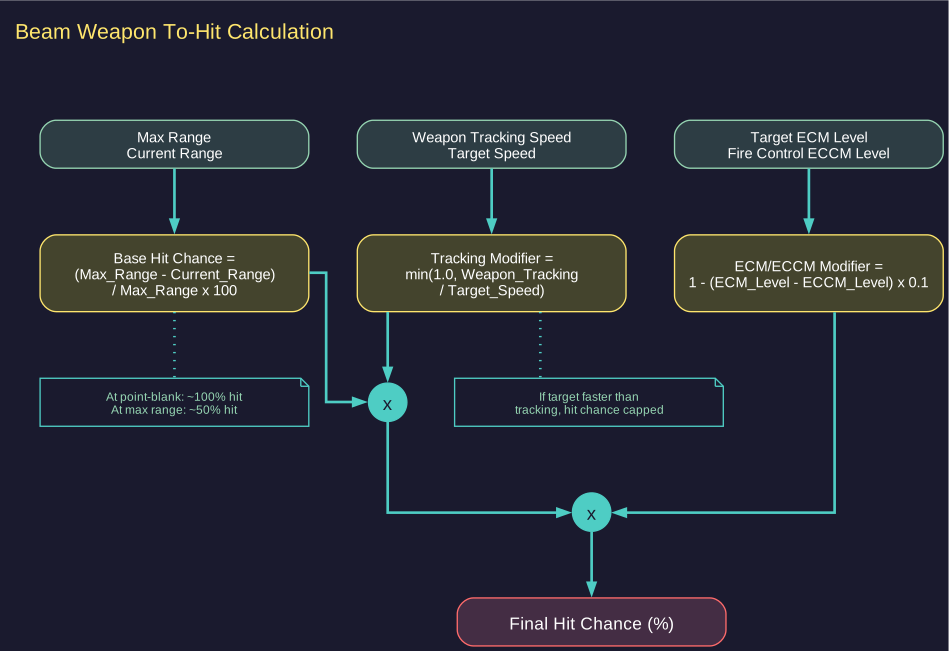
- At maximum range, hit chance approaches 0% per the formula in Section 18.1.3.2: Base_Hit_Chance = (Max_Range - Max_Range) / Max_Range = 0% \hyperlink{ref-18.1-1}{[1]}
- Tracking speed modifiers adjust the effective to-hit chance against fast-moving targets
18.1.2 Production Formulas
Updated: v2026.02.15
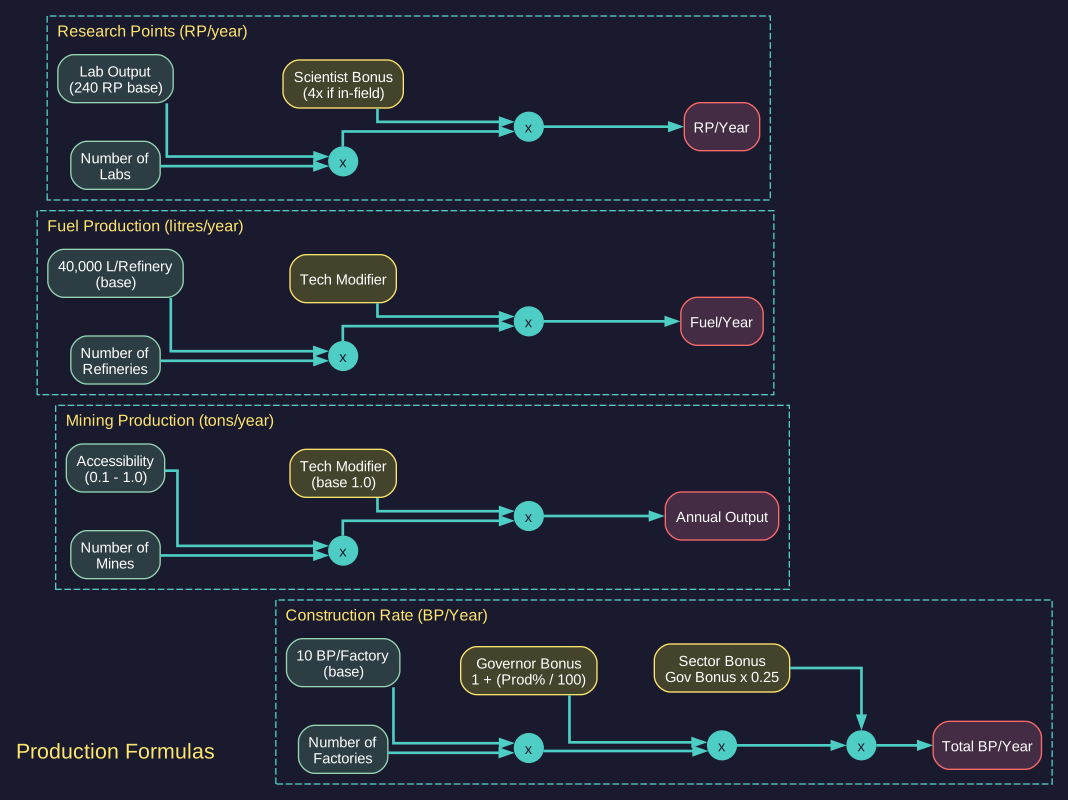
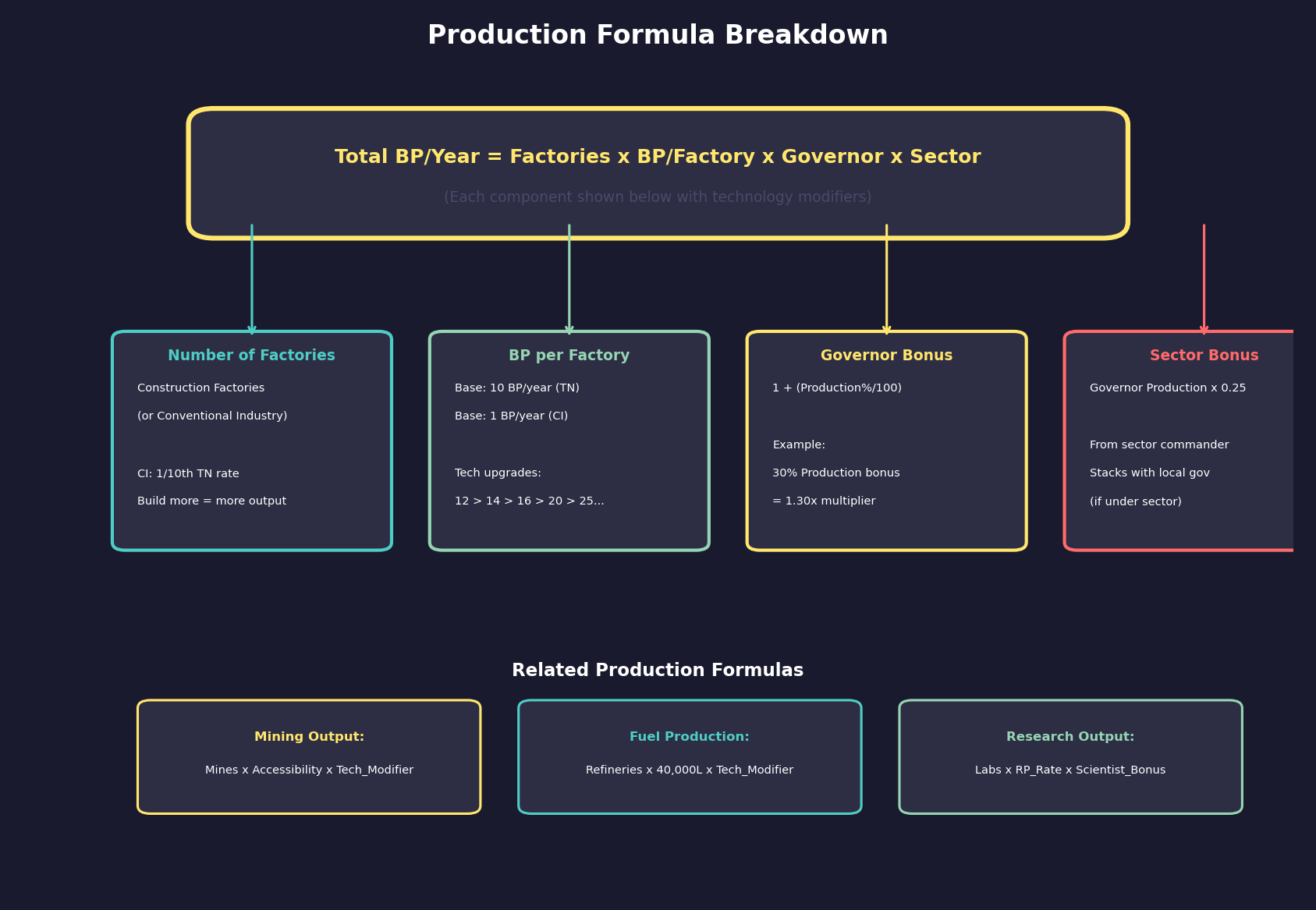
18.1.2.1 Construction Rate
The base construction rate is determined by the number of Construction Factories (see Section 6.3 Construction) (or Conventional Industry) and their per-unit output:
Total BP/Year = Number_of_Factories x BP_per_Factory x Governor_Bonus x Sector_Bonus
Where:
- BP_per_Factory = 10 BP/year for TN Construction Factories (adjustable via technology) \hyperlink{ref-18.1-2}{[2]}
- Governor_Bonus = 1 + (Production_Bonus_Percentage / 100) for assigned governors \hyperlink{ref-18.1-3}{[3]}
- Sector_Bonus = Governor’s Production bonus x 0.25 for Industrial command type administrators \hyperlink{ref-18.1-4}{[4]}
18.1.2.2 Conventional Industry
Conventional Industry produces at 1 BP/year per unit (1/10th the rate of TN factories) \hyperlink{ref-18.1-5}{[5]}. It does not require TN minerals but can only produce items on the Conventional Industry production list (infrastructure, ground forces, some basic installations).
18.1.2.3 Mining Production
Annual_Output_per_Mine = Accessibility x 1_unit_per_year x Tech_Modifier
Where:
- Accessibility ranges from 0.1 to 1.0 (determines what fraction of the deposit is practically extractable per mine) \hyperlink{ref-18.1-6}{[6]}
- Tech_Modifier increases with mining production technology (base is 1.0) \hyperlink{ref-18.1-7}{[7]}
Mines deplete deposits over time. When a deposit reaches zero, mines on that body for that mineral become idle.
18.1.2.4 Fuel Production
Fuel/Year = Number_of_Refineries x Base_Fuel_Rate x Tech_Modifier
The base fuel production rate is 40,000 litres per refinery per year \hyperlink{ref-18.1-8}{[8]}, upgradeable through fuel production technology. Refineries consume Sorium at a fixed ratio of 1 ton per 2,000 litres refined. Each refinery requires a matching supply of Sorium from mining or stockpiles.
18.1.2.5 Research Points
RP/Year = Sum(Lab_Output x Scientist_Bonus)
Where:
- Lab_Output = base research output per lab (set by the racial Research Rate technology; the lowest tier is 240 RP/year per lab) \hyperlink{ref-18.1-9}{[9]}
- Scientist_Bonus = 1 + (Bonus_Percentage / 100). In-field specialization quadruples the bonus percentage. For example, a scientist with a 25% bonus researching in-field gets 25% x 4 = 100%, for a 2x multiplier on RP output \hyperlink{ref-18.1-10}{[10]}
- The number of labs a scientist can manage is limited to 5x their Research Admin rating \hyperlink{ref-18.1-11}{[11]}
18.1.2.6 Wealth and Financial Output
Annual_Wealth = Population x Tax_Rate x Financial_Centre_Bonus
Financial Centres increase wealth generation. Each Financial Centre adds a fixed amount to yearly income.
18.1.3 Combat Resolution Details
Updated: v2026.02.15
18.1.3.1 Turn Order in Combat
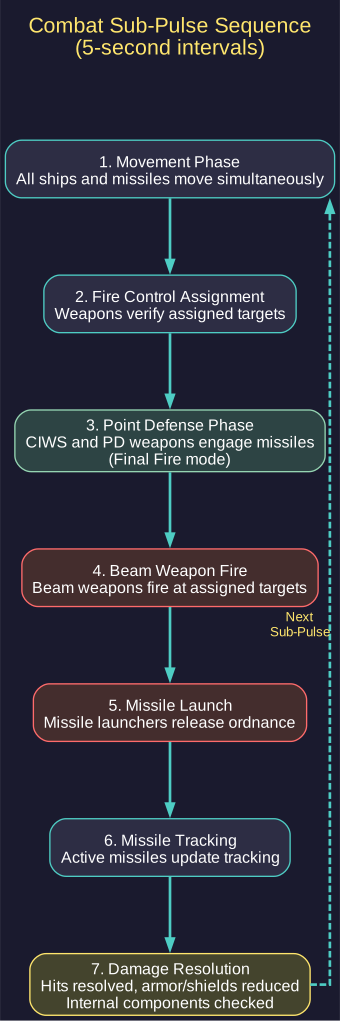
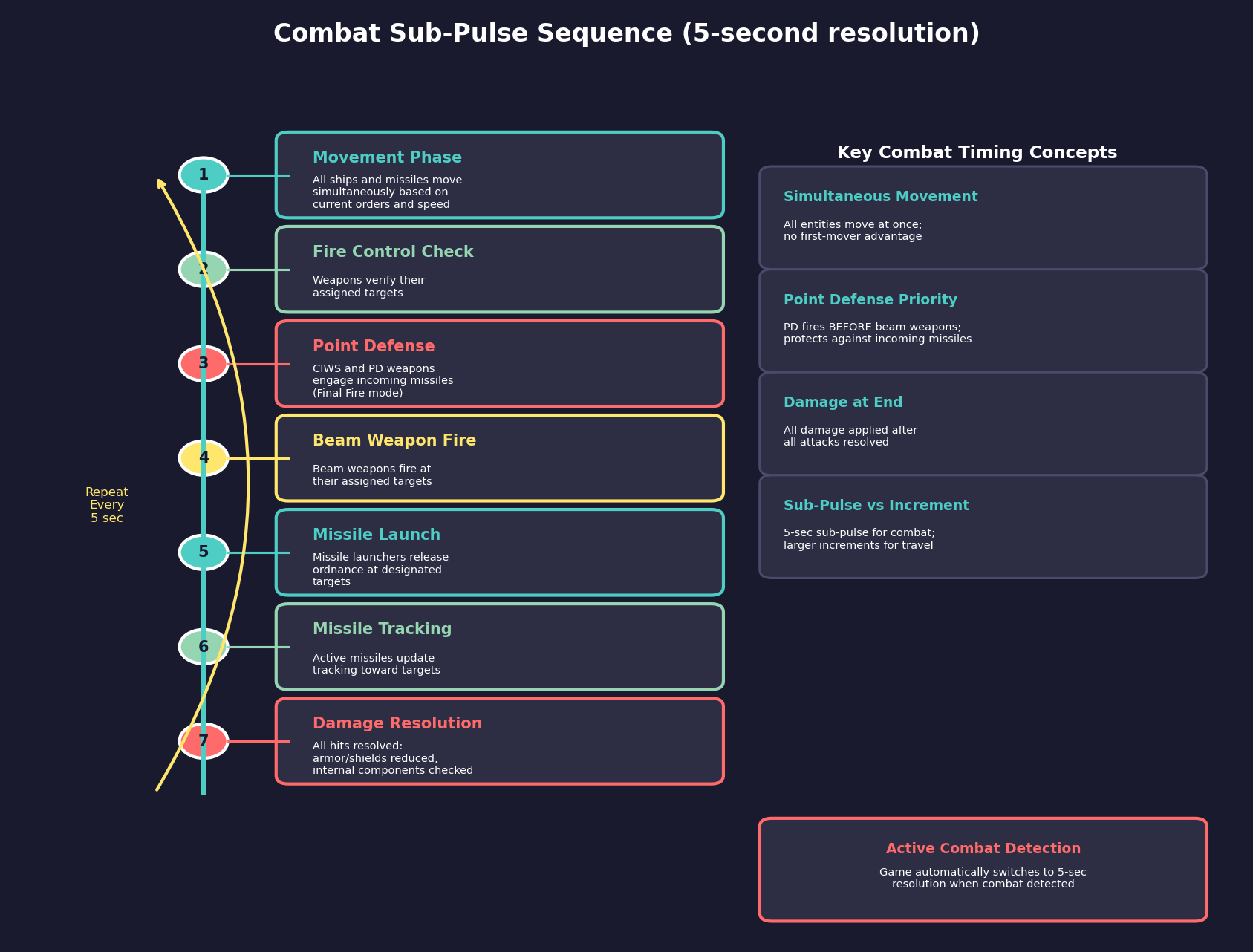
Combat in Aurora C# is resolved in a specific sequence within each combat sub-pulse (see Section 12.1 Fire Controls) (typically 5-second intervals during active engagements) \hyperlink{ref-18.1-12}{[12]}:
- Movement phase: All ships and missiles move simultaneously based on their current orders and speed
- Fire Control assignment check: Weapons verify their assigned targets
- Point Defense phase: CIWS and PD-flagged weapons engage incoming missiles in Final Fire mode
- Beam weapon fire: Beam weapons fire at their assigned targets
- Missile launch: Missile launchers release ordnance at designated targets
- Missile tracking: Active missiles update their tracking toward targets
- Damage resolution: All hits are resolved, armor/shields reduced, internal components checked
18.1.3.2 Beam Weapon To-Hit Calculation
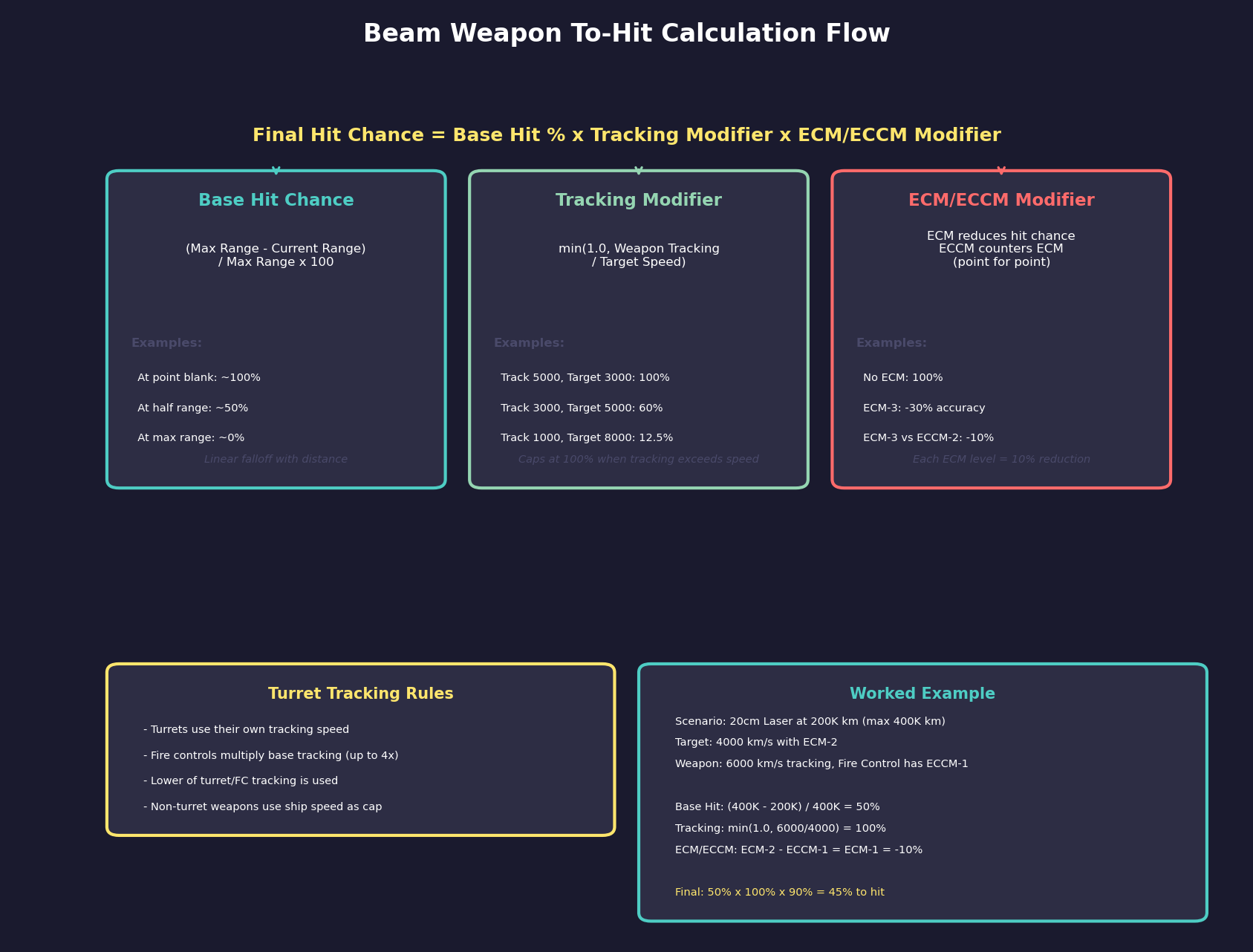
Base_Hit_Chance = (Max_Range - Current_Range) / Max_Range x 100
Tracking_Modifier = min(1.0, Weapon_Tracking_Speed / Target_Speed)
Final_Hit_Chance = Base_Hit_Chance x Tracking_Modifier x ECM/ECCM_Modifier
Key modifiers:
- ECM reduces the effective hit chance by the ECM level \hyperlink{ref-18.1-13}{[13]}
- ECCM on the fire control counters ECM point-for-point
- Tracking speed caps the maximum hit chance if the target is moving faster than the weapon can track
- Turrets use their own tracking speed (set via turret rotation gear technology) rather than ship speed. Fire controls can multiply base tracking speed by up to 4x. The lower of turret tracking speed and fire control tracking speed is used in calculations \hyperlink{ref-18.1-14}{[14]}
18.1.3.3 Missile Hit Resolution
Missiles use a different resolution system:
Missile_Hit_Chance = Missile_ECM_vs_Target_ECCM modifier
The missile must first survive point defense fire. Once it reaches the target (range 0), it detonates. Hit chance is determined by the speed ratio between missile and target \hyperlink{ref-18.1-15}{[15]}:
Base_Hit_Chance = 0.1 × (Missile_Speed / Target_Speed)
Active Terminal Guidance (0.25 MSP component, costs Uridium) provides an additive accuracy bonus from +15% to +60% based on technology level. See Section 12.3 Missiles for the full technology progression.
18.1.3.4 Armor Penetration
When a weapon hits, damage is applied to the armor at a random column location:
- Each hit reduces armor depth at the struck column
- If armor depth at that column reaches 0, subsequent hits penetrate to internal components
- Internal damage is resolved by rolling against the component list — each internal component has a chance of being hit proportional to its HTK (Hit to Kill) size relative to the total internal HTK \hyperlink{ref-18.1-16}{[16]}
- A component struck loses 1 HTK; when all HTK are lost, the component is destroyed
18.1.3.5 Shield Mechanics
Shields absorb damage before it reaches armor:
Shield_Absorption = min(Damage, Current_Shield_Strength)
Remaining_Damage = Damage - Shield_Absorption
Shields regenerate based on the Shield Regeneration Rate technology, which starts at rate 1 and progresses through 1.5, 2, 2.5, 3, 4, 5, 6, 8, 10, 12, and 15 \hyperlink{ref-18.1-17}{[17]}. Shields protect uniformly regardless of hit location. Note that active shields increase a ship’s EM signature by 3x their shield strength.
18.1.3.6 Critical Hits and Explosions
- Magazine detonation: If a magazine is hit and has ordnance loaded, there is a chance of explosion. Explosion damage equals the total warhead strength of all stored missiles, applied to the ship and potentially nearby vessels.
- Engineering hit: Damage to engineering spaces can cause secondary fires and progressive damage if not controlled by damage control teams.
- Power plant hit: Destruction of the main power plant disables all energy weapons and may reduce maximum speed.
18.1.3.7 Electronic Warfare
- ECM: Each level reduces enemy fire control accuracy by 10% (applied per-level, not cumulative multiplication). ECM level 3 means the enemy needs 30% more range accuracy to hit.
- ECCM: Mounted on fire controls, each level negates one level of target ECM. A FC with ECCM-2 firing at a target with ECM-3 effectively faces only ECM-1.
- Cloaking: Reduces the ship’s thermal and EM signature by the cloak percentage. A 60% cloak means sensors detect only 40% of the actual signature, dramatically reducing detection range.
18.1.3.8 Area-Effect Weapons
Weapons that bypass armor (such as meson cannons) strike internal components directly. Meson cannons are single-target weapons, not area-effect; they ignore armor on the targeted ship but do not deal splash damage. This makes them extremely dangerous against individual targets but they typically have shorter range and lower accuracy.
Missile warheads can be designed with variable damage ratings. Higher-damage warheads destroy more armor columns per hit but increase missile size, reducing speed and making them easier to intercept. Note: missile agility was removed from hit calculations in v2.2.0 (see Section 18.1.3.3); hit chance is now based entirely on the speed ratio between missile and target plus optional Active Terminal Guidance.
18.1.4 Salvage Mechanics
Updated: v2026.01.30
18.1.4.1 Salvage Process
When a wreck is salvaged, recovered minerals and components go to freighters in the same fleet (see Section 9.1 Shipyards) as the salvage ship. C# Aurora introduces enhanced mechanics for orbital salvage operations.
Wreck Size Precision (v2.0.0+): As of v2.0.0, wreck sizes are no longer rounded down to the nearest 50 tons. Wrecks now retain their exact tonnage, providing more accurate salvage yields and better intelligence about the original ship’s displacement. (unverified — #837 – requires live testing to confirm version attribution)
Orbital Salvage Enhancement:
When the following conditions are all met, recovered materials are added directly to the population stockpile rather than requiring freighter transport:
- The wreck is in orbit of a population belonging to the same race as the salvage ship
- No freighters are available in the salvage fleet
- Either a ship in the salvage fleet or the population possesses cargo shuttles
This eliminates micromanagement by allowing salvage materials to automatically transfer to nearby friendly populations when transport capacity is limited.
18.1.4.2 Wreck Detection Events
A detection event system triggers when a ship belonging to another faction is destroyed in the same system as either a ship or deep space tracking station of your race. This enables monitoring of combat occurring in nearby space.
Alien Salvage Events:
An “Alien Salvage” event is generated when a wreck disappears in a monitored system without being salvaged by your own forces. This indicates that another faction has recovered the destroyed vessel’s remains.
Detection Requirements:
Both wreck detection and alien salvage events require the presence of either:
- An active ship in the system, or
- A deep space tracking station
These capabilities provide strategic intelligence about nearby conflicts and resource recovery efforts conducted by other races.
18.1.4.3 Technology Acquisition from Wrecks
Salvaging wrecks can yield technology insights from the components recovered. However, as of v2.0.3, ruin-only technologies can no longer be gained from wreck salvage (unverified — #837 – requires live testing to confirm version attribution). Technologies flagged as exclusive to xenoarchaeological ruins (such as certain advanced or unique techs found only in ancient ruins) cannot be reverse-engineered from wreckage, even if an NPC ship was somehow equipped with ruin-derived components. The database confirms that ruin-only technologies exist (marked with RuinOnly=True in the tech system) \hyperlink{ref-18.1-18}{[18]}. This restriction ensures that ruin technologies retain their unique discovery-based acquisition path.
18.1.5 Jump point and universe generation
Updated: v2026.01.30
18.1.5.1 Avoidance of Closed Universe
Aurora C# implements safeguards to prevent players from becoming trapped in known space by ensuring at least one avenue of exploration always remains available.
Standard jump point exploration:
Normally, when jump point exploration takes place, there is a small chance to link to an existing system rather than generating a new one. However, this probability is deliberately bypassed under specific conditions.
Closing Loop Prevention:
The system checks whether a jump point is the only unexplored exit from known space. If so, it will not allow that final connection to link back to an existing system, even though such loops are normally possible.
Random Stars Game Safeguards:
For randomly generated star maps with limited system counts or configurations prone to loops:
- The code makes 20 attempts to find a new system before accepting a link to an existing system (unverified — #837 – requires live testing)
- Any newly generated system created via the final unlinked jump point must contain a minimum of two jump points (unverified — #837 – requires live testing)
This ensures players always have unexplored space accessible through at least one jump point, preventing scenarios where exploration becomes impossible.
18.1.6 Non-Support Fighter Missions
Updated: v2026.02.15
Note: This section documents fighter mission mechanics that affect ground combat outcomes. For general fighter design, see Section 8.1 Design Philosophy. For ground combat mechanics, see Section 13.3 Ground Combat.
Fighters (see Section 12.3 Missiles) can be assigned non-support missions when operating over battlefields. These require a fleet composed only of fighters with orders targeting a system body as destination.
18.1.6.1 Search and Destroy
This mission allows fighters to attack targets of opportunity on planets with enemy ground forces:
- Fighters do not need to be assigned to a friendly ground formation and operate independently
- Fighters automatically select hostile formations regardless of field position
- Hit chance is reduced to 33% of normal (unverified — #837 – requires live testing)
- Hostile anti-aircraft units will engage as they would during standard ground support operations
18.1.6.2 Flak Suppression
This mission focuses on neutralizing enemy air defense systems:
- Fighters select any hostile formation regardless of field position
- Hit chance is 50% of normal (higher than Search and Destroy since targets are pre-identified) (unverified — #837 – requires live testing)
- Only anti-aircraft elements within formations are targeted; if none are present, no air-to-ground attack takes place
- Hostile AA fires on the fighters even if the fighters do not successfully engage
18.1.6.3 Operational Requirements
Both missions require:
- A fleet composed only of fighters
- Orders with a system body as destination
- Enemy ground forces present on the target body
Related Sections
- Section 6.2 Mining – Production formulas and construction factory output
- Section 8.1 Design Philosophy – Ship design parameters used in formula calculations
- Section 12.1 Fire Controls – Combat resolution mechanics and weapon to-hit formulas
- Section 13.1 Unit Types and Formation Design – Fighter non-support missions against ground targets
- Appendix A: Formulas – Comprehensive formula reference including all calculations discussed here
References
\hypertarget{ref-18.1-1}{[1]}. Aurora C# beam combat to-hit formula: Base_Hit_Chance = (Max_Range - Current_Range) / Max_Range x 100. At maximum range, this yields 0%. The previous claim of “50% at max range” was incorrect and contradicted the formula in Section 18.1.3.2. Corrected per formula verification. – AuroraWiki, “Combat Overview” (aurorawiki2.pentarch.org)
\hypertarget{ref-18.1-2}{[2]}. Aurora C# game database (AuroraDB.db v2.7.1) – DIM_PlanetaryInstallation: Construction Factory has ConstructionValue=1.0; AuroraWiki confirms base rate of 10 BP/year per factory
\hypertarget{ref-18.1-3}{[3]}. Aurora C# game database (AuroraDB.db v2.7.1) – DIM_CommanderBonusType: Production bonus (BonusID=5) has Percentage=1 (1% per level), MaximumBonus=1.5 (150%). Correction: The original text used “Manufacturing_Skill x 0.05”; the actual mechanic is a percentage-based Production bonus applied by the governor.
\hypertarget{ref-18.1-4}{[4]}. Aurora C# game database (AuroraDB.db v2.7.1) – DIM_NavalAdminCommandType CommandTypeID=6 (Industrial): Industrial column=0.25, meaning the Industrial command type passes 25% of the commander’s Production bonus to subordinate populations. Note: “Sector Command” is a separate planetary installation (DIM_PlanetaryInstallation ID=20), not a naval admin command type. Other command types pass different fractions of different bonuses (e.g., Naval passes 0.25 of Engineering, CrewTraining, Tactical, and Reaction but 0.0 of Industrial).
\hypertarget{ref-18.1-5}{[5]}. Aurora C# game database (AuroraDB.db v2.7.1) – DIM_PlanetaryInstallation: Conventional Industry has ConstructionValue=0.1 vs Construction Factory at 1.0, confirming the 1/10th ratio
\hypertarget{ref-18.1-6}{[6]}. Aurora C# standard mineral deposit mechanic – Accessibility values range from 0.1 to 1.0 as documented on AuroraWiki, “Population and Production” (aurorawiki2.pentarch.org)
\hypertarget{ref-18.1-7}{[7]}. Aurora C# game database (AuroraDB.db v2.7.1) – FCT_TechSystem: Mining Production technologies (TechTypeID=26) range from 12 to 70 tons per year
\hypertarget{ref-18.1-8}{[8]}. Aurora C# game database (AuroraDB.db v2.7.1) – FCT_TechSystem TechTypeID=32 (Improved Fuel Production): first upgrade is 48,000 litres, confirming base refinery output of 40,000 litres/year. Sorium conversion ratio is 1 ton per 2,000 litres refined. Correction: The original text stated “2,000 litres”; the actual base rate is 40,000 litres/year, upgradeable via Fuel Production technology.
\hypertarget{ref-18.1-9}{[9]}. Aurora C# game database (AuroraDB.db v2.7.1) – FCT_TechSystem: Research Rate technologies (TechTypeID=29) start at 240 RP/year and progress to 1500 RP/year. Correction: The original text stated “typically 10 RP per lab”; the actual base is determined by the Research Rate technology, with the lowest tier at 240 RP/year per lab.
\hypertarget{ref-18.1-10}{[10]}. AuroraWiki, “Research” – Scientists have a percentage bonus (e.g., 25%) that is quadrupled (4x) when researching in their field of specialization. Correction: The original text stated “1 + (Scientist_Skill x 0.2)” with “a skill-25 scientist provides a 6x multiplier”; the actual mechanic is a percentage bonus with 4x in-field specialization.
\hypertarget{ref-18.1-11}{[11]}. AuroraWiki, “Research” – Maximum assigned labs is 5x the scientist’s Research Admin rating
\hypertarget{ref-18.1-12}{[12]}. Aurora C# standard combat resolution occurs in 5-second sub-pulses during active combat – AuroraWiki, “Combat Overview” (aurorawiki2.pentarch.org)
\hypertarget{ref-18.1-13}{[13]}. Aurora C# game database (AuroraDB.db v2.7.1) – FCT_TechSystem: Missile ECM technologies (TechTypeID=279) range from ECM-0 to ECM-10
\hypertarget{ref-18.1-14}{[14]}. AuroraWiki, “Turret” – Turret tracking speed is set by turret rotation gear technology. Fire controls can multiply base tracking speed from 0.5x to 4x. The lower of turret tracking and fire control tracking is used. Correction: The original text stated “4x (single turret) or 3x per weapon (multi-weapon turrets)”; the actual 4x applies to fire control speed rating, not a per-turret multiplier.
\hypertarget{ref-18.1-15}{[15]}. Aurora C# v2.2.0+ missile hit chance formula: Base_Hit_Chance = 0.1 × (Missile_Speed / Target_Speed). Missile agility was removed. Active Terminal Guidance adds +15% to +60% bonus. See Appendix A and Section 12.3 for complete details.
\hypertarget{ref-18.1-16}{[16]}. Aurora C# internal damage resolution – each component has HTK values; the database tracks component HTK in FCT_ShipDesignComponents. AuroraWiki, “Combat Overview” (aurorawiki2.pentarch.org)
\hypertarget{ref-18.1-17}{[17]}. Aurora C# game database (AuroraDB.db v2.7.1) – FCT_TechSystem: Shield Regeneration Rate technologies (TechTypeID=14) progress from 1, 1.5, 2, 2.5, 3, 4, 5, 6, 8, 10, 12, 15. Correction: The original text stated “0.3 shield points per shield emitter per 5-second increment”; the actual regeneration is governed by the Shield Regeneration Rate technology starting at rate 1.
\hypertarget{ref-18.1-18}{[18]}. Aurora C# game database (AuroraDB.db v2.7.1) – FCT_TechSystem: RuinOnly column (Boolean) marks technologies exclusive to xenoarchaeological discovery. Examples include Advanced Laser Focal Size, Advanced Particle Beam, Advanced Railgun, and Advanced Carronade technologies.