5.3 Environment
Updated: v2026.02.15

Note: Claims in this section have been verified against the AuroraDB.db v2.7.1 game database where possible. Numbered references indicate verified sources.
Contents
Updated: v2026.02.15
- 5.3 Environment
- Contents
- 5.3.1 Colony Cost Factors
- 5.3.2 Habitability
- 5.3.3 Environmental Hazards
- 5.3.4 Greenhouse Gases and Surface Temperature
- 5.3.5 Earth Death Spiral
- 5.3.6 Environment Tab Display
- Related Sections
- References
5.3.1 Colony Cost Factors
Updated: v2026.02.15
Colony cost is the comprehensive measure of how hostile a world is to human habitation. Understanding what drives colony cost allows you to make informed decisions about where to colonize and where to focus terraforming efforts.
5.3.1.1 Temperature as a Cost Factor
Temperature is typically the single largest contributor to colony cost:
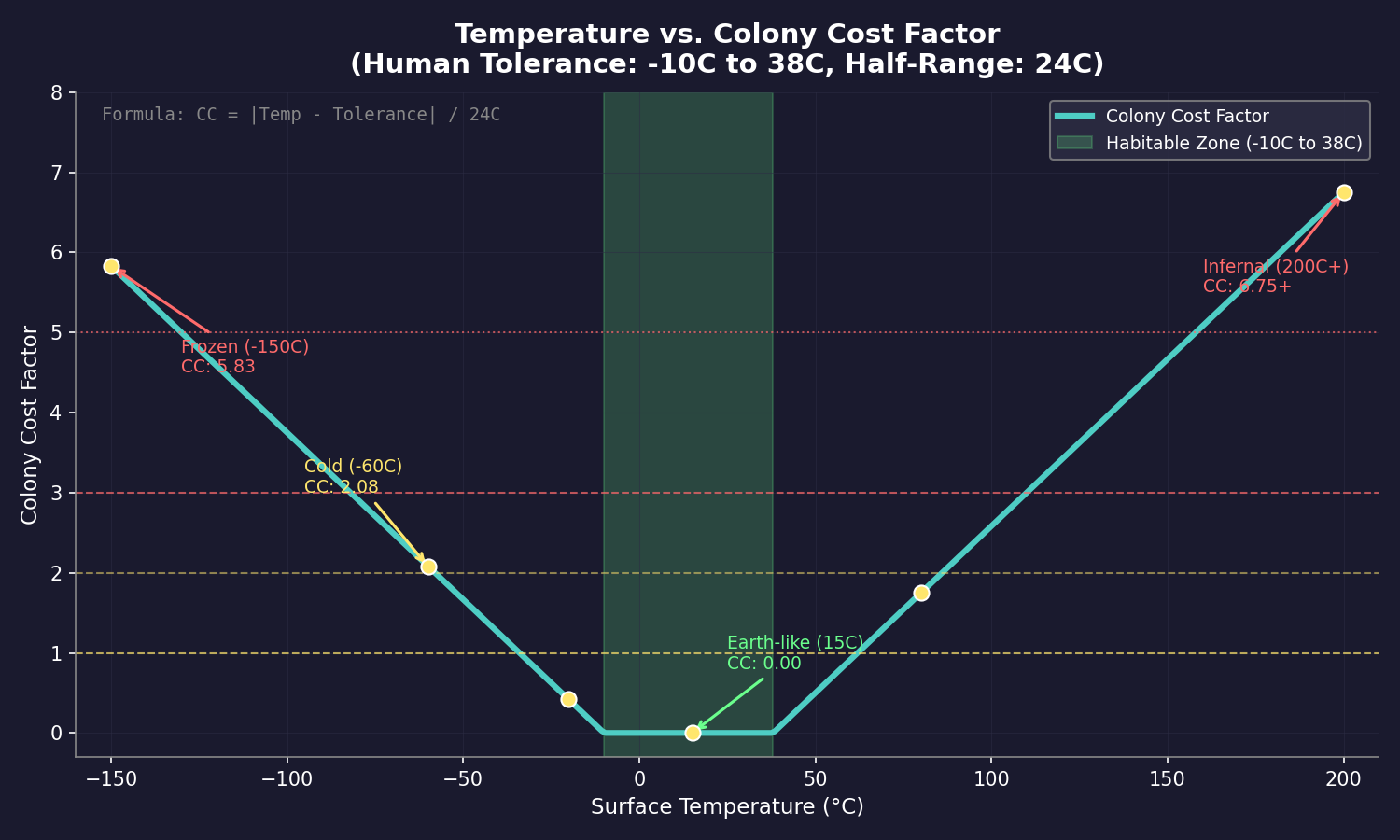
How Temperature Affects Cost:
- When surface temperature falls outside the species’ tolerance range, the cost factor is: Degrees outside tolerance / (Species temperature range / 2) \hyperlink{ref-5.3-11}{[11]}
- For tide-locked planets, the temperature cost is reduced to 20% of normal \hyperlink{ref-5.3-11}{[11]}
- The formula means a species with a 48-degree tolerance range (e.g., the default human range of approximately -10C to 38C) gains 1.0 colony cost for every 24C outside that range \hyperlink{ref-5.3-1}{[1]}
Temperature Examples (assuming default human baseline -10C to 38C tolerance, half-range 24C): \hyperlink{ref-5.3-1}{[1]}
| Surface Temperature | Approximate Cost Factor |
|---|---|
| 15C (Earth-like) | 0.00 |
| -20C (Cold) | ~0.42 |
| -60C (Very Cold) | ~2.08 |
| -150C (Frozen) | ~5.83 |
| 80C (Hot) | ~1.75 |
| 200C+ (Infernal) | ~6.75+ |
5.3.1.2 Atmospheric Composition as a Cost Factor
The atmosphere contributes to colony cost through several distinct mechanisms. Remember that in C# Aurora, only the highest single factor applies:
Atmospheric Pressure:
- If pressure exceeds species maximum tolerance: Colony cost is immediately 2.0, and if pressure exceeds double the tolerance, colony cost increases proportionally \hyperlink{ref-5.3-13}{[13]}
- Insufficient pressure (no breathable atmosphere): contributes through the Breathable Gas factor
Breathable Gas (Oxygen for Humans):
- A flat cost factor of 2.00 applies when breathable gas partial pressure is either too low for respiration or exceeds 30% of total atmospheric pressure \hyperlink{ref-5.3-2}{[2]}
- This represents the need for sealed habitation with supplemental life support
Dangerous Gases:
- Various gases trigger cost factors of 2.00 or 3.00 depending on concentration thresholds
- Halogens (fluorine, chlorine, bromine): trigger at 1 ppm concentration \hyperlink{ref-5.3-3}{[3]}
- Carbon dioxide: triggers at 5,000 ppm (0.5% of atmosphere) – note that CO2 is classified as a dangerous gas in C# Aurora \hyperlink{ref-5.3-3}{[3]}
- Other dangerous gases have their own concentration thresholds
- Only the single worst dangerous gas factor applies (they do not stack)
5.3.1.3 Gravity as a Cost Factor
Gravity affects colonization in a binary manner in C# Aurora:
- Below species minimum tolerance: The body receives a flat colony cost of 1.00 and requires double the amount of infrastructure to support colonists \hyperlink{ref-5.3-13}{[13]}
- Above species maximum tolerance: The body cannot be colonized at all
- Within tolerance range: No colony cost from gravity
- Below 0.1g: The body cannot retain atmosphere, preventing terraforming (but colonization with infrastructure is still possible)
Unlike temperature and atmosphere, gravity cannot be changed through terraforming.
5.3.1.4 Hydrosphere as a Cost Factor
Water coverage below 20% adds a colony cost factor:
- Formula: Colony cost scales linearly from 0 at 20% hydro extent to 2.0 at 0% hydro extent \hyperlink{ref-5.3-13}{[13]}
- At 0% water: Cost factor of 2.0
- At 10% water: Cost factor of 1.0
- At 20%+ water: No cost from this factor
Water coverage can be increased through terraforming (adding water vapor to the atmosphere). Terraforming adds water at 0.1 atm per year, which adds 4% hydrosphere per year.
5.3.1.4.1 Hydrosphere Changes (v2.0.0)
In v1.13.0, hydrosphere state changes were instantaneous – all surface water would immediately convert to vapor when conditions changed, or all vapor would condense at once. In v2.0.0, these transitions are gradual:
Vapor Hydrosphere Changes:
- Surface water on vapor-type planets now evaporates gradually at 4% hydro extent per year rather than converting instantly \hyperlink{ref-5.3-14}{[14]}
- This allows vapor worlds to retain some surface water during transitions
Liquid Hydrosphere Conversions:
- When planets transition from vapor to liquid types, existing atmospheric water follows terraforming rules with no immediate condensation of existing vapor
- Conversion happens at the standard terraforming rate
Eccentric Orbit Benefits:
- Planets with high orbital eccentricity maintain more stable hydrospheres under the new system
- Bodies spending most time in liquid zones retain water; those spending most time at high temperatures accumulate atmospheric water gradually
- This avoids extreme colony cost swings and makes eccentric orbit planets more manageable for terraforming projects
5.3.1.4.2 Water on Airless Bodies (v2.0.0)
In v1.13.0, bodies generated without atmosphere automatically had no water. This has changed in v2.0.0:
- Bodies without atmospheres can generate ice sheets, provided: (partially verified — exact generation chance not confirmed in changelog)
- Temperature is approximately 223K or colder (equivalent to -50C) — see database evidence \hyperlink{ref-5.3-15}{[15]}
- Gravity is at least 0.1G (required for atmosphere retention)
- If an ice sheet is present, the hydro extent is generated normally through standard processes
- This creates more varied planetary environments and strategic considerations for colonizing frozen airless worlds
5.3.1.5 Workforce Impact at High Colony Costs
At colony cost of 5.0 or higher, the available manufacturing workforce is progressively reduced. As population grows on very hostile worlds, the proportion of workers available for industrial production eventually drops to zero, as the entire workforce becomes occupied with life support and infrastructure maintenance. This makes high colony cost worlds impractical for industrial operations even if they have large populations.
5.3.1.6 Colony Cost is Not Additive
Unlike some strategy games, C# Aurora’s colony cost is determined by taking only the single highest factor from all environmental checks. A world with multiple problems still only uses the worst one for its colony cost. This means fixing the single worst factor about a world can dramatically reduce its colony cost, even if other problems remain.
Example:
- Temperature factor: 3.0 (very cold)
- Dangerous gas factor: 2.0 (trace chlorine)
- Hydrosphere factor: 1.5 (low water)
- Final Colony Cost: 3.0 (only the worst applies)
Removing the temperature problem (e.g., via greenhouse gases) would drop the colony cost to 2.0 immediately.
Tip: When evaluating colony targets, identify which factor dominates the colony cost. If it’s temperature, terraforming via greenhouse gases may be practical. If it’s toxic gases, terraforming installations can remove them. But if it’s gravity – you’re stuck with that cost component permanently.
5.3.2 Habitability
Updated: v2026.01.30
Habitability is the qualitative assessment of how suitable a world is for human life without technological support. A fully habitable world requires no infrastructure, while a completely inhospitable one may be impractical to colonize at all.
5.3.2.1 The Ideal Habitable World
A perfectly habitable world in Aurora C# has these characteristics:
- Temperature: -10C to 38C average surface temperature (default human range; center 14C, half-range 24C) \hyperlink{ref-5.3-1}{[1]}
- Pressure: Up to 4.0 atm maximum total atmospheric pressure (default human tolerance) \hyperlink{ref-5.3-4}{[4]}
- Oxygen: 0.1-0.3 atm partial pressure of O2 \hyperlink{ref-5.3-2}{[2]}
- Nitrogen: Present as the primary atmospheric component \hyperlink{ref-5.3-5}{[5]}
- Gravity: 0.1-1.9g surface gravity (default human range; center 1.0g, deviation 0.9g) \hyperlink{ref-5.3-6}{[6]}
- Toxic Gases: None present at any concentration
- Hydrosphere: Liquid water present (improves habitability aesthetically but is not strictly required for zero colony cost)
Finding such a world is rare. Most colonization targets deviate from the ideal in one or more ways.
5.3.2.2 Habitability Spectrum
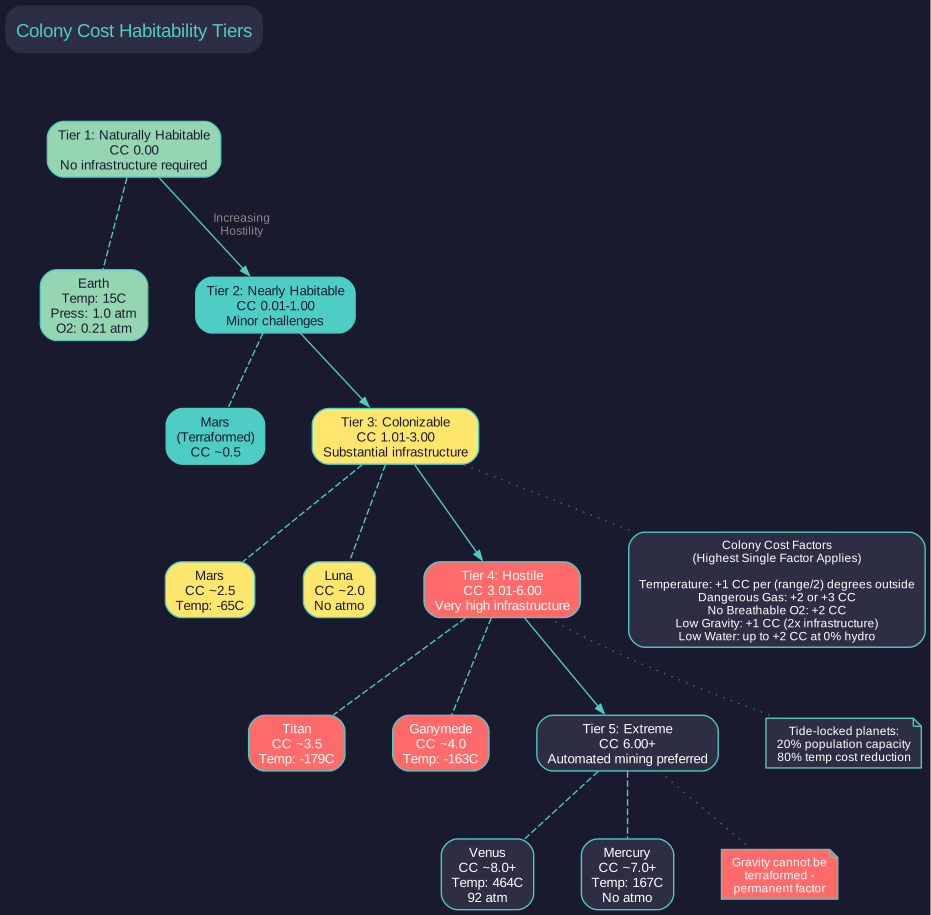
Worlds can be roughly categorized by their habitability:
Tier 1 – Naturally Habitable (Colony Cost 0.00):
- Can sustain human life with no technological support
- Population can live and work outdoors
- Extremely rare in randomly generated systems
- Earth itself is the reference standard
Tier 2 – Nearly Habitable (Colony Cost 0.01-1.00):
- Minor environmental challenges
- Might be slightly too cold, too warm, or have trace atmospheric issues
- Low infrastructure requirements
- Good candidates for terraforming to Tier 1
Tier 3 – Colonizable with Effort (Colony Cost 1.01-3.00):
- Significant environmental challenges but manageable
- Require substantial infrastructure investment
- Most common colonization targets in practice
- Terraforming may reduce costs over decades
Tier 4 – Hostile (Colony Cost 3.01-6.00):
- Severe environmental conditions
- Very high infrastructure requirements
- Only colonized for strategic resources or military necessity
- Long-term terraforming projects or automated mining preferred
Tier 5 – Extreme (Colony Cost 6.00+):
- Nearly uninhabitable conditions
- Infrastructure requirements may be prohibitive
- Usually better served by automated mining installations
- Terraforming likely impractical on reasonable timescales
5.3.2.3 Species Tolerance
Aurora C# allows different species (including your own after genetic modification research) to have different environmental tolerances:
- Temperature Range: Species can be adapted to wider or shifted temperature ranges
- Pressure Tolerance: Some species handle higher or lower pressures naturally
- Gravity Tolerance: Adaptation to different gravity ranges is possible
- Gas Tolerance: Modified species might tolerate gases that are toxic to baseline humans
These modifications effectively reduce colony cost for specific worlds by shifting what counts as “ideal” conditions for that population group.
Tip: Don’t wait for the perfect world. In most games, you’ll colonize Tier 2-3 worlds for their mineral deposits or strategic positions, then terraform them over time while developing the colony. A Tier 3 world with excellent minerals is worth more than a Tier 1 world with nothing to mine.
5.3.3 Environmental Hazards
Updated: v2026.01.30
Beyond the static colony cost factors, several environmental conditions present challenges for colonies. In Aurora C#, atmospheric hazards primarily affect colony cost through the dangerous gas system (see Section 5.5.1 for the complete dangerous gas threshold table \hyperlink{ref-5.3-9}{[9]}). The descriptions below provide context for how these factors affect colony planning.
Note: Many of the specific effects described in this section (infrastructure corrosion, industrial accidents, ship damage from atmosphere, seismic damage) are thematic descriptions rather than confirmed discrete game mechanics. Aurora C# models hostile environments primarily through colony cost, which increases infrastructure requirements and reduces conventional mining efficiency. Individual hazard effects beyond colony cost have not been verified in the database and are marked accordingly.
5.3.3.1 Atmospheric Hazards
Dangerous Gas Atmospheres:
- Atmospheres containing fluorine, chlorine, or bromine trigger colony cost +3.0; other dangerous gases trigger +2.0 \hyperlink{ref-5.3-9}{[9]}
- The colony cost increase represents the infrastructure burden of sealed habitats, air filtration, and protective equipment
- Terraforming to remove these gases below their dangerous thresholds eliminates the colony cost penalty
- Whether corrosive gases cause additional infrastructure maintenance degradation beyond the colony cost effect is unconfirmed (requires live testing — no separate corrosion mechanic confirmed in database)
Pressure Extremes:
- If atmospheric pressure exceeds the species’ maximum tolerance (4.0 atm for default humans \hyperlink{ref-5.3-4}{[4]}), colony cost immediately becomes 2.0, increasing proportionally if pressure exceeds double the tolerance \hyperlink{ref-5.3-13}{[13]}
- Whether high pressure causes discrete structural failure events beyond the colony cost penalty is unconfirmed (requires live testing — not confirmed in database)
5.3.3.2 Radiation Hazards
Radiation is tracked as a discrete game mechanic through the RadiationLevel field on planetary bodies \hyperlink{ref-5.3-10}{[10]}. However, radiation does not affect colony cost or habitability directly – it is introduced specifically through nuclear warhead bombardment and decays over time.
Key Points:
- Radiation is not a natural environmental hazard from stellar proximity or gas giant radiation belts – it only accumulates through bombardment
- Radiation does not increase colony cost or require infrastructure support
- For radiation accumulation, decay mechanics, and decontamination units, see Section 12.6.5 Radiation and Decontamination
Note: If you are looking for information about radiation as an environmental hazard affecting colonization, Aurora C# does not model natural radiation exposure. The radiation mechanic is purely a bombardment consequence.
5.3.3.3 Geological Hazards (requires live testing — geological hazard mechanics)
Volcanism and tectonic activity are not confirmed as discrete game mechanics that destroy installations or alter atmospheres. Aurora C# does not appear to model seismic or volcanic events as separate from the colony cost system. (requires live testing — no geological hazard mechanics found in database)
5.3.3.4 Temperature Extremes
Temperature extremes are modeled through the colony cost system. The temperature-based colony cost factor increases proportionally as surface temperature deviates from the species’ tolerance range \hyperlink{ref-5.3-1}{[1]}. Extremely cold or hot worlds have very high colony costs, requiring proportionally more infrastructure per million population. Whether temperature causes additional discrete effects (fuel freezing, material failure) beyond the colony cost penalty is unconfirmed. (requires live testing — not confirmed in database)
5.3.3.5 Mitigating Environmental Hazards
Short-term Mitigation:
- Build sufficient infrastructure to support population at the current colony cost
- Use automated mines on hostile worlds to avoid population requirements entirely
- Keep construction factories available for replacing infrastructure as needed
Long-term Solutions:
- Terraform to remove hazardous atmospheric components (see Section 5.5 Terraforming)
- Adjust greenhouse gases to moderate temperature extremes (see Section 5.3.4)
- Genetic modification of colonists for different environmental tolerances (see Section 7.1 Technology Tree)
- Relocate populations to more habitable worlds when practical
Tip: Always check a world’s atmospheric composition for dangerous gases before committing to a major colony. A world that looks good on paper (reasonable temperature, acceptable gravity) might have trace fluorine at 1 ppm that adds +3.0 to colony cost \hyperlink{ref-5.3-9}{[9]}. The Environment tab in the colony view shows exactly which factors contribute to your colony cost.
5.3.4 Greenhouse Gases and Surface Temperature
Updated: v2026.01.30
Surface temperature in Aurora C# is calculated from a combination of base stellar heating, greenhouse effects, and anti-greenhouse (cooling) effects. Understanding these mechanics is essential for both evaluating colony targets and planning terraforming operations.
5.3.4.1 Temperature Calculation Formula
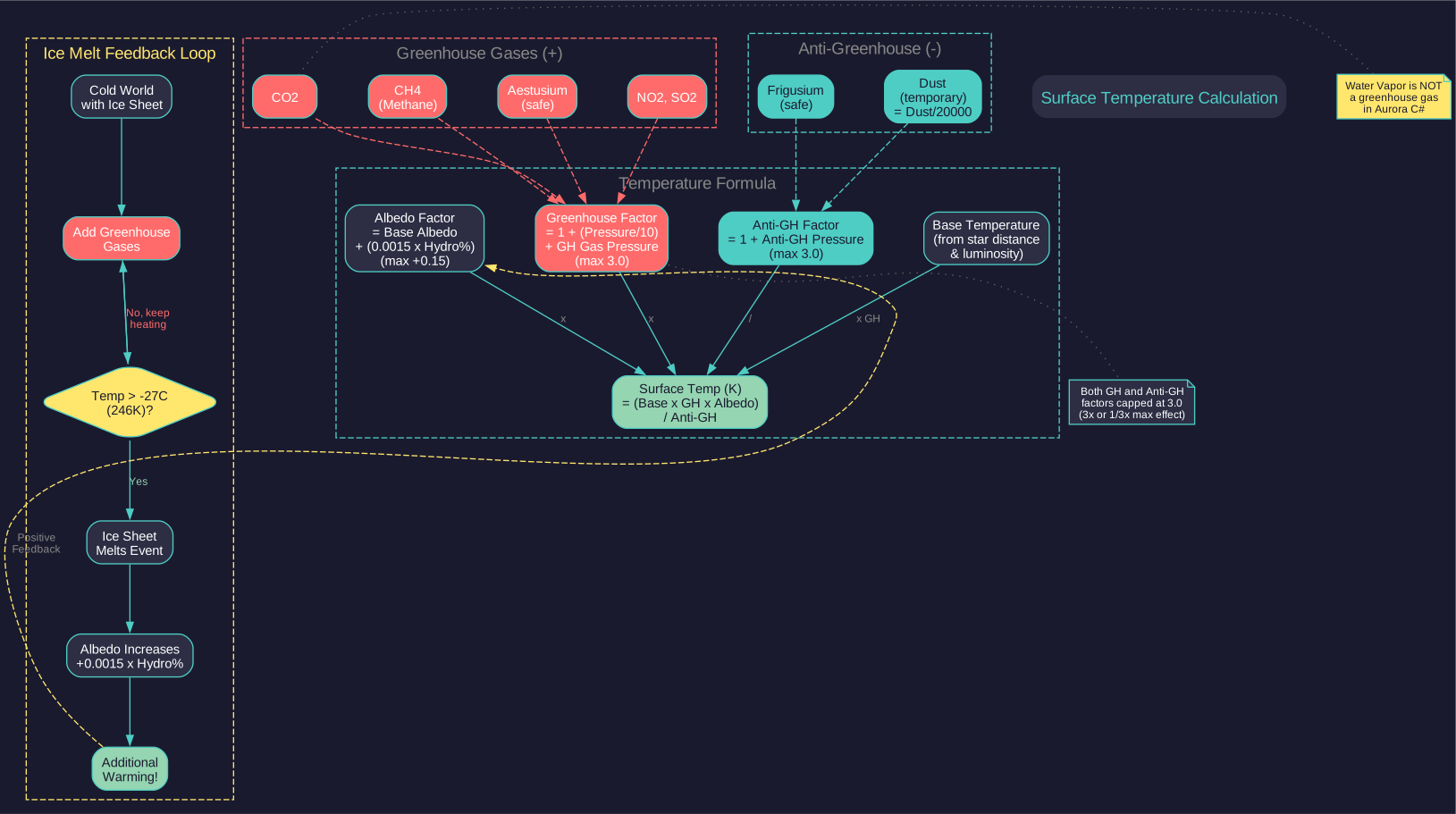
The surface temperature of a body is determined by the following formula:
Surface Temperature (K) = (Base Temperature (K) x Greenhouse Factor x Albedo) / Anti-Greenhouse Factor
Where:
Base Temperature is determined by the body’s distance from its parent star and the star’s luminosity.
Greenhouse Factor = 1 + (Atmospheric Pressure / 10) + Pressure of Greenhouse Gases \hyperlink{ref-5.3-12}{[12]}
- This factor is capped at a maximum of 3.0 \hyperlink{ref-5.3-12}{[12]}
- Greenhouse gases include: CO2, methane, nitrogen dioxide, sulphur dioxide, and Aestusium \hyperlink{ref-5.3-7}{[7]}. Note: water vapor is not classified as a greenhouse gas in the game database despite real-world properties.
- Higher atmospheric pressure provides a modest greenhouse contribution even without dedicated greenhouse gases
Anti-Greenhouse Factor = 1 + Pressure of Anti-Greenhouse Gases \hyperlink{ref-5.3-16}{[16]}
- This factor is capped at a maximum of 3.0 \hyperlink{ref-5.3-16}{[16]}
- Note: The exact contribution of dust to the anti-greenhouse factor is (requires live testing — dust mechanics may differ from community observation)
- Anti-greenhouse gases act as divisors, cooling the planet. Frigusium is the only anti-greenhouse gas in the game database. \hyperlink{ref-5.3-8}{[8]}
- Dust functions mechanically as a temporary anti-greenhouse effect
Albedo = Base planetary albedo + (0.0015 x Hydro Extent %) \hyperlink{ref-5.3-16}{[16]}
- The albedo increase from surface water is capped at a maximum of 0.15 (at 100% Hydro Extent) \hyperlink{ref-5.3-16}{[16]}
- Base planetary albedo varies by body type and is set during system generation
- Albedo is a multiplier in the numerator, so higher albedo increases surface temperature in this formula (note: this differs from real-world physics where higher albedo reflects more energy and cools a body; Aurora’s formula uses albedo as a warming factor)
Ice Sheet Melt Threshold:
When a body’s surface temperature rises above approximately -27°C (246K), an “Ice Sheet Melted” event occurs (unverified — #850, forum-derived) \hyperlink{ref-5.3-17}{[17]}:
- The hydrosphere transitions from ice to liquid water
- The Albedo Factor increases by (0.0015 × Hydro Extent %), up to +0.15 at 100% hydro
- Since albedo is a warming multiplier in Aurora’s formula, this creates a positive feedback loop — the ice melt causes additional warming (unverified — #850, requires live testing)
This feedback loop has significant terraforming implications. On very cold worlds with ice sheets, warming past -27°C triggers a temperature boost from the albedo shift. For example, Titan with 75% hydro extent gains +0.11 to its albedo factor when the ice melts, pushing temperatures from (-32°C to -18°C) up to (-5°C to 11°C) (unverified — #850, community calculation) — the difference between a marginal colony and 0.0 CC.
Tip: On cold worlds with significant ice coverage, consider adding water vapor before Aestusium. Building up hydro extent first maximizes the albedo boost when the ice sheet finally melts.
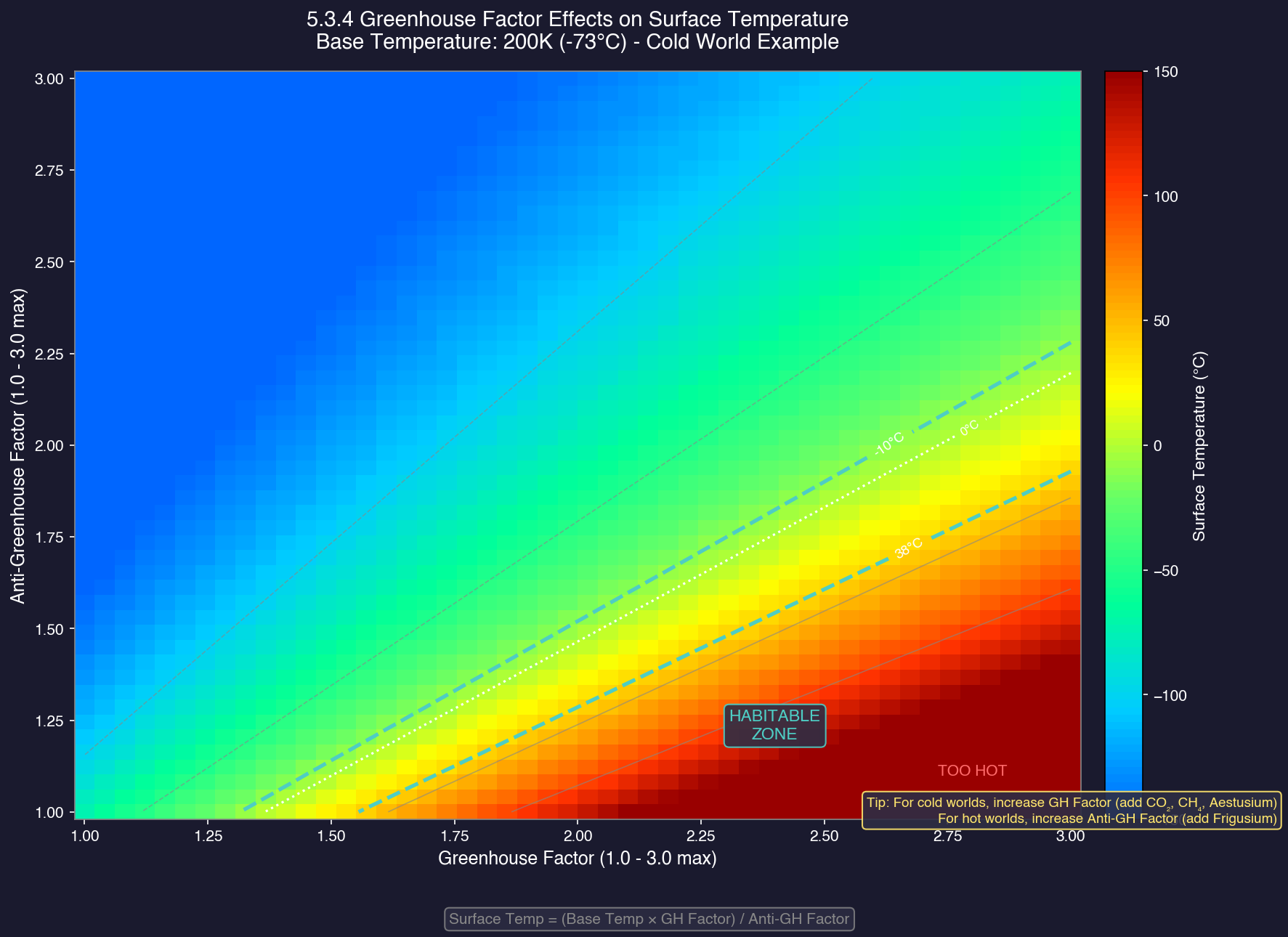
5.3.4.2 Greenhouse vs. Anti-Greenhouse Balance
The system treats anti-greenhouse effects as divisors rather than subtractive values. This design prevents temperatures from dropping below absolute zero (0 K) regardless of anti-greenhouse gas quantities, while still providing meaningful cooling effects.
- A Greenhouse Factor of 3.0 (maximum) triples the base temperature
- An Anti-Greenhouse Factor of 3.0 (maximum) reduces temperature to one-third
- Both at maximum would result in the original base temperature (3.0 / 3.0 = 1.0 multiplier)
5.3.4.3 Dust Mechanics
Dust functions as a temporary anti-greenhouse effect within the temperature calculation:
- Dust reduces surface temperature by increasing the Anti-Greenhouse Factor
- Dust contribution: Dust Level / 20,000 added to the Anti-Greenhouse Factor
- Terraforming equipment cannot remove dust – it dissipates naturally over time
- Dust can be introduced by various game events (asteroid impacts, volcanic activity)
- While dust is present, it may significantly cool a planet, potentially increasing colony cost from temperature
5.3.4.4 Practical Implications
For Cold Worlds:
- Adding greenhouse gases (CO2, CH4) increases the Greenhouse Factor, warming the planet
- Maximum warming is 3x the base temperature (Greenhouse Factor cap of 3.0)
- If the base temperature is very low, even maximum greenhouse warming may be insufficient
For Hot Worlds:
- Adding anti-greenhouse gases cools the planet by increasing the divisor
- Maximum cooling is to 1/3 of the greenhouse-modified temperature
- Removing existing greenhouse gases also helps by reducing the Greenhouse Factor
For Dust-Affected Worlds:
- Dust cooling is temporary but can be significant
- Plan terraforming around dust events – adding greenhouse gases while dust is present may be counterproductive
- Once dust clears, the planet will warm back to its pre-dust temperature
Tip: When planning terraforming for a cold world, first calculate whether the maximum Greenhouse Factor of 3.0 can bring the surface temperature into the habitable range. If 3x the base temperature is still below 0C, no amount of greenhouse gas will make the world habitable through atmospheric modification alone. Focus your terraforming efforts on worlds where the math works out.
5.3.5 Earth Death Spiral
Updated: v2026.02.15
Note: The Earth Death Spiral is a game setup option configured during new game creation. The detailed mechanics are described here for their environmental impact on colonies; for setup instructions, see Section 2.1 New Game Options.
The Earth Death Spiral is a disaster scenario available during game setup that creates an existential challenge requiring players to establish off-world colonies before Earth becomes uninhabitable.
5.3.5.1 Mechanics
Spiral Speed Options: Players select from three rates of planetary degradation: (requires live testing — game setup configuration, speed options not confirmed in database)
- 0.01 AU per year
- 0.02 AU per year
- 0.03 AU per year
Environmental Changes: As Earth approaches the Sun, the game dynamically recalculates planetary conditions. Temperature, year length, and other environmental parameters shift progressively to reflect increasing proximity to the star.
Destruction Threshold: When Earth moves within one million kilometres of the Sun, it is destroyed due to tidal stresses. (requires live testing — destruction threshold not confirmed) Any remaining populations are also destroyed, leaving no survivors on the homeworld.
5.3.5.2 Strategic Impact
This scenario fundamentally shifts Aurora’s strategic focus from planetary management to interplanetary expansion and survival. Players must:
- Research and build colony ships rapidly
- Identify suitable colony targets early
- Transfer industrial capacity off-world before conditions deteriorate
- Balance current production needs against evacuation timelines
The speed option chosen determines how much time players have: at 0.03 AU/year, Earth’s destruction occurs in roughly 50 years; at 0.01 AU/year, players have approximately 150 years. (unverified – #1257 – these timelines may be inflated by ~50%; actual destruction timing depends on Earth’s starting orbital distance and the 1 million km destruction threshold)
5.3.6 Environment Tab Display
Updated: v2026.02.15
The Environment tab in the colony window provides detailed information about a body’s atmospheric composition, temperature, gravity, and habitability factors.
5.3.6.1 Terraforming Capacity Display (v2.6.0)
Added: v2.6.0
The Environment tab now displays active terraforming capacity at the colony location. This includes:
- Terraforming Installations: Ground-based installations actively modifying the atmosphere
- Terraforming Modules: Ship-mounted terraforming modules on vessels stationed at the colony
This consolidated view helps players track total terraforming capacity at a location without needing to check both the colony installation list and orbiting fleet compositions separately. The display is particularly useful for coordinating large-scale terraforming projects that combine ground installations with orbital terraforming ships.
Tip: When planning a major terraforming project, station terraforming ships at the colony to supplement ground installations. The Environment tab will show combined capacity, making it easy to estimate how long atmospheric changes will take.
Related Sections
- Section 5.5 Terraforming – Atmospheric modification and temperature control
- Section 7.1 Technology Tree – Genetic modification and infrastructure technologies
- Section 13.1 Unit Types and Formation Design – Ground forces on hazardous worlds
- Section 14.1 Fuel – Supplying colonies on hostile worlds
- Appendix A: Formulas – Colony cost and temperature calculation formulas
References
\hypertarget{ref-5.3-1}{[1]}. Aurora C# game database (AuroraDB.db v2.7.1) – FCT_Species: Human (SpeciesID 748) has Temperature=287.03K (13.88C center) and TempDev=24.0, giving a tolerance range of -10.12C to 37.88C (48C total width, 24C half-range). The manual previously stated “0-35C” which has been corrected. Note: species tolerances are per-game and may differ from these defaults.
\hypertarget{ref-5.3-2}{[2]}. Aurora C# game database (AuroraDB.db v2.7.1) – DIM_Gases: Oxygen (GasID 10) has Dangerous=2 (colony cost factor +2.0) and DangerousLevel=500.0 ppm. FCT_Species: Human Oxygen=0.2 atm (center), OxyDev=0.1 (deviation), giving breathable range 0.1-0.3 atm. Confirmed.
\hypertarget{ref-5.3-3}{[3]}. Aurora C# game database (AuroraDB.db v2.7.1) – DIM_Gases: Chlorine (GasID 16) Dangerous=3 DangerousLevel=1.0 ppm, Fluorine (GasID 17) Dangerous=3 DangerousLevel=1.0 ppm, Carbon Dioxide (GasID 13) Dangerous=2 DangerousLevel=5000.0 ppm, GHGas=1. All confirmed.
\hypertarget{ref-5.3-4}{[4]}. Aurora C# game database (AuroraDB.db v2.7.1) – FCT_Species: Human (SpeciesID 748) has PressMax=4.0 atm. The manual previously stated “0.7-1.5 atm” which has been corrected. Note: species tolerances are per-game and may differ.
\hypertarget{ref-5.3-5}{[5]}. Aurora C# game database (AuroraDB.db v2.7.1) – DIM_Gases: Nitrogen (GasID 7) has Dangerous=0, DangerousLevel=0.0. Non-toxic at any concentration. Confirmed.
\hypertarget{ref-5.3-6}{[6]}. Aurora C# game database (AuroraDB.db v2.7.1) – FCT_Species: Human (SpeciesID 748) has Gravity=1.0 and GravDev=0.9, giving a tolerance range of 0.1g to 1.9g. The manual previously stated “0.7-1.3g” which has been corrected. Note: species tolerances are per-game and may differ.
\hypertarget{ref-5.3-7}{[7]}. Aurora C# game database (AuroraDB.db v2.7.1) – DIM_Gases: Gases with GHGas=1 (greenhouse): Methane (GasID 3), Carbon Dioxide (GasID 13), Nitrogen Dioxide (GasID 14), Sulphur Dioxide (GasID 15), Aestusium (GasID 20). Water Vapour (GasID 5) has GHGas=0, meaning it is NOT a greenhouse gas in the game database despite common real-world classification.
\hypertarget{ref-5.3-8}{[8]}. Aurora C# game database (AuroraDB.db v2.7.1) – DIM_Gases: Frigusium (GasID 22) is the only gas with AntiGHGas=1. It has Dangerous=0 (non-toxic). Confirmed.
\hypertarget{ref-5.3-9}{[9]}. Aurora C# game database (AuroraDB.db v2.7.1) – DIM_Gases: Complete dangerous gas thresholds. Dangerous=3 (+3.0 CC): Chlorine (GasID 16) 1 ppm, Fluorine (GasID 17) 1 ppm, Bromine (GasID 18) 1 ppm. Dangerous=2 (+2.0 CC): Hydrogen (GasID 1) 500 ppm, Methane (GasID 3) 500 ppm, Ammonia (GasID 4) 50 ppm, Carbon Monoxide (GasID 8) 50 ppm, Nitrogen Oxide (GasID 9) 5 ppm, Oxygen (GasID 10) 500 ppm, Hydrogen Sulphide (GasID 11) 20 ppm, Carbon Dioxide (GasID 13) 5000 ppm, Nitrogen Dioxide (GasID 14) 5 ppm, Sulphur Dioxide (GasID 15) 5 ppm, Iodine (GasID 19) 1 ppm. Cross-reference: ref-5.5-7.
\hypertarget{ref-5.3-10}{[10]}. Aurora C# game database (AuroraDB.db v2.7.1) – FCT_SystemBody table contains RadiationLevel (column 42) and DustLevel (column 43) fields. Radiation accumulates through bombardment and decays over time. See Section 12.6.5 for mechanics.
\hypertarget{ref-5.3-11}{[11]}. Aurora Forums – C# Aurora Changes List v1.00, https://aurora2.pentarch.org/index.php?topic=8495.15 – Steve Walmsley. “If the temperature is outside of the species tolerance, the colony cost factor for temperature is equal to the number of degrees above or below the species tolerance divided by half the total species range.” Also confirms: “The colony cost factor for tide-locked planets is 20% of normal.”
\hypertarget{ref-5.3-12}{[12]}. Aurora Forums – “Terraforming Sol and Basic Terraforming calculations”, https://aurora2.pentarch.org/index.php?topic=3871.0 – Community terraforming guide. Confirms formula: “Greenhouse Factor = 1 + (Atmospheric Pressure / 10) + Greenhouse Pressure (Maximum = 3.0)”. (VB6-era post ~2008-2010; formula may differ in C# Aurora — requires verification #856)
\hypertarget{ref-5.3-13}{[13]}. Aurora Wiki – Colony Cost, https://aurorawiki2.pentarch.org/index.php?title=Colony_Cost – Confirms low gravity: “If Gravity is below the lower bounds of species living on it, it imposes a minimum Colony Cost of 1, as well as demanding double the amount of infrastructure to support the colonists.” Hydrosphere: “below 20% hydrosphere extent…will impose colony cost that’s directly proportional to the amount of missing hydrosphere, capping out at 2 CC.” Pressure: “If it goes above the species’ tolerance, it immediately imposes 2 CC on the colony. If the pressure is higher than double the tolerance, the colony cost will increase proportionally.”
\hypertarget{ref-5.3-14}{[14]}. Aurora Forums – v2.0.0 Changes List (v1.14.0), https://aurora2.pentarch.org/index.php?topic=12523.30 – Hydrosphere Changes entry: “For v2.0, planets that change between vapour and liquid hydrosphere types will also use the gradual process. For vapour hydrosphere types, the water on the surface will evaporate at 4% hydro extent per year.”
\hypertarget{ref-5.3-15}{[15]}. Aurora C# game database (AuroraDB.db v2.7.1) – FCT_SystemBody and DIM_SolSystemBodies: Ice sheets (HydroID=4) observed on airless bodies meeting approximate temperature/gravity thresholds. Examples: Luna (HydroExt=10%, SurfaceTemp=220K/-53C, Gravity=0.165g, AtmosPress=0), Europa (HydroExt=50%, SurfaceTemp=125K/-148C, Gravity=0.134g, AtmosPress=0). All have gravity >= 0.1g and temperatures well below 223K.
\hypertarget{ref-5.3-16}{[16]}. Aurora Wiki – Terraforming, https://aurorawiki2.pentarch.org/index.php?title=Terraforming – Confirms: “Anti-Greenhouse Factor = 1 + Anti-Greenhouse Pressure (max 3.0)”. Albedo: “increase the Albedo Factor by 0.0015 * Hydro Extent %, up to a maximum of 0.15 at 100% hydrographic extent.”
\hypertarget{ref-5.3-17}{[17]}. Aurora Forums – “How is albedo change calculated?”, https://aurora2.pentarch.org/index.php?topic=11405.0 – Confirms ice sheet melt threshold at approximately -27°C (246K). When temperature rises above this threshold, an “Ice Sheet Melted” event triggers, transitioning hydrosphere from ice to liquid and applying the albedo bonus from hydro extent.