8.3 Engines
Updated: v2026.02.15

Engines determine how fast your ships move and how much fuel they burn doing it. Aurora C# offers a deep engine customization system where you choose the base technology, then adjust the size and fuel consumption modifiers to fine-tune performance. Getting engines right is essential — too slow and your fleet cannot dictate engagement terms; too thirsty and it runs dry halfway through a deployment.
Contents
Updated: v2026.02.15
8.3.1 Engine Technology
Updated: v2026.02.15
Engine power comes from a series of technologies in the Power and Propulsion research category (see Section 7.4.8 Power and Propulsion). Each new technology level provides a higher base Engine Power per Hull Space (EP/HS), making ships faster without requiring larger engines.
The C# version includes additional early-level technologies compared to VB6 Aurora to smooth out the speed progression in the early game. The Conventional Engine has a base power of 1.0 EP/HS \hyperlink{ref-8.3-1}{[1]}; lower effective power values (down to 0.1 EP/HS) are achieved by reducing the power modifier, allowing pre-TN civilizations to field slow but functional spacecraft.
Engine technology progression:
As of v1.14.0, engine technologies were renamed to eliminate confusion between “Internal Confinement Fusion” and “Inertial Confinement Fusion.” The old “Internal Confinement Fusion” level was removed entirely, with all subsequent technologies shifted down one research level. Each technology now has a distinctive name emphasizing its underlying physics, paired with a corresponding power plant technology:
| Drive Technology | Power Plant | EP per HS | Era |
|---|---|---|---|
| Conventional Engine | Conventional Reactor | 1.0 | Pre-TN |
| Nuclear Radioisotope Engine | Radioisotope Thermal Generator | 5.0 | Pre-TN |
| Nuclear Thermal Engine | Pressurised Water Reactor | 6.4 | Starting TN |
| Nuclear Pulse Engine | Pebble Bed Reactor | 8.0 | Early |
| Nuclear Gas-Core Engine | Gaseous Fission Reactor | 10.0 | Early |
| Ion Drive | Magnetic Mirror Fusion Reactor | 12.5 | Early-Mid |
| Magneto-Plasma Drive | Stellarator Fusion Reactor | 16.0 | Mid |
| Magnetic Confinement Fusion Drive | Tokamak Fusion Reactor | 20.0 | Mid |
| Inertial Confinement Fusion Drive | Inertial Confinement Fusion Reactor | 25.0 | Mid-Late |
| Solid Core Anti-matter Drive | Solid-core Anti-matter Power Plant | 32.0 | Late |
| Gas Core Anti-matter Drive | Gas-core Anti-matter Power Plant | 40.0 | Late |
| Plasma Core Anti-matter Drive | Plasma-core Anti-matter Power Plant | 50.0 | Advanced |
| Beam Core Anti-matter Drive | Beam Core Anti-matter Power Plant | 64.0 | Advanced |
| Photonic Drive | Vacuum Energy Power Plant | 80.0 | Advanced |
| Quantum Singularity Drive | Quantum Singularity Power Plant | 100.0 | Extreme |
All values verified against AuroraDB.db \hyperlink{ref-8.3-1}{[1]}
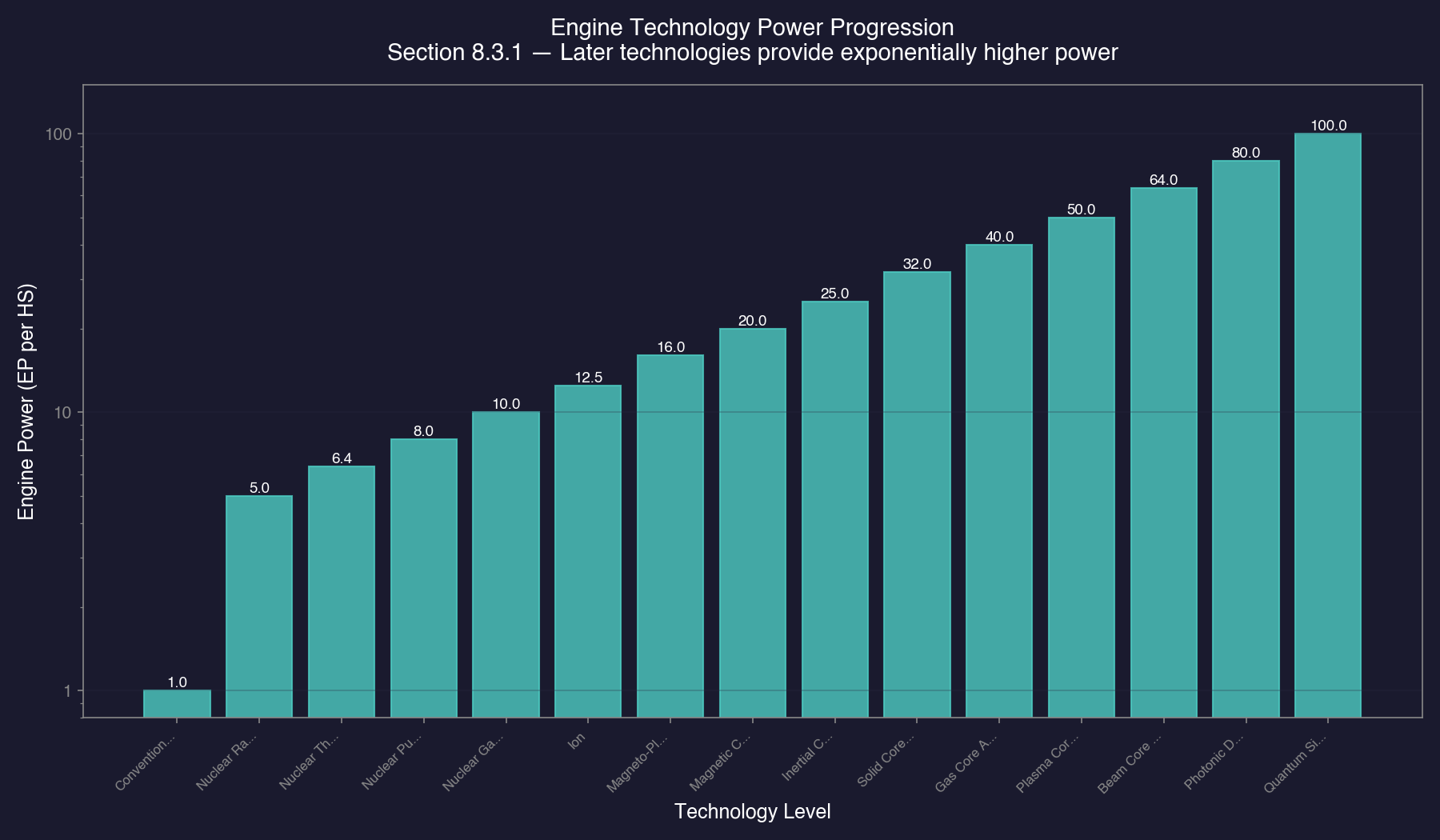
Note: The Ion Drive technology was adjusted from 12 to 12.5 EP/HS and Beam Core Anti-matter from 60 to 64 EP/HS in C# Aurora \hyperlink{ref-8.3-1}{[1]} to provide smoother progression between levels. The renaming in v1.14.0 added one additional technology tier (Quantum Singularity) at the top while maintaining the same total number of TN-era research tiers by removing the redundant “Internal Confinement Fusion” entry.
Conventional Reactor (v1.9.0+):
The Conventional Reactor is a low-power reactor available as an alternative power source for pre-TN or early-TN designs. It produces 20% of the power output of a Pressurised Water Reactor (0.5/2.5 power ratio) \hyperlink{ref-8.3-2}{[2]}. While significantly less capable than standard TN reactors, it provides a power option for designs that require only minimal electrical generation, such as orbital platforms, space stations, or other vessels where propulsion power is not the primary concern.
Military vs. Commercial engines:
Aurora distinguishes between two engine categories:
- Military engines: Higher power per ton, smaller size for equivalent thrust, but cost more minerals and BP (build points). Used on warships, scouts, and any vessel that needs performance. Subject to normal maintenance requirements.
- Commercial engines: 10x the physical size (in HS) of an equivalent military engine for the same mineral and BP cost \hyperlink{ref-8.3-6}{[6]}. This means they produce far less power per hull space but are dramatically cheaper per unit of size. They also use cheaper minerals. Commercial engines are exempt from maintenance failures, making them ideal for long-duration deployments. Mandatory for freighters, colony ships, tankers, and other logistics vessels where speed is secondary to economy and reliability. Commercial engines have a minimum size of 25 HS (1,250 tons) and a maximum fuel consumption modifier of 0.5 \hyperlink{ref-8.3-6}{[6]} (compared to military engines which can use modifiers up to 10.0). These constraints are what make commercial ships inherently larger but more fuel-efficient per ton of thrust – you cannot build a small, thirsty commercial engine.
Classification Rules:
An engine is classified as Commercial (rather than Military) when both of the following conditions are met \hyperlink{ref-8.3-6}{[6]}:
- Engine Power Modifier is 50% or below (the power ratio setting in the engine designer)
- Engine Size is 25 HS or greater
If either condition is not met, the engine is classified as Military. For example, a 24 HS engine at 50% power is still Military; increasing to 25 HS with the same power setting flips it to Commercial. Note that using 50% power also dramatically reduces fuel consumption (to roughly 20% of full-power consumption), making commercial engines highly fuel-efficient.
Tip: A commercial engine on a survey ship is still worthwhile even though the ship itself is classified as military (due to geo survey sensors). The commercial engine is exempt from maintenance failures, reducing overall maintenance burden even when the ship requires military maintenance for its other components.
The 10x size factor means a commercial engine that costs the same as a 1 HS military engine occupies 10 HS – providing the same total power output but at a much larger physical footprint. Commercial ships benefit from scale – their larger hulls can fit bigger engines to partially offset the power-per-HS penalty. A 50,000-ton freighter with commercial engines will still move at a respectable speed if you dedicate enough tonnage to propulsion.
The maintenance exemption is particularly significant for commercial operations: freighters and colony ships on long trade routes never suffer engine failures, eliminating the need for engineering support on routine logistics missions.
Tip: Research engine technology as a high priority. Each tier increases the previous tier’s output by roughly 25%. A single engine tech advance makes every ship design in your fleet significantly more capable — existing ships can be refitted with new engines, and new designs benefit immediately.
8.3.2 Creating Engine Components
Updated: v2026.01.30
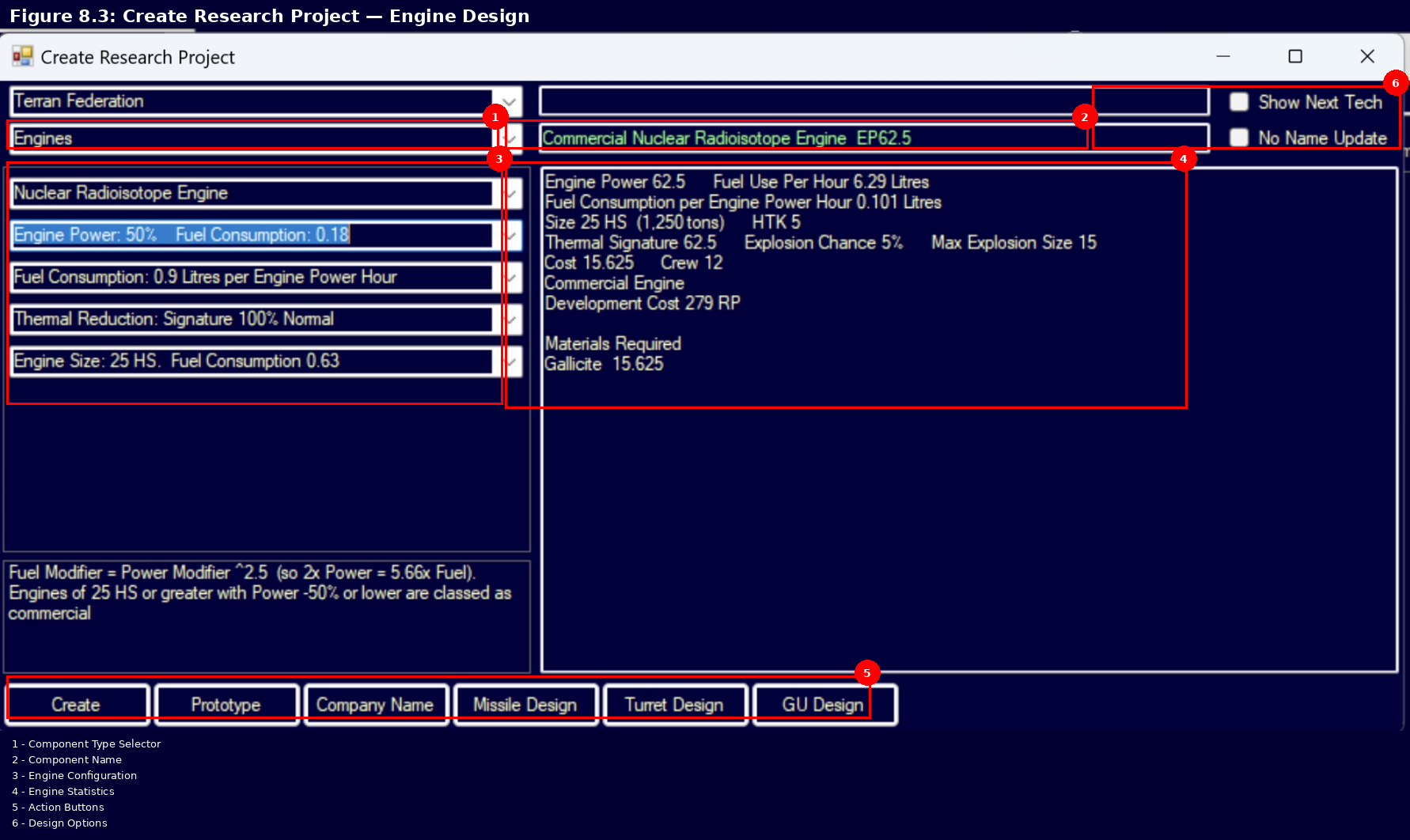
Before an engine can be used in a ship design, it must be created as a component through the Create Research Project window (accessed via the toolbar). This is a critical intermediate step between researching engine technology and designing a ship.
Step 1: Select Category
Choose “Engines” from the component type list in the Create Research Project window.
Step 2: Configure Engine Parameters (5 factors):
- Engine Type: Dropdown selecting the technology (e.g., Nuclear Radioisotope vs. Nuclear Thermal). Only technologies you have researched are available.
- Fuel Economy: Auto-fills based on your researched fuel consumption technology level (e.g., 0.8 if researched to that level).
- Thermal Reduction: If researched, reduces the engine’s thermal signature.
- Engine Size: Slider from minimum to maximum researched size (default 10 HS).
- Power Modifier: Percentage of base power output (50% for commercial, up to 150%+ for boosted military).
Step 3: Review Stats
The window displays real-time values as you adjust parameters:
- Engine Power (EP) output
- Fuel consumption rate
- Tonnage
- Military or Commercial classification
- Required research points (e.g., 153 RP for a typical early engine)
Step 4: Name the Component
- Top field: Company/manufacturer name prefix (e.g., “Aerojet Propulsion Systems”)
- Main name field: Custom designation (e.g., “APS-CNE-75/30 Radioisotope Engine”)
Step 5: Create or Prototype
- Create: Adds the engine to the research queue. It must be fully researched before it becomes available in the Class Design window for ship construction.
- Prototype: Makes the engine immediately available in the Class Design window for design experimentation. The ship design can be finalized, but the ship cannot be built until the engine is researched.
Warning: Fuel consumption technology is NOT retroactive. You must design a new engine component using the improved technology – it does not automatically apply to previously designed engines. If you research better fuel economy, create a new engine to benefit from it.
Once created, the engine component appears under Power and Propulsion in the research tab. Research time for individual components is typically short (weeks to months with a few labs assigned).
8.3.3 Engine Size and Power
Updated: v2026.01.30
When designing an engine component in the Component Design window, you select a size in Hull Spaces (HS) that determines the engine’s tonnage and output. This is one of Aurora’s most flexible design tools.
Engine size:
Engine size ranges from 0.1 HS (for fighters and small craft) up to a maximum determined by your Maximum Engine Size technology. The starting maximum is 25 HS, with a dedicated research line extending this:
| Max Engine Size (HS) | Research Cost (RP) |
|---|---|
| 25 \hyperlink{ref-8.3-3}{[3]} | 1,000 |
| 40 \hyperlink{ref-8.3-3}{[3]} | 2,000 |
| 60 \hyperlink{ref-8.3-3}{[3]} | 4,000 |
| 100 \hyperlink{ref-8.3-3}{[3]} | 8,000 |
| 160 \hyperlink{ref-8.3-3}{[3]} | 15,000 |
| 250 \hyperlink{ref-8.3-3}{[3]} | 30,000 |
| 400 \hyperlink{ref-8.3-3}{[3]} | 60,000 |
The ability to design engines down to 0.1 HS is particularly important for fighter and small craft design, enabling dedicated ground-support aircraft or micro-fighters with minimal powerplants.
Engine power output:
The base EP/HS from your technology is multiplied by the engine size:
- A 1 HS engine using Nuclear Pulse technology (8 EP/HS) produces 8 EP and weighs 50 tons
- A 10 HS engine using the same technology produces 80 EP and weighs 500 tons
- A 25 HS engine produces 200 EP and weighs 1,250 tons
You can install multiple engines per ship. Four 10 HS engines produce the same total power as one 40 HS engine, but with different trade-offs (see below).
Engine HTK (Hit to Kill):
Engine durability is calculated as the square root of the engine size in HS:
Engine HTK = SQRT(Engine Size in HS)
This formula (changed from VB6’s linear calculation) means that larger engines are proportionally easier to destroy than multiple smaller engines of equivalent total size. For example:
- A 1 HS engine has 1 HTK
- A 4 HS engine has 2 HTK
- A 9 HS engine has 3 HTK
- A 25 HS engine has 5 HTK
- A 100 HS engine has 10 HTK
The square root formula prevents large engines from functioning as unintended armor (absorbing hits through sheer HTK values). This encourages distributed propulsion designs for combat ships rather than reliance on a single enormous engine.
Multiple engines vs. single large engine:
- Multiple smaller engines: If one is destroyed, the ship retains partial thrust. Better redundancy. Total HTK across multiple engines is higher than a single equivalent engine (e.g., four 25 HS engines have 4 x 5 = 20 total HTK vs. one 100 HS engine with only 10 HTK).
- Single large engine: More space-efficient (one component slot instead of several), but a single hit can cripple the ship’s propulsion entirely. Lower total HTK makes it more vulnerable.
- Combat ships generally benefit from 2-4 engines for redundancy
- Commercial ships often use 1-2 large engines since they are not expected to take fire
Power ratio modifier:
The engine designer lets you adjust the power ratio of your engine, which determines the EP output relative to the base technology value. The power ratio can be set within the following ranges:
- Base range (starting technology): 100% (150% requires 1,000 RP research) \hyperlink{ref-8.3-4}{[4]}
- Extended range (with tech advancement): 10% to 300% of base EP/HS value
Higher power ratios increase the engine’s EP output but also increase fuel consumption according to a compounding multiplier. The fuel consumption penalty scales with each increment of boost above 100%:
- Each 10% boost above 100% increases fuel consumption by 25% compounding:
- 110% power: 125% fuel use – reasonable trade-off
- 120% power: 156% fuel use – noticeable fuel penalty
- 130% power: 195% fuel use – fuel use nearly doubles
- 150% power: 305% fuel use – extreme fuel consumption
- 200% power: 953% fuel use – only for very short-range combatants
Conversely, reducing power below 100% decreases fuel consumption, making lower power ratios useful for long-range patrol or survey vessels where speed is less critical than endurance.
Maximum Engine Power Modifier:
The Maximum Engine Power Modifier is a separate research line that controls the upper limit of the power ratio available to your engines. Research costs for this line have been halved compared to VB6 Aurora, making higher boost levels more accessible. The Minimum Power Modifier line retains its original research costs and extends the lower bound of the power ratio range.
Thermal signature:
Every engine generates a thermal signature proportional to its total power output. This is important because thermal sensors can detect ships by their engine emissions. Higher total engine power = larger thermal signature = easier to detect at range. Ships with engines powered down have reduced thermal signatures.
Tip: For most warships, a 10-20% power boost offers a good speed advantage with manageable fuel costs. Anything above 30% should be reserved for ships with very specific short-range missions where fuel endurance does not matter. When choosing engine size, remember that multiple smaller engines provide better combat survivability due to the square root HTK formula.
8.3.4 Speed Calculations
Updated: v2026.01.30
A ship’s maximum speed is determined by the relationship between its total engine power and its total mass.
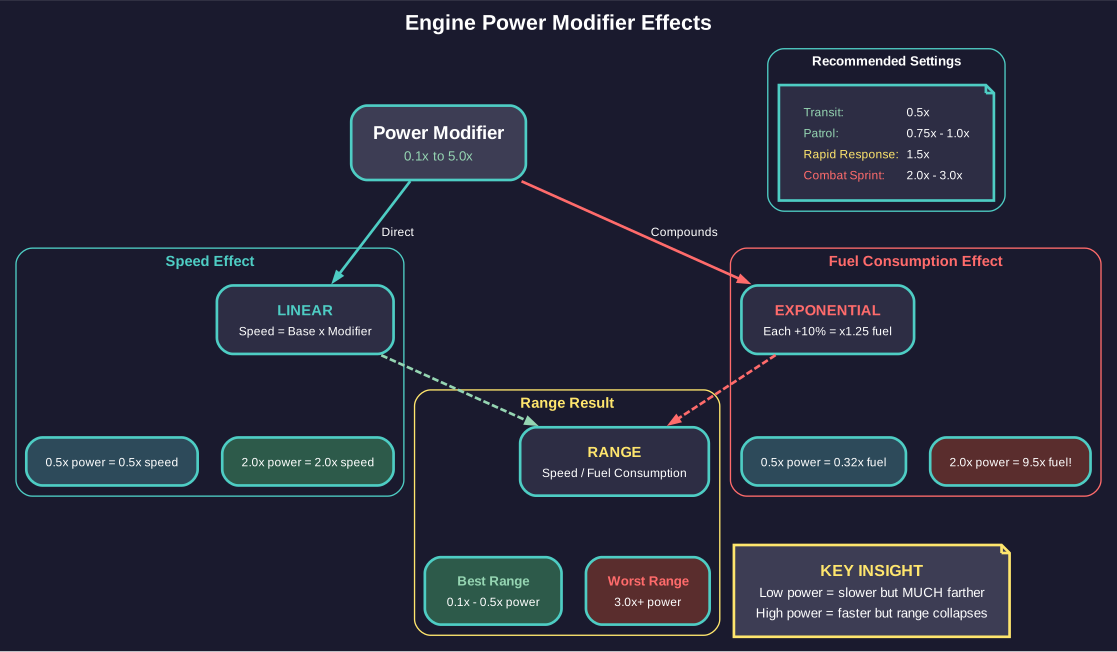
Figure 8.3.4: The engine power modifier affects speed linearly but fuel consumption exponentially. Low power settings (0.5x) dramatically improve range despite slower speed, while high power settings (2.0x+) cause range to collapse as fuel consumption explodes.
The speed formula:
Aurora uses the ship’s design tonnage (the fixed hull size set in the designer) for the base speed calculation:
Speed (km/s) = Total_Engine_Power * 1000 / Ship_Size_HS
Or equivalently (since 1 HS = 50 tons):
Speed (km/s) = Total_Engine_Power * 50000 / Ship_Design_Tonnage
For example, a 200 HS ship (10,000 tons) with 5,000 EP total produces: 5000 * 1000 / 200 = 25,000 km/s.
Note: The speed shown in the ship designer uses the fixed design tonnage (Ship_Size_HS), which is a static value. However, the actual in-game speed varies dynamically based on current mass. Ships carrying cargo, colonists, or ordnance are slower than when empty, and ships accelerate faster as they burn fuel. The design speed represents the ship’s performance at its base design weight without cargo or external loads.
The key insight is that speed is a ratio – adding more engine power increases speed, but adding more mass (armor, weapons, cargo) decreases it. This is why every component you add to a ship has an indirect impact on performance.
Factors that affect speed:
- Engine power: Directly proportional. Double the EP, double the speed (if mass stays constant).
- Ship mass: Inversely proportional. Double the mass, halve the speed (if EP stays constant).
- Armor: Often the largest single mass contributor after engines themselves. Each armor layer significantly reduces speed.
- Fuel load: Full fuel tanks are heavy. Ships accelerate faster as they burn fuel. The design speed assumes full fuel tanks.
- Cargo: Ships carrying cargo, colonists, or ordnance are slower than when empty. The design speed does not account for cargo weight.
Speed classes (rough guidelines with standard tech):
- Slow (under 1,000 km/s): Heavy freighters, fully-loaded colony ships, early-game commercial vessels
- Moderate (1,000-3,000 km/s): Escorts, destroyers, reasonably fast cruisers
- Fast (3,000-5,000 km/s): Scouts, light combatants, missile boats
- Very fast (5,000-10,000 km/s): Interceptors, advanced-tech warships
- Extreme (10,000+ km/s): Late-game fighters, specialized chasers
Fleet speed:
A task group moves at the speed of its slowest member (see Section 9.3.2 Task Group Speed). This has profound implications for fleet composition — one slow tanker attached to a fast battle group will drag the entire formation down to tanker speed. Solutions include:
- Designing logistics ships with enough engine power to keep up with combatants
- Using separate task groups for slow and fast ships, rendezvousing at destinations
- Establishing fuel depots so fast combat groups do not need to bring tankers along
Tip: When designing a class, check the speed readout in the designer as you add components. If your cruiser has dropped below the speed of your destroyers, your battle group will be limited to cruiser speed. Design your fleet together, not in isolation.
8.3.5 Fuel Consumption
Updated: v2026.01.30
Fuel management is a constant concern in Aurora. Ships burn fuel whenever they move, and running out of fuel in deep space leaves a fleet stranded — potentially fatally if enemies are nearby.
Fuel consumption formula:
In C# Aurora, both ship and missile engines use a unified fuel consumption formula based on engine size:
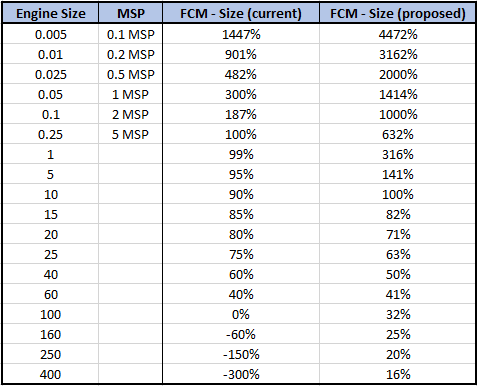
Fuel Consumption Modifier = SQRT(10 / Engine Size in HS)
This replaces the linear fuel consumption model from VB6 Aurora. The key implications:
- A 10 HS engine has a base modifier of 1.0 (the reference point)
- A 1 HS engine has a modifier of ~3.16 (much less fuel-efficient per unit of power)
- A 25 HS engine has a modifier of ~0.63 (significantly more fuel-efficient)
- A 100 HS engine has a modifier of ~0.32 (very fuel-efficient)
This creates a natural efficiency advantage for larger engines and larger ships, while also making the fuel portion of missile engine design more interesting. The formula provides a smooth transition across all engine sizes and allows engines beyond the previous 50 HS limit.
The designer shows fuel consumption in litres per hour at maximum speed. This value, combined with fuel tank capacity, gives you the ship’s maximum range.
Fuel efficiency modifier:
When designing an engine, you can adjust the Fuel Consumption modifier from 0.1 to 10.0 (in increments of 0.1) \hyperlink{ref-8.3-7}{[7]}. This further modifies the base fuel consumption:
- 1.0: Standard fuel consumption. The baseline.
- 0.5: Half the fuel consumption but the engine is larger (more HS) for the same power.
- 0.25: Quarter fuel consumption but much larger engine. Excellent for survey ships needing extreme range.
- 2.0: Double fuel consumption but smaller engine. Useful when tonnage is at a premium and range is not a concern.
Lower fuel consumption values increase the engine’s physical size for the same power output. This is a trade-off — you get better range but the engine takes up more space (and therefore mass), which means you need more fuel savings to offset the larger hull.
Missile engine fuel consumption:
Missile engines use the same base formula as ship engines. However, when boost exceeds the maximum racial boost multiplier technology, an additional linear multiplier applies:
High Boost Modifier = (((Boost Used - Max Boost Multiplier Tech) / Max Boost Multiplier Tech) * 4) + 1
This prevents excessive fuel consumption from becoming trivial while maintaining consistency between ship and missile engine mechanics.
Range calculation:
Range (billion km) = Fuel Capacity (litres) / Fuel Consumption (litres/hour) * Speed (km/s) * 3600 / 1,000,000,000
The ship designer shows range directly, so you do not need to calculate this manually. However, understanding the relationship helps you make informed trade-offs.
8.3.5.1 Worked Example: Engine Power Modifier Effects on Fuel and Range
Understanding how the power modifier affects fuel consumption is critical for designing efficient fleets. The compounding 25%-per-10% formula (described in Section 8.3.2 Creating Engine Components) means that high power settings burn fuel at an alarming rate, while reduced power settings offer dramatic fuel savings.
Reference ship for all examples:
- Ship size: 10,000 tons (200 HS)
- Engine: 10 HS Nuclear Radioisotope Engine (5 EP/HS base) \hyperlink{ref-8.3-1}{[1]}, power modifier 1.0x = 50 EP per engine
- Number of engines: 2 (total 100 EP at 1.0x power)
- Fuel capacity: 2,000 tons (400,000 litres)
- Base fuel consumption at 1.0x power: 100 litres/hour (for illustration; actual values depend on all modifiers)
- Speed at 1.0x power: 100 EP * 1000 / 200 HS = 500 km/s
Fuel consumption and speed at each power level:
The power modifier scales EP output linearly but fuel consumption compounds. Each 10% above 1.0x multiplies fuel consumption by 1.25; each 10% below 1.0x multiplies by 0.75.
| Power Modifier | EP Output | Speed (km/s) | Fuel (litres/hr) | Fuel Multiplier | Range (bn km) |
|---|---|---|---|---|---|
| 0.1x | 10 | 50 | 3 | 0.03x | 24.0 |
| 0.25x | 25 | 125 | 13 | 0.13x | 13.8 |
| 0.5x | 50 | 250 | 32 | 0.32x | 11.3 |
| 0.75x | 75 | 375 | 56 | 0.56x | 9.6 |
| 1.0x | 100 | 500 | 100 | 1.0x | 7.2 |
| 1.25x | 125 | 625 | 191 | 1.91x | 4.7 |
| 1.5x | 150 | 750 | 305 | 3.05x | 3.5 |
| 2.0x | 200 | 1,000 | 953 | 9.53x | 1.5 |
| 2.5x | 250 | 1,250 | 2,980 | 29.8x | 0.6 |
| 3.0x | 300 | 1,500 | 9,313 | 93.1x | 0.2 |
| 5.0x | 500 | 2,500 | 286,102 | 2,861x | 0.01 |
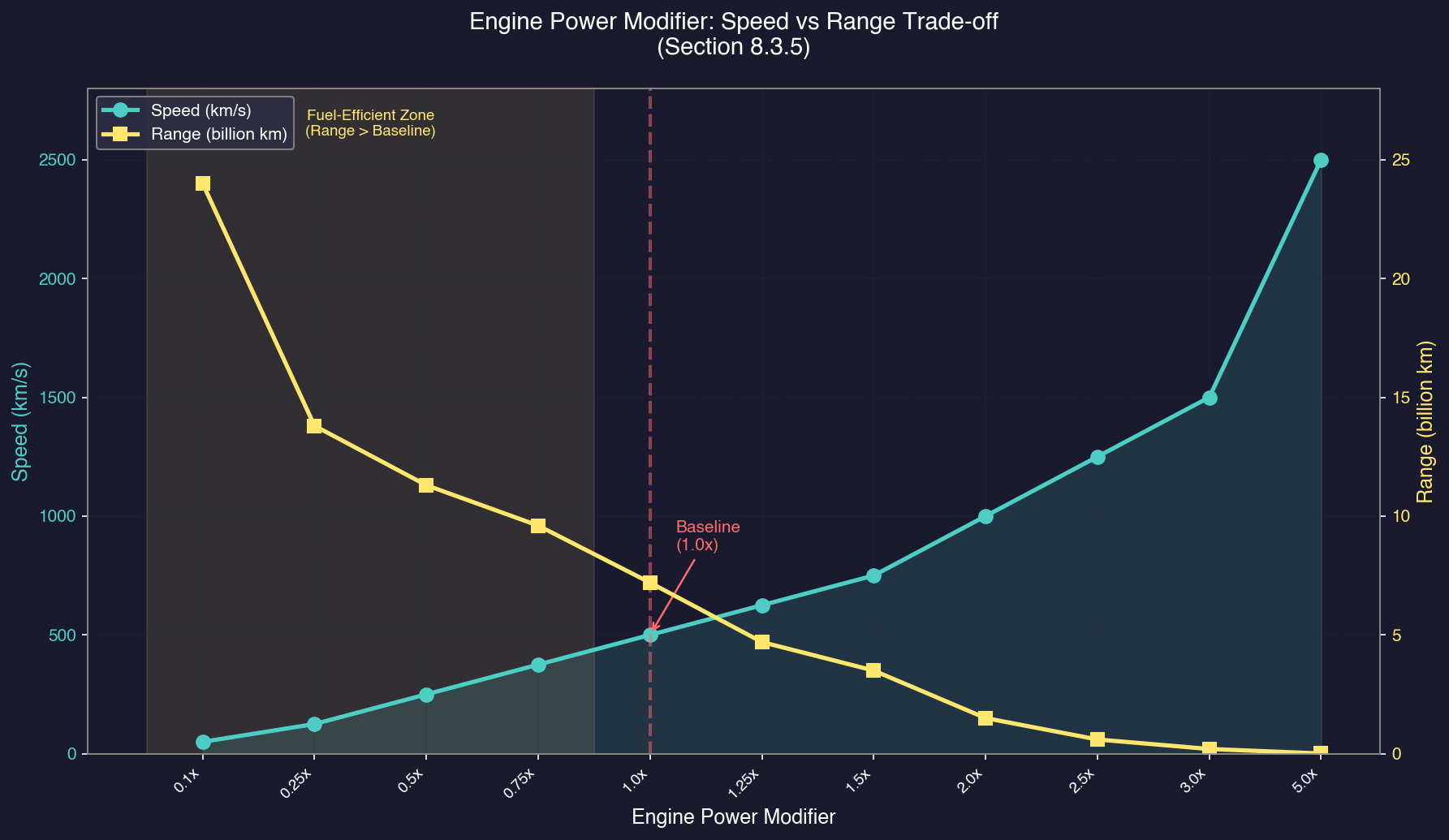
Note: The range column uses the formula from above (Fuel Capacity / Fuel Consumption * Speed * 3600 / 1,000,000,000). Observe that range peaks at the lowest power settings despite the slower speed, because fuel savings outpace the speed reduction.
The diminishing returns curve:
The pattern above reveals a fundamental trade-off. Below 1.0x, fuel savings are meaningful but bounded — you cannot reduce below 0.03x of baseline consumption. Above 1.0x, fuel consumption escalates exponentially. The practical implications:
- 0.5x power gives you half the speed at roughly one-third the fuel consumption. Your range improves by about 57% compared to 1.0x. This is the sweet spot for long-range transit.
- 1.0x power is the designed baseline. Reasonable speed, reasonable fuel burn. Suitable for standard operations within a system.
- 1.5x power gives you 50% more speed but costs 3x the fuel. Your range drops to less than half. Acceptable for rapid response within a system, but not for sustained operations.
- 2.0x power doubles your speed but costs nearly 10x the fuel. Range drops to roughly 20% of baseline. This is combat-only territory — sprinting to engage or disengage.
- 3.0x power and above burns fuel so fast that your ship effectively has no strategic range. These settings exist for short-duration intercepts measured in hours, not days.
Scenario: Patrol frigate transiting between jump points
A patrol frigate must travel 2 billion km between jump points. Using our reference ship:
- At 0.5x power (250 km/s): Transit time = 92.6 days. Fuel consumed = 71,111 litres (18% of capacity). The ship arrives with plenty of fuel for patrol duties.
- At 1.0x power (500 km/s): Transit time = 46.3 days. Fuel consumed = 111,111 litres (28% of capacity). Faster arrival but noticeably more fuel used.
- At 2.0x power (1,000 km/s): Transit time = 23.1 days. Fuel consumed = 529,167 litres (132% of capacity). The ship cannot complete this transit — it runs dry after 1.5 billion km.
The frigate at 0.5x power arrives 46 days later than at 1.0x, but uses only 64% of the fuel. For routine peacetime patrols, this is almost always the correct choice.
Scenario: Combat sprint to intercept hostiles
The same frigate detects hostiles 50 million km away and must intercept before they reach a colony:
- At 1.0x power (500 km/s): Intercept time = 27.8 hours. Fuel consumed = 2,778 litres (0.7% of capacity). Plenty of fuel remaining for combat maneuvering.
- At 2.0x power (1,000 km/s): Intercept time = 13.9 hours. Fuel consumed = 13,236 litres (3.3% of capacity). Still manageable — the short distance keeps absolute fuel burn low despite the high rate.
- At 3.0x power (1,500 km/s): Intercept time = 9.3 hours. Fuel consumed = 86,389 litres (21.6% of capacity). Expensive but possibly worthwhile if the colony is at risk.
For short-distance combat sprints, even extreme power settings are affordable in absolute terms. The exponential cost only becomes ruinous over long distances.
Practical guidance:
- Routine transit (peacetime): Use 0.5x power. The fuel savings are enormous and speed rarely matters for scheduled movements. Design dedicated transit engines at low power if your doctrine supports it.
- Patrol operations: Use 0.75x to 1.0x power. A balance between responsiveness and endurance for ships that may need to react to contacts.
- Rapid response: Use 1.5x power. When you need to get somewhere fast but still need fuel on arrival for combat or the return trip.
- Combat maneuvering: Use 1.0x to 2.0x power. Enough speed advantage to dictate range, with fuel reserves measured in hours of combat rather than days of transit.
- Emergency sprint: Use 2.0x to 3.0x power. Only for critical intercepts over short distances where arrival time matters more than fuel state.
- Never use 4.0x+ for any sustained operation. These settings exist for edge cases like missile-armed FACs making a single attack run from a nearby base.
Tip: Many experienced players design two engine types for their fleet — a fuel-efficient patrol engine at 0.5x power for survey and logistics ships, and a higher-power combat engine at 1.0x to 1.5x for warships. Some even refit engines between peacetime and wartime deployments, swapping efficient cruise engines for combat-rated ones when hostilities are imminent.
Practical range targets:
- System defense ships: 5-15 billion km (enough to traverse a solar system a few times)
- Patrol ships: 30-60 billion km (enough for multi-system patrols)
- Survey ships: 80-200+ billion km (must operate independently for years)
- Freighters and tankers: 30-100 billion km (need to make round trips between colonies)
- Long-range exploration: 150+ billion km (for venturing into unknown space)
Fuel tank sizing:
Fuel tanks come in a standard 250-ton size (50,000 litres) but can be customized. The designer allows you to specify tank sizes. More tanks increase range but take up hull space that could be used for weapons or other systems.
A common approach:
- Warships: 15-25% of hull tonnage devoted to fuel
- Survey ships: 25-40% of hull tonnage devoted to fuel
- Freighters: 5-15% of hull tonnage (they carry cargo, not fuel)
The “bingo fuel” problem:
Ships do not automatically turn around when fuel reaches 50%. You must manage fuel levels manually or set conditional orders. A ship that burns 60% of its fuel reaching a destination only has 40% to get home — and that assumes a direct return trip. Always plan for:
- The outbound journey
- Time spent on station (patrol, survey, combat maneuvering)
- The return journey
- A reserve margin (10-20%) for unexpected detours or combat
Tip: For your first survey ships, err heavily on the side of fuel endurance. A survey frigate that can operate for 2-3 years without refueling saves enormous logistics headaches compared to one that needs a tanker visit every 6 months. Use low fuel consumption modifiers (0.3-0.5) and generous fuel tanks, even if it makes the ship slower.
8.3.6 Power Plants
Updated: v2026.01.30
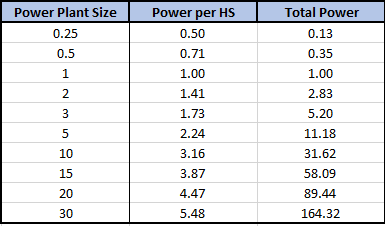
Power plants generate the energy required to recharge beam weapons and power shields. Each engine technology tier has a corresponding power plant technology (shown in the engine technology table above).
Power plants are covered comprehensively in Section 8.6.14 Power Plants, including the power output formula, boost technology, explosion risks, size selection, and the power allocation priority system.
Key points for engine/power plant pairing:
- Power plants use the same square root size-efficiency scaling as engines — larger reactors are more space-efficient
- Power plant HTK follows the same SQRT(size) formula as engines, creating the same redundancy trade-off
- Each engine technology tier has a matched power plant technology; the power plant determines beam weapon recharge capability
- Boosted power plants provide up to 100% extra output but carry explosion risk from 5% (unboosted) to 50% (100% boost) \hyperlink{ref-8.3-5}{[5]}
Tip: For beam-heavy warships, consider using one large power plant rather than several small ones for space efficiency, but pair it with backup plants for redundancy. See Section 8.6.14 Power Plants for detailed design guidance.
UI References and Screenshots
Updated: v2026.02.15
- Ship Design Window Layout — engine selection and performance display
- Forum screenshots:
- Power Plant — power generation interface
- Fuel Model V2 — fuel consumption calculations
Related Sections
- Section 7.4 Tech Categories – Power and Propulsion research unlocking engine technologies
- Section 8.2 Hull and Armor – Armor weight trade-offs against speed
- Section 9.3 Task Groups – Task group speed limited by slowest member
- Section 6.2 Mining – Sorium fuel harvesting and Gallicite for engines
- Appendix A: Formulas – Speed, fuel consumption, and range calculations
References
\hypertarget{ref-8.3-1}{[1]}. AuroraDB.db FCT_TechSystem: Engine Technology (TechTypeID 40) – Conventional Engine (1.0 EP/HS) through Quantum Singularity Drive (100.0 EP/HS), 15 tiers
\hypertarget{ref-8.3-2}{[2]}. AuroraDB.db FCT_TechSystem: Conventional Reactor – Power output 0.5 vs Pressurised Water Reactor 2.5 (20% ratio)
\hypertarget{ref-8.3-3}{[3]}. AuroraDB.db FCT_TechSystem: Maximum Engine Size (TechTypeID 214) – 25 HS (1,000 RP) through 400 HS (60,000 RP), 7 tiers
\hypertarget{ref-8.3-4}{[4]}. AuroraDB.db FCT_TechSystem: Maximum Engine Power Modifier (TechTypeID 130) – x1 (starting) through x3 (15,000 RP); Minimum Engine Power Modifier (TechTypeID 198) – x0.5 (starting) through x0.1 (30,000 RP)
\hypertarget{ref-8.3-5}{[5]}. AuroraDB.db FCT_TechSystem: Power Plant Boost – None (5% explosion, 250 RP) through 100% (50% explosion, 30,000 RP), 8 tiers
\hypertarget{ref-8.3-6}{[6]}. Aurora Forums — Commercial engine classification rules: 50% power modifier threshold and 25 HS minimum size for commercial designation; 10x physical size multiplier vs. military equivalent. Maximum fuel consumption modifier of 0.5 for commercial engines.
\hypertarget{ref-8.3-7}{[7]}. AuroraDB.db FCT_TechSystem: Fuel Consumption (TechTypeID 65) – 1.0 L/EPH (starting) through 0.1 L/EPH (2,000,000 RP), 13 tiers. Engine designer fuel consumption modifier range is 0.1 to 10.0.