12.4 Point Defense
Updated: v2026.02.15

Point defense is the art of destroying incoming missiles and hostile small craft before they can damage your ships. Aurora provides two primary point defense mechanisms: Close-In Weapon Systems (CIWS) using beam weapons, and Anti-Missile Missiles (AMMs) using dedicated interceptor missiles. Effective defense requires layering both systems and understanding their individual strengths.
Contents
Updated: v2026.02.15
12.4.1 CIWS
Updated: v2026.02.15
Close-In Weapon Systems are beam weapons configured for point defense duty. They automatically engage incoming missiles and hostile fighters within their fire control’s designated range. In C# Aurora, CIWS operates as a separate phase from other point defense, firing independently of the main PD resolution.
Note: As of v2.8.0, CIWS components research under the Direct Fire category (previously categorized under Missiles).
Gauss Cannons – The Premier PD Weapon
Gauss cannons are the most commonly used CIWS weapon in Aurora. They fire bursts of kinetic projectiles at extreme rates, providing many individual hit opportunities against each incoming missile.
Key characteristics:
- Rate of fire: Fires multiple shots per 5-second combat tick (determined by the number of barrels and technology)
- Damage per shot: 1 point (sufficient to destroy any standard missile in one hit; fractional warhead rules apply to small AMMs – see Section 12.3 Missiles)
- Range: Short (10,000 km base, cannot be extended)
- Tracking speed: Uses the assigned fire control’s tracking speed
- Ammunition: Uses gauss cannon ammunition (mass-produced, cheap)
- Size: Available from 1 to 3 turrets per installation, with each turret adding shots per burst
- Gauss size penalty: Gauss cannons smaller than the racial standard size have reduced per-shot accuracy. Each size reduction step lowers the individual shot hit probability. This is a per-shot accuracy penalty independent of the 10cm railgun auto-PD classification (see line below under Other PD-Capable Weapons). When designing gauss cannons, larger variants are more accurate per shot but consume more hull space.
- ECCM: CIWS fire controls can integrate ECCM at 5% of fire control cost per level (no size penalty)
Gauss cannon configurations:
| Type | Shots per Burst | Size (HS) |
|---|---|---|
| Single Turret | Base shots | 1 |
| Twin Turret | 2x base shots | 2 |
| Triple Turret | 3x base shots | 3 |
The number of base shots is determined by the Gauss Cannon Rate of Fire technology (6 levels), which can provide up to 8 shots per turret per burst at maximum research (750,000 RP).\hyperlink{ref-12.4-1}{[1]} See Section 12.2 Beam Weapons for the full gauss cannon research progression table.
CIWS Reference Example:
The following is a representative CIWS installation combining gauss cannons with an integrated fire control and tracking system:\hyperlink{ref-12.4-6}{[6]}
| Stat | CIWS-160 |
|---|---|
| Rate of Fire | 4 shots/5 sec |
| Range | 10,000 km max |
| Size | 11.9 HS |
| HTK | 3 |
| Tracking Speed | 16,000 km/s |
| ECCM Level | 2 |
| Base Hit Chance | 50% |
| Cost | 66.2 BP |
| Crew | 12 |
| Materials | 32 Duranium, 13.2 Corbomite, 10 Vendarite, 11 Uridium |
| Dev Cost | 575 RP |
Note: CIWS installations are self-contained systems with integrated fire controls and built-in ECCM. They do not require separate beam fire controls or reactor power. The ECCM level is determined at design time and counters missile-mounted jammers.
Lasers as PD Weapons
Lasers can also serve as point defense weapons when assigned to a fire control in PD mode. Compared to gauss cannons:
- Longer range: Can engage at full fire control range (Ranged Defensive Fire or Area Defence modes)
- No ammunition: Uses capacitor recharge only
- Fewer shots per tick: Typically 1 shot per 5-second cycle (with recharge tech, potentially more)
- Higher per-shot damage: Can damage missiles at range brackets where gauss cannons cannot fire
- Better for ranged defense: Thinning salvos at distance before they reach CIWS envelope
- Weapon failure risk: 2% chance per shot – relevant for sustained PD\hyperlink{ref-12.4-2}{[2]}
Other PD-Capable Weapons
- Railguns: Can serve as PD but lack the rate of fire of gauss cannons; reduced-shot variants are compact options. As of v1.10.0, 10cm railguns are automatically treated as point defense weapons by the auto-assign fire control system, reflecting their role as compact defensive armament.
- Mesons: Destroy missiles without penalty in C# Aurora (missiles are unarmored), making them viable PD weapons
- Plasma Carronades: Too short-ranged for effective PD in most cases
CIWS Effectiveness Formula
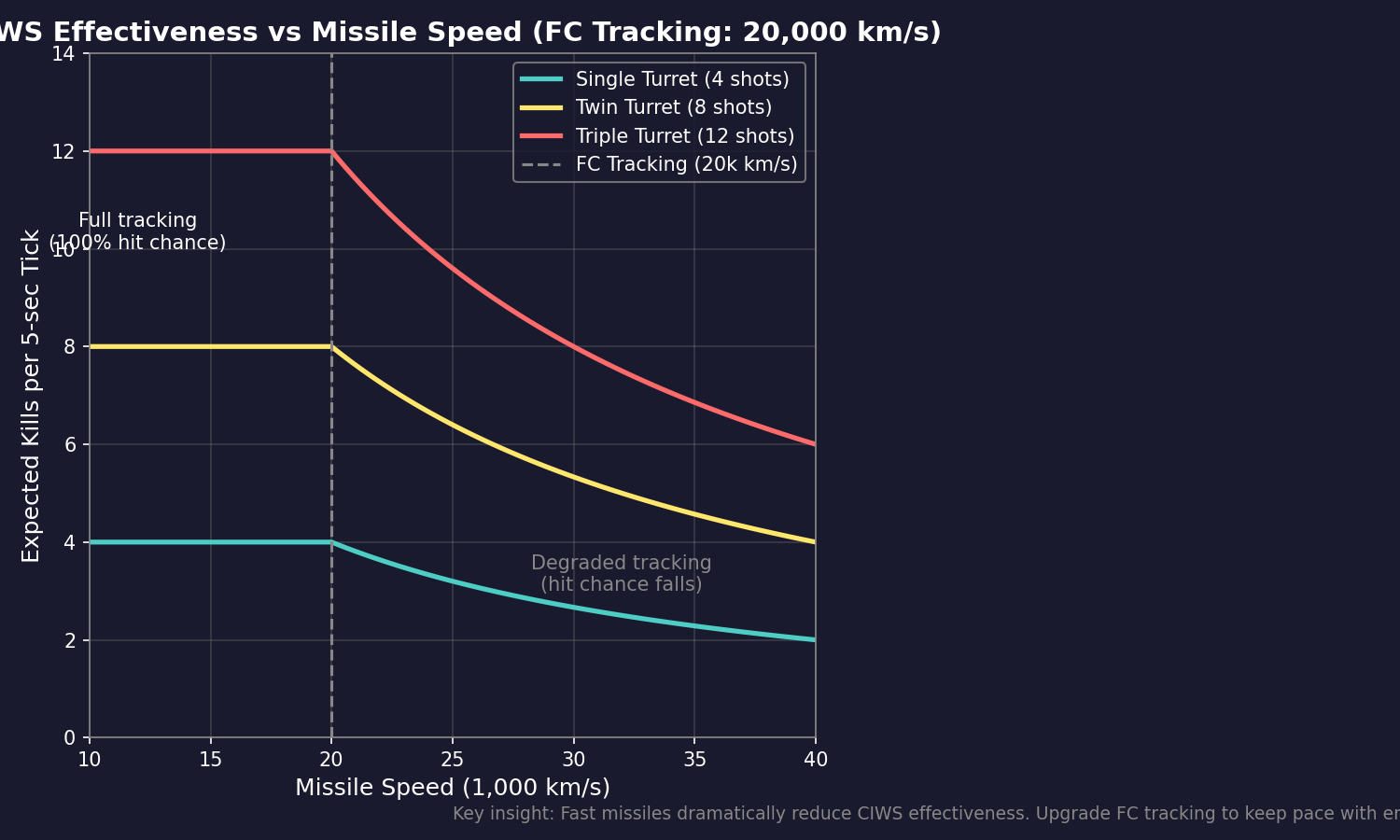
The number of missiles destroyed per combat tick by a CIWS installation:\hyperlink{ref-12.4-3}{[3]}
Expected Kills = Shots per Tick * Hit Probability
Hit Probability = min(1.0, FC Tracking Speed / Missile Speed)
                  * Crew Training
                  * ECM/ECCM Modifier
                  * CIC Bonus
                  * Tactical Bonus
                  * Gauss Size Modifier
                  * Range Modifier
Factor details:
- Crew Training: Fractional modifier based on crew training level (1.0 at 100% training)
- CIC Bonus: Commander’s Combat Information Center skill bonus (increases PD coordination; exact multiplier determined by commander skill level)
- Tactical Bonus: Commander’s Tactical skill bonus (improves fire accuracy; exact multiplier determined by commander skill level)
- Gauss Size Modifier: Gauss cannons below the racial standard size suffer reduced per-shot accuracy (see Gauss Cannons subsection above for details)
- Range Modifier: For Ranged Defensive Fire beyond 10,000 km, accuracy decreases with distance. Within 10,000 km (Point Blank modes), this modifier is 1.0 (no penalty). Beyond 10,000 km, accuracy is calculated at the actual engagement distance rather than the 10,000 km baseline.
The ECM/ECCM modifier applies when incoming missiles have Fire Control Jammers (see Section 12.5.3 Fire Control Jammers for detailed mechanics):\hyperlink{ref-12.4-4}{[4]}
ECM Penalty = max(0, Missile FC Jammer Level - CIWS ECCM Level)
ECM Modifier = 1 - (ECM Penalty * 0.1)
Version Note: The exact multiplier values for CIC Bonus and Tactical Bonus are determined by the commander’s skill level and may vary with game version. See Section 16.2 Skills and Bonuses for commander skill details.
A single triple-turret gauss cannon with rate-of-fire 4 technology fires 12 shots per burst (3 turrets * 4 shots/turret = 12). Against missiles at 80% tracking (FC tracks faster than missile) with no ECM, expected kills per tick = 12 * 0.8 = 9.6, meaning roughly 9-10 missiles destroyed per 5-second combat cycle.
CIWS Limitations
- Gauss cannons have very short range (10,000 km) – missiles are extremely close when engaged
- CIWS operates as a separate phase from other PD – it fires independently
- If the salvo is larger than your CIWS can handle in one tick, excess missiles hit
- Ammunition consumption can be significant in prolonged engagements
- CIWS weapons used for PD cannot simultaneously fire offensively
- Each weapon has a 2% failure chance per shot – high rate of fire means more MSP consumption
12.4.2 PD Fire Controls
Updated: v2026.02.15
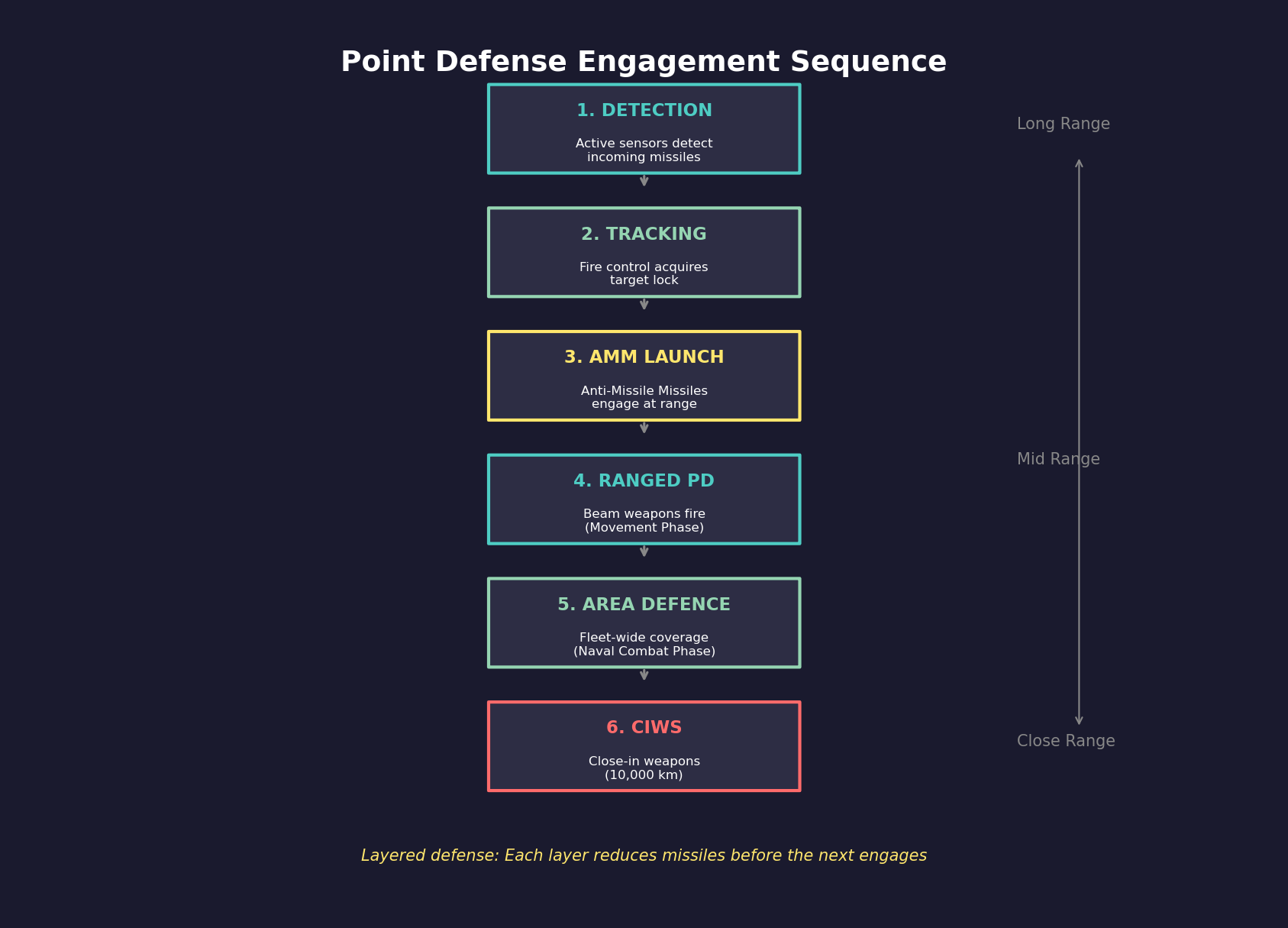
The fire control configuration determines when, how, and at what range your point defense weapons engage. Proper fire control setup is as important as the weapons themselves.
Dedicated PD Fire Controls
Best practice is to design fire controls specifically for point defense:
- Maximum tracking speed: The highest Fire Control Speed Rating technology available
- Range consideration: For Point Blank fire, range beyond 10,000 km is unnecessary. For Ranged/Area Defence, maximum range is desirable.
- Size: Standard 1 HS for ship-mounted PD. Reduced-size (0.5 HS) for fighters/FACs.
- ECCM integration: Include ECCM to counter missile-mounted Fire Control Jammers (5% cost per level for CIWS, 10% for standard BFC)
Automatic PD Classification:
Any beam fire control with a tracking speed at least 2x the racial base speed is automatically classified as a point defence fire control. The game uses this to intelligently assign defensive duties.
Fire Control Mode Configuration (v2.2.0)
| Mode | Phase | Range | Hit Calc | Targets |
|---|---|---|---|---|
| Point Blank Defensive Fire | Movement | 10,000 km | 10,000 km baseline | Any hostile missile |
| Point Blank (Self Only) | Movement | 10,000 km | 10,000 km baseline | Missiles targeting this ship |
| Ranged Defensive Fire | Movement | Full FC range | Actual distance | Any missile in envelope |
| Area Defence | Naval combat | Full FC range | Actual range | Closest hostile missile |
Ranged Defensive Fire is the default mode for automated fire control assignment.
Point Defence Priority and Fire Concentration:
Each PD fire control can be configured with:
- Point Defence Priority: Order in which weapons assign to missile targets (lower = fires earlier)
- Fire Concentration: Number of shots allocated to individual missiles (1 = spread fire, higher = focused)
Guidelines for these settings:
- Cheap, rapid-fire weapons (gauss): High priority, high concentration
- Expensive, single-shot weapons (large lasers): Low priority, low concentration
- This prevents wasting expensive shots and MSP on weapon failures
Multiple Target Engagement:
In C# Aurora, a fire control in defensive fire mode will continue to fire on incoming salvos as long as it has unfired weapons remaining. Each individual weapon or turret can only engage a single salvo per increment. This means point defence ships no longer need a large number of fire control systems.
Shot-Level Allocation (Developer Confirmed):
Point defense targeting in C# Aurora operates at the individual shot level, not the weapon or salvo level. This is a fundamental change from VB6 Aurora: \hyperlink{ref-12.4-5}{[5]}
- Fire controls assign individual shots against individual missiles (not weapons against salvos)
- A single turret can engage missiles from multiple different salvos within the same combat tick
- This creates more realistic and effective point defense behavior
- Example: A triple gauss turret with 12 shots can split fire across missiles from 3 different incoming salvos if needed
Fire Delay Exception for Point Defence (v1.13+):
Fire delay will only apply to point defence fire if it is caused by jump point transit. Offensive fire controls changing targets or opening fire do not impose delays on PD fire controls. This ensures automated point defence functions consistently even when offensive weapons are engaging new targets. See Section 12.1 Fire Controls for full fire delay mechanics.
Tracking Time Bonus vs. Missiles:
PD fire controls gain a tracking speed bonus against missiles that have been continuously tracked by active sensors: 1% per 5 seconds of continuous tracking, up to a technology-determined maximum. This significantly improves PD effectiveness against missiles that have been visible for extended periods. See Section 12.2.3 Tracking Speed for the full technology progression table.
Tracking Speed vs. Missile Technology
As missile technology advances, missiles get faster. Your PD fire control tracking speed must keep pace:
| Era | Typical Missile Speed | Required FC Tracking |
|---|---|---|
| Early game | 10,000-15,000 km/s | 12,000-20,000 km/s |
| Mid game | 20,000-30,000 km/s | 25,000-40,000 km/s |
| Late game | 40,000-60,000+ km/s | 50,000-80,000+ km/s |
If your tracking speed falls behind missile technology, CIWS becomes ineffective. This is why tracking speed research should be prioritized alongside offensive weapon research.
PD Fire Control for AMMs
AMM guidance requires missile fire controls (MFCs, active sensors) with resolution 1. See Section 12.3 Missiles for details on AMM fire control configuration. Note that AMM fire controls are separate from beam PD fire controls – you need both types for a layered defense.
AMM fire controls support a minimum engagement range setting (see Section 12.1 Fire Controls) to prevent AMMs from launching at targets already within beam PD range.
Automatic AMM Launch (v1.12.0+): Missile fire controls configured with point defence modes will automatically launch anti-missile missiles when hostile missiles are detected, without requiring the player to issue explicit “Open Fire” orders. This ensures defensive missiles respond immediately to incoming threats regardless of the fleet’s offensive fire status.
Practical Tips
- Always design PD fire controls with the latest tracking speed technology
- Point Blank mode is most weight-efficient for gauss cannons (no need for long-range FC)
- Ranged Defensive Fire is most efficient for lasers (leverages their range advantage, fires during movement phase)
- Area Defence fires during naval combat phase – useful for broad fleet coverage
- Consider one backup PD fire control per ship in case the primary is destroyed
- PD fire controls do not need to be toggled manually – they engage automatically when missiles threaten
- A single fire control can now engage multiple salvos, reducing the need for many FCs on PD ships
- Include ECCM on PD fire controls to counter missile jammers
12.4.3 Layered Defense
Updated: v2026.02.15
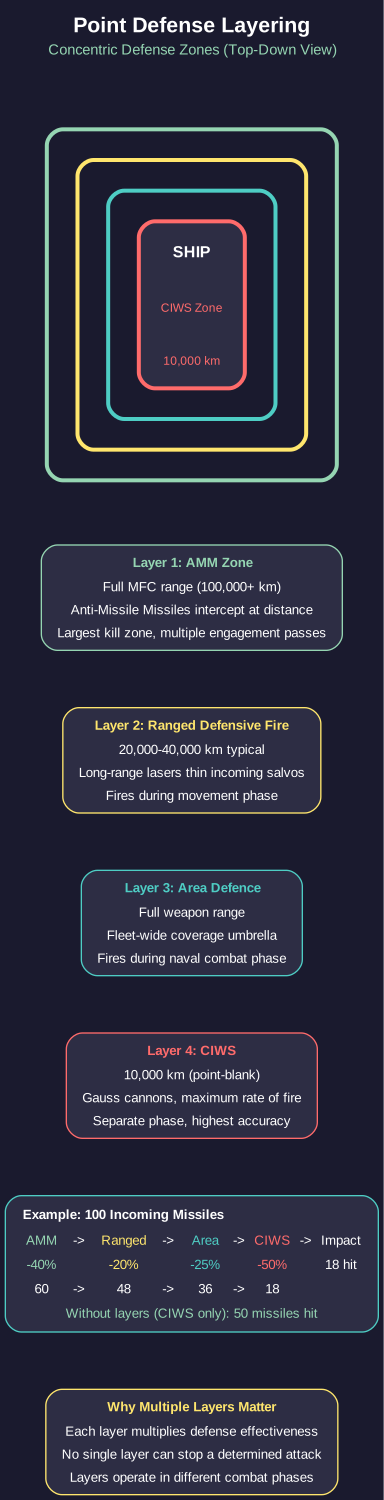
The most effective missile defense combines multiple engagement zones and weapon types, creating a layered defense that attrites incoming salvos progressively. No single PD system is sufficient against a determined missile attack.
Defense Layers
A comprehensive layered defense in C# Aurora operates across distinct phases and zones:
Layer 1: AMM Engagement Zone (configurable minimum range to maximum MFC range)
- Anti-Missile Missiles intercept incoming missiles at long range
- Provides multiple engagement opportunities as missiles close
- AMMs must be faster than incoming missiles to catch them
- Requires resolution-1 missile fire controls (active sensors)
- Minimum AMM range setting prevents launching at targets already in beam PD range
- Largest potential kill zone but each AMM engages only one target
Layer 2: Ranged Beam Defense (full weapon range to 10,000 km)
- Lasers and other long-range beam weapons in Ranged Defensive Fire mode
- Engages during the movement phase
- Beyond 10,000 km, hit calculation uses actual missile distance at detonation point
- Within 10,000 km, always uses 10,000 km as the range baseline (beneficial to defender)
- No ammunition concern (capacitor-based)
- Limited by rate of fire, tracking speed, and ECM penalties
Layer 3: Area Defence (full weapon range, naval combat phase)
- Beam weapons in Area Defence mode fire during the naval combat phase
- Targets the closest hostile missile within weapon range
- Provides broad defensive umbrella engagement
- Separate timing from Layers 1-2, creating additional engagement windows
- As of v1.12.0, each beam weapon in Area PD mode can only fire once per 5-second combat interval, preventing multiple engagements within the same tick
Layer 4: CIWS (10,000 km, separate phase)
- Ship CIWS engages first in its own separate phase
- Gauss cannons and short-range weapons at point-blank range
- Maximum number of shots in a single burst
- Highest hit probability (always calculated at 10,000 km baseline)
- CIWS operates independently of other PD phases
Engagement Sequence (C# Aurora):
The defensive fire engagement sequence is:
- Ship CIWS engages first (separate phase)
- Point Blank Defensive Fire controls on the target ship
- Allied ships within PD range (checked by distance, closest first)
- Planetary defenses (assigned ground units, then ship prioritization)
Missiles are processed in descending order of speed, then by descending salvo size. The fastest, largest salvos are engaged first.
Layer Synergy
The four layers work together mathematically. If each layer kills a percentage of incoming missiles:
Missiles Surviving = Incoming * (1 - Layer1_Kill%) * (1 - Layer2_Kill%) * (1 - Layer3_Kill%) * (1 - Layer4_Kill%)
Example against 100 incoming missiles:
- Layer 1 (AMMs) kills 40%: 60 missiles survive
- Layer 2 (Ranged Beam PD) kills 20%: 48 missiles survive
- Layer 3 (Area Defence) kills 25%: 36 missiles survive
- Layer 4 (CIWS) kills 50%: 18 missiles survive and hit
Without layered defense using only CIWS: 50 missiles hit. The difference is enormous.
Fleet Defensive Formation
Dedicated PD escorts can protect capital ships:
- PD Frigates: Small ships packed with gauss cannons and AMM launchers
- Screen Position: PD escorts operate in the same task group as high-value targets
- Area defense weapons protect the entire task group, not just the firing ship
- Specialized roles: Some escorts handle AMMs (layer 1), others handle CIWS (layer 3)
Fleet PD Configuration Example
For a battle group of 4 capital ships:
- 1 AMM escort with 20x size-1 launchers and large AMM magazines (Layer 1: AMM engagement)
- Capital ships with long-range lasers in Ranged Defensive Fire mode (Layer 2: ranged beam defense)
- 2 dedicated PD frigates with 6x triple gauss cannons each in Area Defence mode (Layer 3: area defence)
- Each capital ship with 2x twin gauss CIWS installations (Layer 4: final-fire CIWS)
- Combined: AMMs thin salvos at distance, ranged lasers engage mid-range, PD frigates provide area coverage, capital ship CIWS handles leakers
Overcoming Layered Defense (Attacker’s Perspective)
Understanding defense helps design better offense:
- Salvo size: Larger salvos overwhelm each layer
- Missile speed: Faster missiles reduce time in each engagement zone
- Missile ECM: Each level makes missiles 10% harder to hit with energy PD weapons. This uses the same 10% per level coefficient as ship-mounted Fire Control Jammers (see Section 12.5 Electronic Warfare)
- Fire Control Jammers: Mounted on missiles, degrade beam PD tracking (10% per advantage level)
- Decoys: Each decoy and the missile itself have a weight of 5 in a probabilistic targeting system. With N decoys, the chance a PD shot hits the missile is 5/(5 + 5*N) – e.g., 3 decoys = 5/20 = 25% chance to hit the actual missile (see Section 12.3.1 for full decoy mechanics)
Decoy Probability Formulas (Defender Perspective): (unverified — #865)
When engaging missiles with decoys:
Base Hit Probability = 1 / (1 + decoy_number)   [when ECCM <= ECM]

With ECCM advantage:
Hit Probability = 1 / (1 + (decoy_number * (1 - 0.2 * (ECCM - ECM))))
Average shots needed to kill a missile with decoys: 1 + 0.5 * decoys
Ranged Defensive Fire vs. Laser Warheads: (unverified — #865)
Point Defense (general) mode cannot engage laser warhead missiles at their detonation distance because the engagement window is inside the 10,000 km CIWS envelope while laser warheads detonate outside this range. Use Ranged Defensive Fire mode instead, which engages laser warheads at their detonation range before they can fire.
- Multiple warheads on AMMs: Counter decoy-equipped missiles by providing multiple hit chances
- Active Terminal Guidance: Improves hit probability during final approach (up to 60% bonus; see Section 12.3.1 for the full technology progression)
- Missile Retargeting: Missiles can bypass detonation if hit chance is low, trying again until fuel runs out
- Multiple vectors: Salvos arriving from different directions split PD coverage
- Mixed salvos: Fast cheap missiles to absorb PD, followed by slow heavy missiles with big warheads
- ECCM on missiles: Counters enemy Fire Control Jammers on their own defensive missiles
Common PD Mistakes
- Building only one layer of defense (typically only CIWS) and being overwhelmed
- Neglecting ammunition: gauss cannons run out of ammo in sustained engagements
- Tracking speed too low: PD weapons cannot hit advanced missiles
- Not enough PD fire controls: weapons without FCs cannot engage
- All PD on one ship: if that ship is destroyed, the entire fleet loses PD
- Ignoring AMMs: they provide the largest engagement zone and highest total kill potential
- Not matching AMM speed to expected threat missile speed
Scaling PD with Threat Level
Plan PD capacity based on expected enemy missile doctrine:
- Against NPR (Non-Player Races): Start with moderate PD, scale up after observing their salvos
- Against known missile powers: Match PD capacity to 1.5-2x the expected salvo size
- In unknown territories: Over-invest in PD until the threat level is understood
- Always carry surplus AMMs and gauss ammunition for extended engagements
UI References and Screenshots
Updated: v2026.02.15
- Ship Design Window Layout — CIWS and PD weapon selection
- Fleet Window Layout — PD mode assignment in combat orders
References
\hypertarget{ref-12.4-1}{[1]}. Aurora C# game database (AuroraDB.db v2.7.1) – FCT_TechSystem (TechTypeID=141): Gauss Cannon Rate of Fire technology, 6 levels from ROF 2 (1,500 RP) to ROF 8 (750,000 RP). Maximum of 8 shots per turret per burst confirmed.
\hypertarget{ref-12.4-2}{[2]}. Aurora Wiki (C-Ship-Combat) – Weapon failure rate of 2% per firing event. With maintenance supplies available, weapons receive instant repair; without MSP, the weapon becomes damaged.
\hypertarget{ref-12.4-3}{[3]}. Aurora Wiki (C-Ship-Combat, C-Beam_Weapons) and Naval Gazing tutorials – CIWS effectiveness formula combining tracking speed ratio, crew training, ECM/ECCM modifier, commander bonuses, gauss size modifier, and range modifier.
\hypertarget{ref-12.4-4}{[4]}. Aurora Wiki (ECM, ECCM articles) – ECM penalty formula: 10% hit chance reduction per point of Fire Control Jammer advantage over ECCM. At 10+ advantage, hit chance drops to zero.
\hypertarget{ref-12.4-5}{[5]}. Aurora Forums – Steve Walmsley response (https://aurora2.pentarch.org/index.php?topic=13722.0). Confirmed: “This assignment is done at the level of individual shots (not weapons) against individual missiles (not salvos).” One turret can engage missiles from multiple salvos.
\hypertarget{ref-12.4-6}{[6]}. Aurora C# game database (AuroraDB.db v2.7.1) – FCT_ShipDesignComponents (SDComponentID=153718, ComponentTypeID=51): CIWS-160. Size=11.9 HS, Cost=66.2 BP, HTK=3, Crew=12, TrackingSpeed=16000 km/s, ECCM=2, NumberOfShots=4, WeaponToHitModifier=0.5, Materials: Duranium=32, Corbomite=13.2, Vendarite=10, Uridium=11. FCT_TechSystem (TechSystemID=153718): DevelopCost=575 RP.
Related Sections
- Section 8.5 Weapons – CIWS and gauss cannon component design
- Section 11.3 Active Sensors – Sensor detection of incoming missiles
- Section 12.1 Fire Controls – PD fire control modes and configuration
- Section 12.3 Missiles – AMM design and missile threats
- Section 12.5 Electronic Warfare – ECM effects on PD accuracy; see especially Section 12.5.3 Fire Control Jammers for CIWS accuracy reduction mechanics
- Section 12.7 Planetary Defence Centres – CIWS on PDCs for ground-based anti-missile defense
- Section 14.3 Supply Ships – AMM resupply via colliers